Tuesday, February 05, 2008

Memoirs of a Teen Age Amnesiac, by Gabrielle Zevin


If Naomi had chosen heads, none of it would have happened. So begins this latest YA book I read. Once again, we have a 16 year old trying to figure out who she is in the context of the boys/men in her life. This hoary and frankly regressive format is made more tolerable by the use of amnesia. Naomi has hit her head on the stone staircase at school, and wakes up unable to remember anything about the last four years--her entire middle school and high school career.

She is found at the bottom of the stairs by James Larkin--a sulky James Dean type boy, who rides with her to the hospital. She quickly is reintroduced to the eccentric Will--who claims he is her best friend--and Ace, her tennis playing jock boyfriend. She also has to confront her parents' divorce, her mother's remarriage and four year old half sister, a new house, and who she has become over the last four years.

There is an interesting premise that hovers tantalizingly over the first half of the book--does a girl given a clean slate make herself anew, or does she fit herself back into the person she used to be? Naomi does a little of both--she gives herself some time to figure out what she saw in Ace, before deciding that whatever it was, he's not enough for her now. She finds herself drawn to the mysterious James, who nobody seems to like, and who runs hot and cold unpredictably. She settles into Will's proffered friendship, both because she genuinely likes him, and because he can tell her about who she used to be.

The amnesia causes some practical difficulties for her, which are handled deftly and with a light touch. She can't remember how to drive, but hates being dependent on her father to take her places. She remembers math and science, but not language, and she struggles to keep up with her classes while working on the larger problem of who she is and where she fits in.

It won't be a surprise to anyone who has ever seen Sixteen Candles that Naomi's fascination with James breaks Will's heart--because Will has been in love with her forever. What Zevin does with this triangle is slightly different from the usual--Naomi doesn't figure out that Will loves her, and she develops a relationship with the troubling James. However, she's with him long enough to learn that he isn't really right for her either. She eventually recovers her memory, realizes what Will means to her, but that relationship is no longer viable due to the choices she has made since the accident.

Will is angry with her because she has quit the yearbook, which the two of them were co-chairing, first to appear in a play, and then to be with James. Will gets another girlfriend, who is also angry at Naomi for how she has treated Will. By the end, however, the two of them have been through enough that they are able to (slowly, cautiously) reapproach each other.

The emotional territory Naomi moves through in her relationships with Ace, James and Will are authentic and well handled. Zevin has overloaded the book, I think, with more plot than she can handle. Naomi was adopted by her parents as a baby from Russia, which creates another identity crisis that is more or less just thrown in briefly, then dropped. Similarly, Naomi finds a food diary in her bedroom, indicating an incipient anorexia with it's obsessive focus on minimal calories. She (wisely) throws it out, calling it insane--and the issue also disappears. We later learn that Naomi was an outstanding tennis player--an athleticism with is at odds with the food diary. Again--more plot than Zevin could handle.

The whole issue of her parents' divorce is also more weight than the book can handle. The pre-accident Naomi has refused to speak to her mother, because her mother's infidelity ended the marriage. The two never quite make up, but neither does Naomi really have a believable emotional arc over this new disruption in her life. Her father, too, is about to remarry--a decision that pre-accident Naomi apparently was a complete bitch about, but post-accident Naomi accepts with slightly more grace--but not entirely believably.

Finally, the exquisitely depressed James (as Will derides) turns out to have serious and recurrent depression, a failed suicide attempt in his past, and more demons than he can handle. He ends up in California, and Naomi lies to her father and goes to meet him there. James is sinking rapidly, and ends up abandoning her for hours on a beach where she has no way to get in touch with anyone. James' problems are too large for a girlfriend to shoulder or solve, and this harebrained trip to California is not really consistent with the girl we are discovering. In fact, the post-accident Naomi seems to have messed up her life as thoroughly as pre-accident Naomi did, just in new and excitingly different ways.

Zevin does a nice job with the amnesia, so it's not merely a gimmick, but does lend some emotional crediblity to Naomi's attempts to find her balance. It's just sad that neither Naomi seems to have had any real female friends, or really any non-romantic relationships with boys either. Still, it's sensitively written and the emotional path she takes to find her way to Will feels authentic. A few less disasters would have kept the book better balanced is all.

I'd Tell You I Love You, But Then I'd Have To Kill You, by Ally Carter


Yup--I'm doing a bunch more YA reading recently, as the kidlets are reading books that they enjoy a great deal. So, since I'm not picking such great reading material, I'm borrowing theirs.

Tell/Love/Kill is a hybrid spy/romance/boarding school novel and is clearly setting itself up to become a series. Our Heroine, Cammy Morgan, is the enrolled at the Gallagher Academy for Exceptional Girls, and all girls boarding school outside Washington D.C. that is actually a training school for spies. The humor comes from the juxtaposition of spy training with ordinary school routines, as well as the on-going joke about all the things invented by past "Gallagher girls." "Duct tape didn't invent itself, you know.

Cammy is in an unusual position--her mother is the headmistress of the academy, and her father disappeared on a mission some years back. As a result she has become "the Chameleon"--a girl who fades into the background so she isn't noticed. Things change one night when the girls are allowed into town to attend a carnival, and a boy sees her. Really sees her, which is so unusual that Cammy is surprised.

A relationship develops, which Cammy tries to keep secret from her mother, while sneaking out to see Josh--a task which is made possible by her spy training. She then invents a "cover" for Josh, since she can't tell him she's a Gallagher girl--he doesn't have the right clearance for that kind of sensitive information.

Things develop as you think they might, made fresh and funny by the spy motif. Cammy and her friends rappel in and out of Josh's house to confirm he isn't there to infiltrate the school--Cammy goes along because she's dying to know more about him. Things come to a head as she's about to be outed to Josh as a Gallagher girl, so she decides she has to break up with him--sacrificing their budding relationship to maintain secrecy. So it's just too bad that her Covert Ops final is sprung on her as she walks away--poor Josh sees her grabbed, blindfolded and pulled into a speeding van. Safe to say that very few Gallagher finals have concluded with a town boy driving a front end loaded into a school building to rescue his girlfriend.

Written with some of the flippancy of Meg Cabot's Princess Diaries series, Tell/Love/Kill covers the excitement of developing romantic relationships while warning girls of the pitfalls of trying to be someone else for a boy--a lesson made easier to swallow by the whole spy theme. The book ends satisfactorily, but without a clear and final resolution for Cammy and Josh. There is already a sequel out, Cross My Heart And Hope To Spy, and that one will be coming home too.

Thursday, January 31, 2008

The Constant Princess, by Philippa Gregory


Gregory has previously mined the lives of the Tudors in The Other Boleyn Girl, The Boleyn Inheritance, The Queen's Fool and The Virgin's Lover. The Constant Princess is the story of Katherine of Aragon--more specifically, her life prior to 1514 and the birth of Mary I.

Gregory doesn't replow the years Katherine is best known for--the years in which Henry VIII struggled to rid himself of her in order to marry Anne Boleyn. These years are well covered in The Other Boleyn Girl, albeit from a different perspective. Katherine is only a marginal figure in that book, as she has seemed in history.

As a Protestant myself, I have found myself irritated by Katherine's refusal to step aside, because I know how the story ends with the glorious and long reign of Elizabeth I. As a result, I have always seen her refusal to step away as a dam in the flow of history, which was remedied by Henry's break with the Roman Church and Katherine's death in 1536. It is useful to be reminded that no one knew at the time what would happen, and Katherine had her own reasons for refusing to be supplanted.

However, save yourself the time and don't bother reading this book. Gregory simply doesn't have the grasp of her material that she had in the Boleyn books. There are basically two ideas in this book, reiterated ad nasuseum: Katherine was raised by fanatic believers in the True Religion; and Katherine's marriage to Arthur (Henry's older brother) was not only consummated, but was the One True Love of her life. Thus the Great Question of Katherine's divorce--was she married in name only to Arthur?--is answered here by Gregory's frankly syrupy depictions of Katherine and Arthur as the Tristan and Isolde of their age. Sent off to Wales to "learn to rule," Arthur spends all his time sneaking into her rooms (why? Well, no good reason, except that historically, it seems that the two spent very little time together except as ordered--which does not support Gregory's theory of Twue Wuve). There the two of them have sex multiple times, and then engage in pillow talk about making England a great country--the New Camelot.

It is to gag. I mean, really! Arthur was about 15 when he married, and he died about five months later. Sure, the marriage was probably consummated--that's why she had come all the way from Spain. But really--her One True Soul Mate for All Time? Gregory piles on the slop with a deathbed promise--Katherine promises her nearly dead husband that she will stay in England, marry Prince Harry, become Queen of England, and make the England the two of them had planned. Oh, how Noble and Selfless these two were! How tragic for the country that the Real King should have died and his younger brother--who had never been taught to rule--should inherit the crown.

Let's get down to facts. Arthur was no more than 16 when he died. Even had he lived, he was not ready to rule at that age. Henry was then 11 years old, maybe 12. He was thus the heir apparent for six or seven years--enough time for him to have been taught everything he needed to know about ruling--or at least as much as Arthur knew when he died.

But no. Gregory can't have that--it interferes with the picture of True Love. Henry has to be--in every way--Arthur's inferior. Katherine has to do everything she does because of her Deathbed Promise to Arthur. Even though she knew Arthur for less than 5 months, and was married to Henry seven YEARS after Arthur's death, and remained married to Henry for 23 YEARS before he married Anne Boleyn--her heart was always true to Arthur. At best, it's not remotely believable, at worst, it's downright delusional.

Gregory hasn't finished, however. Despite being the daughter of Ferdinand and Isabella, despite going on the campaigns which drove the Muslims from Spain--Katherine meets a single Muslim and immediately comes to understand that her entire understanding of them was wrong. They aren't heretics to be converted or killed! They are just people who deserve to have their own understanding of God! That just smacks of pandering to contemporary culture. But, once you take away Katherine's faith--why else would she refuse to accept the new religion?

Oh, right. Because she promised Arthur that she would be Queen. It has nothing to do with her bloody inculcation into the Christian cause; nothing to do with forging a single nation out of warring factions through the imposition of a single faith. No--it's just Twue Wuvve--the Wuvve that outlasts life itself.

Well, barf. I would prefer a woman who is not magically capable of running an entire country without any training; I would believe in a woman who stood by her duty to God as she understood it; I would understand a woman who had intellect and ambition to make a country out of the remnants of the Wars of the Roses. I gag at this "I'm doing this all for you, dearest Arthur!" picture Gregory foists upon us.

Interestingly, each of my girls picked up this book at one point--it took me a long time to finish it, as you can probably guess by my review. Each girl read the promo material on the back "[I]t is Katherine herself who takes control of her own life by telling the most audacious lie in English history[.]" Each girl asked me what that lie was. How do you explain the whole nonsense about Henry marrying his brother's widow, and the farcical court of inquiry into whether Katherine had been a virgin 23 years before? I ended up saying something succinct like "Katherine had been married to Henry's older brother before she married him. The lie is that she said they never had sex." To which both girls said: "Ewwwww."

Which really is the proper response to this book.

Saturday, January 26, 2008

The Blind Assassin, by Margaret Atwoood


This novel won the Booker Prize in 2000, and Margaret Atwood is one of the grande dames of contemporary literature. . .which is the long way of saying that this was one hell of a tedious book and I wouldn't recommend it to anybody I can think of.

How's that for succinct?

The conceit of the book is that the narrator--an 83 year old woman named Iris Chase Griffen--is writing out the story of her life. Interspersed with this narrative are chapters from a (fictional) novel called The Blind Assassin, published in 1947-ish, written by Iris' sister, Laura Chase before she died in an automobile accident. Also interleaved in these two narratives are newspaper clippings of major life events of the main characters.

What little actual suspense this book holds is what connection the fictional novel of Blind Assassin has with the "real" people of the novel. I figured out the Big Secret about a quarter of the way in, which is not much of a secret to anyone who has read much of anything written in the last ten years.

So, here comes the plot spoiling. The Chases are the wealthy family in town, and the girls are raised in isolation, as "befits their station." When the Depression hits, the family loses all its money, and the town becomes inflamed by "communist agitators," including a man named Alex Thomas, whom the girls meet. Before losing everything, Iris's father marries her off to his business rival, Richard Griffen, and the businesses consolidate. Her father then drinks himself to death, so Laura (then 14) goes to live with Iris and her husband.

Iris has an ongoing affair with Alex Thomas which lasts until he is killed in WWII. Richard has an ongoing affair with Laura, then has her committed into a sanitarium subjected to electroshock therapy when she becomes pregnant. He has the baby aborted as well. Iris in unaware of much of this, because Richard confiscates any mail that comes to her. Laura gets out and goes into hiding until the war is over. She re-contacts Iris, who tells her that Alex Thomas is dead and that she was his lover. Laura takes Iris car and drives herself off a bridge. Iris then writes this novel as her revenge against Richard, claiming that Laura wrote it. Richard kills himself when his treatment of Laura and the sanitarium become public, ruining his political aspirations. Iris then lives another 60 years where almost nothing happens and then she dies.

The only lively writing in this entire pretentious mess is in the fictional novel. The "novel" itself is merely a chronicle of Iris's affair with Alex Thomas--all their assignations and the story he makes up for her. It is a genre tale about a barbaric civilization, complete with blind assassins and female sacrifices who have their tongues cut out. The two lovers have nothing in common, and don't seem to even like each other very much. Alex is bitter about all class distinctions, and Iris can never do anything right. All they have is the sex. They don't even agree about how the story should go.

So this is the plot of Atwood's novel. It is jumbled up, and padded out with all kinds of boring details about Iris' life, both past and present. We are treated to numbing descriptions of how far she walks for her health, and how much she doesn't eat. We get details about what clothing women wore. We get small town newspaper social columns full of the vacations taken by people who are literally nothing more than names. We get Latin exercises. Lots of minutia, no character development. Alex Thomas is completely unattractive--he seems to be the only person either Iris or Laura have ever met, otherwise, there is no reason either of them should be drawn to him. Laura is constantly described as "different," but it's hard to see how.

I passed a lot of the book entertaining myself by noticing how Iris was like the imprisoned and voiceless sacrificial virgin of Alex's story, and by trying to figure out who was like the blind assassin. There is a lot of writing about who can see, who is seen. Iris fears that people stare at her, and she dislikes being in a spotlight; her name is evocative of sight, as it is a part of the eye. Otherwise, the book is remarkably dull.

One blogger I found described the book as being the story of Iris' life with all the interesting bits taken out. After she published the book, and Richard died, she lost her daughter (Alex's as well) to Richard's pushy sister, and her daughter's child as well. So, we are supposed to believe that this woman has lived 60 years since the end of WWII . . .doing what? Regretting her life? Being a victim? Merely waiting to die? But suddenly she decides she needs to write it all out (in a boring and convoluted way) for her granddaughter to find?

There is some clever writing, but not enough to justify such an enormous waste of time. Thank god this was an audiobook, so I listened while doing other, more productive things. My recommendation? Don't bother.

Monday, January 21, 2008

The Queen of Babble, by Meg Cabot


Meg Cabot is an unusually prolific writer, famous for her teen books "The Princess Diaries," now in its 9th volume, I think. She also wrote two other teen series: The Mediator and 1-800-WhereAreYou. She has a number of adult novels as well, which are differentiated from her teen books mostly by being slightly more sexually graphic.

The Cabot formula is front and center in The Queen of Babble: a young woman (Lizzie) with the ability to run off at the mouth is uncertain about her career future, and is in love with an unsuitable man. When betrayed by him (in this case, because he is working as a waiter AND still "on the dole" in London), she flees to France, where her friend is spending the summer working at a chateau that hosts weddings. On the train, she meets a good looking young man to whom she spills--at length--her woes over her now ex-boyfriend, only to find this stranger is actually a member of the family that owns the chateau.

We have the usual obstacles to overcome: he has a girlfriend, who is obviously completely wrong for him; she insists she is too fresh from her break-up to get into a relationship; the first wedding of the season involves a terrible wedding dress that only Our Lizzie can fix. Evil Inappropriate Girlfriend gets dumped, Lizzie alters a vintage couture gown found in the attic to save the wedding, boy and girl have sex on a wine cask and all ends well.

It's exactly the kind of novel Meg Cabot writes, but it's charming and has some redeeming quirky moments. One of my favorites is when Lizzie sees her crush wearing wingtips, and nearly passes out because to Lizzie, wingtips are "so hot." Another is when Lizzie realizes her English boyfriend was lying and using her, and she wants to "take back" the blow-job she gave him. She spills this particular tidbit to the stranger on the train, and he understandably finds her funny. She gets a phone call from Bad Boyfriend, and her new friend calls himself her "attorney, seeking return of the blow-job. If he is unable to return it to her, she will be forced to sue." It's the modern "meet cute," with a side of raunchy.

A light time waster, frivolous and frothy, no surprises, but no disappointment either.

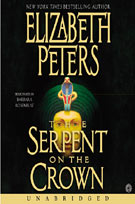
The Serpent On The Crown, by Elizabeth Peters


This is the first Amelia Peabody book I've read--and to be completely and pointlessly honest, I listened to in from Audible.com. Apparently there are quite a few of these--set in time starting in 1884 up to 1923 or so. This one is 1921 or 22--Tutankhamen's tomb has not yet been discovered, although Howard Carter is hovering around the edges of the story, and "everyone" agrees that there are no more new royal tombs in the Valley of the Kings.

Amelia is married to Egyptologist Professor Emerson, and with their grown son Ramses, his wife Nefret, and their four year old twins, they excavate and inevitably get mixed up in mysteries and murder. In this book, the Emersons are approached by a Lady Novelist, who gives them a priceless solid gold statuette, claiming there is a curse on it that killed her husband. The lady then goes missing, only to be found after a week--dead. The Emersons need some additional assistance on their team, and are approached by a German who worked on digs before The War, and a Russian who can decipher papyri.

The family endures a number of attacks on their home and their members, as thieves attempt to take the priceless statuette. They do not believe in a curse, but they do wish to know were the statute came from originally, as they have never seen anything like it.

I suppose better knowledge of the characters would have given me a better understanding of what the hell was going on most of the time. As it was, I found this to be an extremely slow moving mystery. The total reading time of the audiobook was around 10 hours, and I was already more than halfway through before the first body showed up.

The Emersons are gruff, tempermental, veddy veddy English, and hard to warm up to. They order the police around, and seem to run Luxor for their own interests--yet there is a sense that they skirt the racism that would be normal for their time. There is what appears to be some solid archeological foundation to the book--the Emersons get permission to re-excavate a tomb known as KV55, and what I found about it on the internet was precisely how Peters described it.

Nevertheless, it was an unsatisfying mystery. The murder is solved when the murderer makes a dying confession--and reveals that he had assumed somebody else's identity. So there were no clues, no decent suspects--the mystery seemed to get solved offstage. There were some lingering threads that turned out to be completely unrelated: there were at least two people running around attempting murder at the same time, but neither had anything to do with the other.

It was a pleasant enough listen, and there is something inherently Romantic about the tombs of Ancient Egypt--but I think it may be unfair for me to just jump into this series at book 16 (more or less). I could go back and read the earlier ones and see if it changes my opinion about this one.

Saturday, January 19, 2008

Lamb: The Gospel According to Biff, by Christopher Moore


So, first off, I have to admit that I have read Moore's "A Dirty Job" and enjoyed it. I'm a fan of Terry Pratchett, as you can probably tell from my profile, and I was looking forward to an off-beat and irreverent view of the Bible.

Not that I was disappointed, exactly, but it wasn't what I expected. If you are offended by the concept of the thirty year old Messiah calling his disciples "dumb fucks," then this book isn't for you. If that breathes some fresh air into an ossified image, then you might enjoy this book. Moore, though, isn't much more iconoclastic than that.

Everything reported in the Bible happened, more or less exactly as reported, with a few swear words tossed in. Jesus (actually called "Joshua," the Hebrew name he actually had) did do all the miracles, did cast out demons and heal the sick, etc. etc. Sure, as a kid, he and his younger brother played "resurrect the lizard," but even that isn't really heretical.

Biff--or, as reported, "Levi who is called Biff" met Joshua when they were six, and the two were best friends their entire lives. It was Biff (his name is a Hebrew slang term meaning "slap upside the head") is Joshua's first disciple, and chronicles their lives together between the ages of 6 and 30, when Joshua returns to Galilee and begins his ministry.

The intervening years are spent performing minor miracles--Joshua puts his face on all the Passover bread one year--and as they approach manhood, they leave Israel to travel east to find the three wisemen. Joshua doesn't understand what he is supposed to do as the Son of God, and hopes to learn his mission from the three men who travelled to see him at his birth.

He finds Balthazar outside Kabul, where the man studies magic and has a powerful demon trapped in a warded room, which makes him immortal. Balthazaar is attended by eight beautiful and brilliant Chinese women, and Biff gets to live a sybaritic life for the years Joshua studies with the magus. This, incidentally, is where the Jewish tradition of celebrating Jesus' birthday with Chinese food starts.

After leaving Kabul, Joshua and Biff travel to Tibet, where Gaspar is the abbot of a Buddhist temple. Joshua masters Buddhist disciplines, and meets the last remaining yeti--a gentle creature that was hunted to extinction by the humans who could not understand its non-aggressive nature. Foreshadowing much? The monks of Gaspar's monastery make every one who seeks them wait outside their door for three days (significant much?) before letting them in. Joshua swears that anyone who knocks on his door to heaven will be let in.

After eight years or so in Tibet, they leave to seek Gaspar's brother Melchior, who lives in India. There they interrupt a bloody sacrifice to Kali, and Joshua swears there will be no more sacrifices. Well, okay, maybe ONE more.

Perhaps there is something to be gained in experiencing Jesus as a student of several world religions, and thus thinking of Christianity as yet another aspect of a universal search for relationship with the divine. This is as far from canonical Bible as Moore takes his book; leaving one to wonder what drove him to write this particular book. There is nothing very outrageous here: Jesus does not marry, he does not ever doubt his role as the Son of God. Culturally, this book is much less daring than "The Last Temptation of Christ" or even Dan Brown's "Da Vinci Code."

In the end, this is a pleasant diversion, but very little that you wouldn't find in Sunday School.

Monday, January 14, 2008

One Good Turn, by Kate Atkinson


I picked this one up at a "Buy 1 Get 2nd Half Price" sale. I read her book "Case Histories" quite a while ago. So long ago, in fact, that I can't remember much about it, other than it was a good read. This one had gotten some good reviews as well, so I figured it was worth a shot.

It was. The novel takes place over three days in Edinburgh, during the Fringe Festival--a period when hundreds of tourists clog the town. The timing on my reading this was coincidentally right after hearing from two dear friends about their trips to Edinburgh. So many of the locations for the book felt familiar to me, because I had just spent some time immersed in the geography of the city.

The story starts with a bang--literally, as a shady character in a silver Peugeot is rear-ended by someone driving a blue Honda. The street is crowded with people lining up to get into a Fringe venue, and so there are a lot of witnesses who see the Honda guy get out of his car brandishing a pipe and beating the Peugeot guy senseless. One person in the crowd throws his briefcase at the Honda guy, clipping him on the shoulder, and stopping the beating long enough for the police to come.

Each chapter is told from a different point of view, with a different character as its locus. The first chapter is told from the point of view of Peugeot Guy, the second by the gentle man who threw the briefcase. There is the wife of a shady real estate developer, a retired policeman whose girlfriend is acting in a Fringe production, a fading comedian whose career is bottoming out at the Fringe, and probably some others I have forgotten. We see the "road rage" incident from several points of view, and see how its ripples spread out from the center.

Atkinson is straddling a couple of genres with this book, as she did in "Case Histories." Her policeman is putting together the pieces of what happened, but this is not strictly a detective story. Who was Honda man? Where has he gone? Why did he beat up the guy in the Peugot? What happened after the man threw his briefcase? Atkinson pulls us along through the book with these questions, but the book is more interested in exploring the characters who are caught up in this incident. We see the disintegration of the policeman's relationship with his actress girlfriend, attended by his unease in having inherited a substantial fortune that means he no longer has to work.

We see the grim malice of the real estate developer's wife as the government agents close in on his business. She has been setting aside money in preparation for this--she has suspected he was going to disappear once the business was exposed, and she intended to keep herself in the style to which she had become accustomed. It was a form of karmic payback that he had a stroke while in bed with a prostitute. He lay in a coma at the hospital as his shady dealings all came home to roost.

We see the hard life of a policewoman who lives in one of those substandard housing developments, as her house deteriorates around her, she struggles to raise her teenage son as a single parent and struggles to be accepted in the largely male world of the police.

Things become complicated when the former policeman finds a girl's corpse washed up on an island, but it slips out on the tide before he can pull it to shore. Who was she, why was she killed, and who killed her?

Atkinson is a smart writer, and she keeps a sure hand on all the various plots. Each of the characters assumes a richness that makes each of them sympathetic in some way, while simultaneously serving as elements of a complicated plot. Matryoshka dolls appear over and over again in the book--the Russian nesting dolls, where each doll holds another one inside it, until you come to the last, tiny doll: the nub of the system.

The novel itself arguable has a similar structure--each story opens up to reveal another one inside it, until at the end Atkinson reveals the center of the story--the reason it all started. Upon finishing the book, however, I was immediately reminded of the ourobouros, the snake that swallows its own tale. The ending of the book is its beginning, and the whole spins around until it meets its beginning again. It's a well crafted book, and an engaging and entertaining read.


***********HERE BE SPOILERS************

I was puzzled throughout the book--why would Honda guy be the one with road rage? He was the one who hit the other car--why did he get out and proceed to beat up the presumably innocent driver of the other car?

Atkinson answers this at the end of the book--with a little slight-of-hand/sly storytelling. Peugot guy was shady, and he had been hired by the real estate developer's wife to kill her husband. It was just coincidence that he had a stroke at the very time the "road rage" incident was happening. Honda guy is the developer's personal thug, and was trying to foil the murder before it happened. Everyone is implicated. Everyone is guilty of something. There are different degrees of guilty, and we see many of them in this book.

Monday, November 19, 2007

Endymion Spring, by Matthew Skelton


I picked this one up a year ago at the school book festival. It looked intriguing, but apparently not so much that I read it right away.

Endymion Spring is the name of a young man living in Mainz, Germany, in 1453. He is an apprentice to Johann Gutenberg, helping to carve type for the Bible printing project. Herr Gutenberg is approached by the malevolent Johannes Fust, who provides financing for the Bibles in return for an undefined, but unholy, project.

The book switches between 15th Century Germany and modern Oxford, where a young man named Blake Winters is spending part of the year with his scholar mother and his younger sister. The family is on the verge of divorce, and Blake's father has remained in the States. While waiting--once again--for his mother to finish up in the library, Blake finds an old book that seems to have no writing in its pages, until a cryptic poem appears that only he can see. But the book disappears, a shadowy figure begins to follow Blake, and the race is on to solve the mystery of this book.

This is a debut novel, and it falls into an increasingly populated genre of what might be called "library mysteries." Like A.S. Byatt's Possession, or Diane Setterfield's The Thirteenth Tale, or Elizabeth Kostova's The Historian, or even The Club Dumas, by Arturo Perez-Reverte, there is a mystery that only an academic can solve through patient research and a little bit of supernatural intervention.

The strength of this book is not the mystery, involving dragon skin and forbidden knowledge, the characters or the writing. Rather, it is clear that Matthew Skelton has a great love for Oxford, which is lovingly detailed throughout the book. The colleges, the traditions, the architecture, the quality of the light--Oxford is the real star of this book.

It's a YA title, and as such is not ever too scary, nor does it end ambiguously. Blake succeeds in his quest, he retains possession of the elusive book of all knowledge, and the book ends as he opens it to read--raising the possibility of future sequels. I have plenty of quibbles, but slight as the book is, it's probably not worth detailing them.

Not a bad read, and does offer a view of scholarship as a deeply exciting pursuit.

Sunday, October 21, 2007

Eat, Pray, Love, by Elizabeth Gilbert--Part II

I finished this book on the plane home from San Francisco. And while I have some quibbles about it, I have found myself flashing back to it. There are specific scenes which are very good, and there is something about the feelings the book created in me that I keep returning to. It's as though the emotional landscape is hard to leave. I remain conflicted about this book, however.

After four months in an ashram in India, learning to meditate, Gilbert ends the book in Bali. There, she has crafted a bookend finish that is in many ways the exact opposite of the way the book began. The woman who was trapped and miserable in a house, with a husband and the pressure for a baby in New York is now somewhat older, homeless, with a Brazilian lover 16 years her senior. Not only has he already raised a family, he now has a vasectomy, so there is no chance of a baby at all. They make a commitment to each other that they will share their lives between America, Australia, Bali and Brazil.

She also ends with a story about a Zen teaching—that an oak tree is created by the existence of the acorn, plus the force of the tree the acorn will grow into, willing the acorn into growth, to create its own existence. Perhaps, she thinks, the voice that comforted her back when she was sobbing on the bathroom floor in her house in New York was the older, happier, more balanced self who is now in Bali . She does not have a house. . .so far as we know; she is not planning on marrying her lover, and the two of them are not going to have any babies. Her life at the end of the book is the mirror opposite of the life she was leading at the beginning. The book leaves the impression that she is a different person from the woman she was at the beginning, and as all such "journey of self discovery" books must, we have a happy ending.

But is this really believable? Certainly, Gilbert could not have ended the book ambiguously--a book that ended with her feeling dissatisfied and uncertain what to do next would simply not have been one that would be published. I left the book feeling a little bit manipulated--played, if you will--by this woman.

Think about it, after all. Here is a woman who is in a terrible place in her life--her divorce got ugly and dragged on and on. Her rebound relationship also fell apart. She was left with very little after the settlement. So, she proposes a book where she will spend four months in each of three countries to find herself, or find balance, or something. How likely is it that at the end of a single year she will have any real handle on The Right Way to live her life?

I'll tell you. Not very likely at all. BUT--it can be written as though she has found The Right Way, and she doesn't have to reveal any glitches, or failures, or anything negative that happened. And I think that is what happened. It all looks lovely at the end, but I doubt that her life stayed as idyllic as it looked while she was on vacation with her new lover in the South Pacific.

NOBODY'S life ever ends up as idyllic as it looks while on vacation.

So, here's the problem I have with this book: I think we have been manipulated into thinking that Elizabeth Gilbert ate and prayed her way into balance, which was actualized on Bali. I think she was not all that different a person at the end than at the beginning of the book, and all the "growth" the book presents is illusory.

What makes me say that? The first thing that really rang false for me was the night she met her Brazilian lover. She hardly noticed him at all that night. Instead, she met a Welsh ex-pat named Ian, and they talked for hours. She says at least twice "I really liked this guy." At the end of the evening, they part without exchanging contact information, and Ian says "We will meet again when [the gods] think it's right."

And she goes home and obsesses over this guy. She relives everything they said, and projects a future with him. She starts to worry about where they would live, how she would be able to continue her career from Bali. She essentially abandons everything about herself in order to mold herself around this new man. This is David Redux--everything about this monologue is exactly the same endless dither she used to do about David.

Remember, she doesn't know where he lives, she doesn't have a phone number for him. He doesn't have her address or her email. Even Prince Charming had Cinderella's shoe to help him find her again! Ian and Liz have less than that. So, we are treated to the very real idea that if Ian ever called her again, she'd dive right back into the same kind of clingy dependent relationship that she had with David less than a year before. Everything about this spells disaster.

Except that she doesn't run into him again. Ever. (As far as we know.) The infatuation burns itself out, we are left to suppose, because she doesn't mention him again after that one experience. It seems that the only thing that allowed her to move herself out of the rut of bad relationship patterns was sheer luck in not seeing this guy again! How enlightened is that?

Second, the final scenes of the book feel set up and manipulated. Gilbert ends the book describing a vacation she is taking on another island close to Bali. This is an island she has visited before, at the nadir of her divorce and breakup. Here she took a vow of silence, and meditated and tried to quiet her turbulent emotions. She describes beautifully the process of examining her fear. anger and shame, and accepting those feelings. She says she invites those things into her heart to rest. She reassures them (and herself) that they are loved, accepted, and that "it is over." After ten days, she finds herself at peace.

SO--why were we walked through her time in India, if she was already able to do this? And why should we believe that her experience in India is any more permanent than her island retreat had been? Even before she started this book project, she had learned how to let things go. Her biggest revelation in India is that she has to let David go. But does she--really? She has at least one night in Bali when she considers calling David to see if he wants to get back together. Sure, she doesn't act on it--so far as she tells us--but the fact that she hasn't really let him go makes me suspicious of how much of this book is really fiction.

So, with these questions in my mind, what do I have at the end of this book? I have a woman who had a bad divorce and a bad rebound relationship. From the time she realized she didn't want to be married anymore until the peaceful ending of this book was roughly 4 or 5 years. Look, even without eating pasta in Italy, meditating in India, and vacationing in Bali, she might have felt better--and felt wiser too. As far as I can see, she was lucky to meet a fabulous man who seems to love her just the enveloping way she wanted her previous men to love her. She doesn't need to cling to Felipe, because he clings to her. He is, she says, molding his life around her--so she doesn't have to mold her life around him. But the relationship dynamic isn't really all that different. Her expectations of love haven't really changed. She is a little older, a little more at peace, a little wiser--maybe. And not necessarily because of anything that has happened in this book.

Lots of people love this book, and I would be very interested in hearing from those of you who did. Do you have any of the misgivings I have about this?

Thursday, October 18, 2007

Eat, Pray, Love, by Elizabeth Gilbert--Part I


Yet another book that everyone is reading. But the closer I came to reading it (the TBR list is particularly long right now), the more I ran into people who did not love it. Did not like it, to tell the truth. Which surprised me, given its ubiquitousness.

Although that is probably a good thing, because it lowered my expectations, and no matter how good a book is, most cannot live up to their positive press.

I am now one third of the way through, having traveled through Italy with Liz Gilbert, and I must say I see the strengths and the weaknesses I was warned about.

First off, I have a lot of sympathy with where Our Liz found herself at the beginning of the book. Turning 30 (more or less) is a hard thing, not because an age that ends with a "0" is a particularly traumatic thing in itself. Rather, 30 is an age when you start to truly cross over out of adolescence. During your twenties, in America, you are working your way through college, graduate school, first jobs. You have prepared yourself for a career and life with which you have very little visceral experience, but you have already invested heavily of time, energy and money.

Think about it--the standard American model is that you select a college when you are about 17--we have only just decided you can be trusted with a driver's license, then we throw you into a decision that will affect many many choices about the rest of your life. You select a major, you prepare yourself for what you think you want, often having little or no way to know is that is really the life you think it will be.

Liz Gilbert starts her book huddling on the bathroom floor, sobbing, suffocating in the life she has chosen. The plan was that she and her husband would spend their twenties being young, expecting that by the time they were 30, they would be ready to settle down, buy a big house, start a family. What happened was that at 30, Gilbert found that she wasn't ready. She had the husband, she had the big house, she had the life she thought she would want at 30.

Only problem was that she didn't want it.

And it was a physical rejection she experienced. Her body wouldn't let her sleep, wouldn't let her breath between sobs. She was desperately unhappy, and she truly couldn't explain why. She had a wonderful life, a life a lot of women would give significant body parts to have. Why wouldn't she want that life?

But these things are not logical, and cannot be explained. And they cause a lot of pain. She went through a lot of pain herself before she even began to understand what it was she wanted; then the pain started to spread, and her husband got hurt as well.

It wasn't his fault, you know. They both made this plan, and it was a good plan for him. Nothing had changed to make it a bad plan--it was just that his wife didn't want it any more. And how can that feel? You were together, on a life path, and then suddenly you weren't. And his hurt made him mean, just as it made her miserable and desperate.

She didn't want to hurt him, but the only way NOT to hurt him was to push herself forward into a life she desperately didn't want. There are no good choices in that situation, and I have a lot of sympathy for both of them.

Which has affected my experience of this book. As I read this, I see much that I can relate to, much I can admire; but I'm not sure I would like Elizabeth Gilbert if I met her in person. I'm not sure I would enjoy spending the hours in her company that I am spending with her book. So I see why the people who didn't like this book felt that way.

The book is also curiously distancing; she spends the first third of the book in Italy, learning to love the culture, the food, the experience of living in a world view fundamentally different from her upbringing. And yet, the experience on the page is a bit flat. She admits that she doesn't see Rome architecturally, historically, or any of a number of ways that would bring it alive for me. It's good food (which I love, of course, but even that is a bit dull), and how she feels about it. And since I'm not invested emotionally in her, it's a bit off-putting. She doesn't show me Rome so I can appreciate it and share--she shows me how Rome affects her, in a way that keeps me out of Italy.

So, the solution, I guess, is to bloody well go to Rome myself, and write that book. Right?

Wednesday, October 17, 2007

Water For Elephants, by Sara Gruen


This is a book that I greatly enjoyed, probably more for the setting than for the more usual strengths of a novel. To be honest, the characterization was rather thin, the plot rather predictable where it wasn't straining credulity. Still, it was a greatly enjoyable ride and one I would recommend.

The tale is told by Jacob Jankowsky, a ninety-some year old man remembering when he was twenty-three years old working in a small circus for a season during the Depression. We are introduced to Jacob as a young man in the middle of a crisis resulting in a man's death and a stampede of circus animals. Following this prologue, we meet the elderly Jacob in "assisted living" where he has earned himself a reputation as uncooperative because he insists on his own humanity. As he argues, "There's nothing wrong with me, I'm just old." He is old; very old, but he has all his faculties as well as his teeth.

A small circus has come to town and set up within sight of the facility. It is all the residents talk about, and one man makes himself interesting to the group by claiming he used to carry water for the elephants. Jacob calls him a liar: he knows how much water an elephant drinks, and no one could carry that much water. (I looked this up, and an elephant can drink up to 50 gallons of water a day--that's 400 pounds of water. Daily.)

This leads Jacob to remember his days with the Benzini Brothers Circus; a "grift" circus that made money on surruptitious stripper shows and false "freak shows;" that obtains new clothes for its members by stealing them from wash lines in the towns they pass through; where the owner regularly withholds pay to keep the workers in line; where strong men "redlight" anyone they perceive as a troublemaker, throwing them off the train while in motion, sometimes even off of train trestles.

Gruen does a pretty skillful job of getting her narrator into the circus in a fashion that allows him to see all the different castes: because make no mistake, there is a strictly defined hierarchy, and there are not many people in a circus who would get the chance to see the other levels. As the novel starts, Jacob is finishing his degree in veterinary medicine at Cornell, with plans to join his father's practice after graduation. Just before the end of term, he learns that his parents have both been killed in a car accident, have mortgaged their property to the hilt, and since the Depression means no one can afford to pay the vet, there is nothing left. It all goes to the bank. Jacob travels home to identify the bodies of his parents; the shock of it all comes to a head during his final exams, and he simply cannot concentrate enough to write them. He walks away from everything--literally--and after about two days realizes he's lost, hungry, penniless, homeless, and has nowhere to go. He decides to climb a train, with the idea he will get off at the next town and try to find work. It turns out to be a circus train, and the stage is set.

The men in the train car he boards are roustabouts--working men who raise and lower the tents, move the equipment, feed and muck the animals, and are generally the muscle of the circus. Jacob is first put to work cleaning out the animal cars, soon graduates to herding customers into the tents, works security for the cooch tent (the stripper show), and finally gets assigned as the circus vet. Here he meets the Equestrian Director, Augus Rosenbluth (his new boss), and Marlena, the bosses wife and a performer herself.

You could probably write the plot from here. Jacob falls in love with Marlena, her husband turns out to be a violent man, a climactic circus disaster occurs which takes August's life, closes down the Benzini Brothers Circus for good, and allows Jacob and Marlena to marry. This is not the interesting part of the book. What makes this book so enjoyable are the scenes for the circus world--the basic mechanics of moving and feeding so many people and animals, for example. There is the side of the circus the public sees: the spangles, the tricks, the parades--which contrasts sharply with the inside view of the circus: distrust, envy and anger between the performers and the working men; the way the black men have to hide so they are never glimpsed by the public; the hard decisions that are made about sick animals; the sharp business practices to keep the show going.

There is some tenderness as well. The first man to help Jacob get a job later becomes paralyzed from drinking contaminated "jake"--illegal alcohol. Jacob protects the man, giving up his own bedroll out of loyalty and concern. Ultimately, however, Jacob cannot save him (or others) from being redlighted, and his two closest friends die. Jacob earns the affection of several of the animals as well, especially Bobo the chimp, and Rosie the elephant. We see him struggle with his innate need to care for animals, and the business needs of the circus, uncertain where his loyalty must lie. In the end, Jacob champions the animals in his care, and finds how to be true to himself.

I enjoyed the breezy writing, the tour of this exotic world. The ending is a bit fanciful: at 93, Jacob rejoins a circus--which strains credulity, but at the same time ends the book on such an upbeat note that it's hard not to smile.

There are literary elements I've not yet plumbed, as well. According to the author interview in the back of the book, Jacob's story is based on the story of Jacob in the Bible. That might be interesting to pursue. Also, there is an inherent parallel between Jacob in the nursing home, and the animals in the circus: both are helpless, dependent on others to provide what they are used to getting for themselves. This is the stuff just made for book clubs, and mine is scheduled to discuss it November 15th.

Tuesday, October 09, 2007

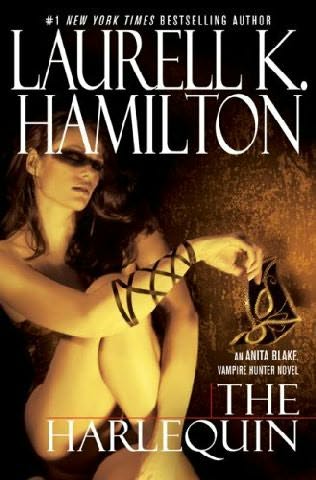
The Harlequin, by Laurell K. Hamilton

I have kind of a love/hate relationship with Laurell Hamilton's works. On the surface, it's just hard to admit to reading them--just try and summarize what's going on. Well, it takes place in St. Louis, where there are vampires running strip clubs, werewolves and wereleopards and wererats and werehyenas and werelions and zombies and . . .

See? I have now lost all credibility as a critical reader of contemporary fiction. This is not prize-wining midlist fiction--this is the kind of stuff that you get at the cash register aisles at the grocery store. Just look at the cover and see if my credibility remains:

Oh yeah. The fact that it's hardcover only means that I can take that picture off, which slightly compensates for the fact that this stuff sells at typical hardcover price. Which I paid. Because once I knew it was out, I couldn't wait for it to get to the library. Or to paperback.

And I'm not really sure why.

This is about book 15 in the Anita Blake Vampire Hunter series, and it's right in line with its immediate predecessors. And just as incredible. And I mean that literally. In-credible, as in unbelievable. But I keep reading them.

Anita Blake started as a necromancer, who used her talents on a hired basis to raise zombies. In a move that makes me laugh, the most often repeat customers are lawyers, who need to find out where the will is hidden, or who the killer was, or some other matter of evidence and estate. Trust lawyers to hire zombies, eh? At the start of the series, Anita did that job full time, while occasionally serving as a consultant to the police on crimes committed by non-humans. She had studied vampires and the "furry community" (meaning all those were-animals), and was able to provide more information than the police had on their own. Her necrotic abilities gave her some psychic powers not ordinarily available either, and for the first half dozen or so books, she primarily solved violent preternatural crimes. She started out with a boyfriend (Richard) who had caught lycanthropy from a vaccine, and was twisted with self-hatred for what he viewed as the monster in him. She was also avoiding being courted by Jean-Claude, a powerful vampire--since part of her job involved killing vampires convicted of a crime, it seemed like a conflict of interest. Plus, she saw vampires as monsters herself.

And the violence was a big part of all of this. Lots of blood, lots of gore, lots of scary scary monsters and magic and violence. I am not a big fan of violence, and I don't find blood to be anything but offputting. As the books went on, Hamilton seemed to find herself in a bind--the books demanded escalating violence, but there were only so many ways to do that, and she was running out of ideas. She had to change something, and so she switched to sex.

Which is not to say there isn't any blood--there's still a LOT of that. Psychotic mercenaries, serial killing vampires, were-animals with anger issues and powerful claws--someone usually ends up dead one way or another, which is typical for thriller kind of novels: science fiction/vampire thriller detective novels, I guess, which is (oddly enough) a growing genre. But increasinly, the focus is on the relationships between the characters--personal relationships, sexual relationships, political alliances, and the way the different powers of the different preternaturals combine and divide.

Which is maybe why I like these--Hamilton takes time to show that werewolves are organized differently than leopards would be, based on the survival tactics of the animals. Vampires have laws that govern their behavior--reasonable, given that they are essentially immortal, inhumanly powerful, and capable of creating their own armys of completely loyal vampires--so vampire relations are marked by deceit, cunning, hidden agendas, and political maneuvering. When vampires of different strengths and powers get together, there is strict protocol which cannot be ignored for any reason. Meanwhile, the werewolves only respect physical dominance and simply fight out their differences.

We see Anita come to accept that humanity inherent in the different preternaturals--accepting that the "monsters" are not necessarily monstrous. Although they are just as capable of inhuman acts as humans are. She falls in love with Jean-Claude, and grows over the course of the books in ways she would never have imagined at the start. She thought, at the beginning, that she could be happy married to Richard, living the white picket fence life--maybe. But as time goes on, she finds that his self-loathing gets in the way of his ability to accept her and the way her live has developed. In this most recent book, it looks like the two of them may break up for good--one that has been a long time coming, in the way it happens in real life too.

Sure, realism isn't a big thing in these books. For example, it's a little hard to accept that Anita has all the different powers she has gained over time--apparently, no one in this alternate history have had as many different types of affinity for were-animals (without being one herself), or such strong vampire powers (without being one herself), or the ability to form power triumvirates with other species while remaining technically human. But some of the emotional power of these books feels true--true enough for fiction, anyway.

Interestingly, despite the growing populations of all these different meta-humans, we still see a lot of prejudice and hatred, which spices up the pot. The head of the Preternatural Crimes Team is completely squicked out that Anita is "dating" a vampire--as she "dates" more and more different men/creatures, he can't stand to even look at her and doesn't call her onto cases any more. When they are thrown together--as they are in this book--he can't stop himself from interrogating her about her personal life, even as there are preternatural criminals to catch. Richard can't stand how Anita is comfortable with the "monsters" and lives a life that involves sleeping with far too many different men. He is possessive, significantly homophobic, and unwilling to acknowledge that maybe. . .just maybe. . .he's stuck with the life he has. Anita is learning to accept that her life is going to have to be unlike the one she thought she would have--it's the nature of what has happened to her. Richard cannot. And again--that feels like a real emotional battle.

So, I guess I'm going to keep reading these, and being embarrassed by the fact that I do. Maybe I'll come to some form of acceptance too. . .you never know.

First Among Sequels, by Jasper Fforde


I can't believe I haven't written about this one yet. I adore Jasper Fforde. If you are, like me, a geeky English major, there is nothing funnier than The Eyre Affair, the original Thursday Next adventure. Set in a highly literary "alternative history," the Thursday Next series stars Our Heroine, a lowly government worker in the SpecOps department. Her beat? Counterfeit classics--a truckload of Spenser with a street value of millions? She'll stop it. Need help verifying a lost Shakespeare play? She's got the equipment. If it's written in ball point pen in a lined, spiral bound notebook. . .authenticating is the easy part. Convincing the owner is the hard part.

It is clear that Fforde loves literature, and he loves words. He has created a version of England that is populated with the kind of literary groupies most of us wish we could be. Door to door evangelists for the theory that Francis Bacon wrote the Shakespeare plays. At diner booths, there are no juke boxes. Instead, there are "WillSpeak" machines: put in your coins and get a puppet reciting Shakespeare monologues.

Once you have accepted that this England is only tangentially related to our world, the pseudoscience of it becomes even funnier. Reverse bioengineering has created a world in which woolly mammoth migrate through back gardens, and there are no ducks, but dodos are wonderful pets. Thursday's father is a member of the ChronoGuard--time travelling policemen who enforce history. Thursday's father has gone rogue, and the Guard are after him.

According to Fforde, time-travel is hard to write. The inconsistencies start to pile up, and after about the third book, he was making promises to himself that he would never write any more time-travel books. First Among Sequels is his delivery on that promise.

He had to finish up the plot lines he had started, which took him until book 4 of the series. This latest is either Book 5 of the old series, or Book 1 of a new series, and in it he writes himself free of the ChronoGuard permanently. Which is really all you need to know about the plot.

Because the plot is the engine that steams you through the book, but the fun is in the details. It helps if you've read a lot of classical/canonical fiction, because then the jokes are funnier. I happened to have gotten Cold Comfort Farm from Mr. Sweetie for my birthday, and so Fforde's comment about "something nasty in the woodshed" made more sense to me than if I hadn't read it. But you don't have to be particularly well read to appreciate that the bad guy's name is Jack Schitt.

And don't ask, just go to www.jasperfforde.com for the complete post-reading experience!

Sunday, October 07, 2007

John Adams, by David McCullough--Part I


This is still on my TBR (To Be Read) pile, as I am working my way through it. S-l-o-w-l-y. Because it is non-fiction of the drier sort. Unlike The Glass Castle, reviewed below, John Adams does not aspire to novelistic elegance. This is history, and the goal is to put in ALL the information.

Well, maybe not ALL of everything McCullough knows, since he's also published a book just about 1776 (called, creatively enough, 1776). But the goal here is to trace what all Adams did in his life, and the writing comes secondarily.

I picked this book up after having seen the play 1776 (no relation to the McCullough tome). In it, Adams and Thomas Jefferson on amiable colleagues, both seeking the same goal of independence. Yet my memory of their presidential histories is that they were quite vivid antagonists, and the brief period of Adams' presidency was Jefferson's vice presidency, and they fell apart decisively.

A not small reason for picking this up was also my father, who has indicated that he felt TJ was overrated, and Adams was unfairly uncelebrated. This intrigued me--my (admittedly somewhat limited) studies in history had made me admire TJ quite a bit, and of course I love Monticello--a man who did all the TJ did, at a relatively young age as well--how was he overrated?

Well, I'm about halfway through McCullough's book now, and I see where my dad is coming from. The timeline is post Declaration, but pre-Washington presidency. John Adams is stuck in Europe trying to get loans and recognition from European countries for this new nation. No one is really buying into the idea that America will stay independent. So, here's poor JA, away from his wife--AGAIN--being patronized by the French. And TJ is back home in Virginia, with his wife and family.

Then JA gets sent to Holland, to try to get some major bank loans to fund the new country--and nobody will even acknowledge him. And TJ is back home in Virginia, with his wife and family (and at some point fleeing the British, which is read contemporaneously as contemptuous). Here is JA, setting up the first American embassy in the world, while TJ is STILL home in Virginia.

Eventually, TJ comes to Paris to work with JA, and they are great friends. However, TJ just CANNOT stop shopping! He buys a big house, he buys fine clothes, he buys crates and crates of books, and gloves, and horses, and. . . and. . .and. . . Meanwhile, Abigail and her family come to France as well, and are barely making ends meet on their stipend from Congress. TJ is also short of funds, but doesn't seem to be able to make the connection that Lack of Funds + Compulsive Shopping = Debts. He laments his debts, he keeps careful track of each and everything he buys---but he never actually adds up the costs nor compares it to his income.

Then, JA is sent to the Court of St. James as the (first ever!) American ambassador to England. And boy, is he snubbed. The British firmly believe that the colonies will return to English rule--after all, why wouldn't they? So why take this silly little obnoxious man seriously? No one speaks to him, no one acknowledges him, no one is willing to discuss any trade or fishing rights or anything the new country needs to have to live. And TJ? Still off shopping in France.

TJ is even confronted (as he should be) about the hypocracy of insisting on independence for white men while continuing to hold slaves. His answer? Is only that if he freed his slaves, he could never pay back all his debts. . .

So, perhaps the romantic images of TJ as a giant among men is overstated. And John Adams worked tirelessly and without much salve for his ego to assure the success of the American Experiment, and his efforts really are not broadly understood. The precariousness of the new country is hard to understand from our point in history, and the fact that it succeeded at all probably has more to do with Adams' ceaseless efforts than with Jefferson's elegant Declaration.

So, we'll see how things progress. I have some hard feelings against JA for the Alien and Sedition Act he instigated, and how it was used. TJ, at least, didn't resort to silencing his critics--but again, it's hard to understand those times. That portion of history still lies ahead, and it will be interesting to see how McCullough handles that and Adams' appointment of the "Midnight Judges," which for all it's potential for abuse gave us the Supreme Court's balancing powers as we know them.

Saturday, September 29, 2007

The Glass Castle, by Jeannette Walls


I read this book for my book club--just like every other book club in America, it seems. All of us women slipping gracefully into a youthful middle age, reading books about how badly our parents' generation served its children. Well, as much as I like to be unlike everybody else, there are some books you just have to read to understand what is going on in the culture. So we read this.

First of all, this is a memoir, and I have to confess that I have failed to finish EVERY SINGLE book of non-fiction our group has selected. Sure, I believe you when you tell me Undaunted Courage by Stephen Ambrose is outstanding--I just can NOT make my way through it. The incredible story of an unlikely racehorse, Seabiscuit? Nope. Couldn't get past the second chapter, and I tried. I read the first chapter about five times, because as soon as I put the book down, I forgot what had happened. I have nothing by admiration for what it took to get that book written. . .but I just can't read it.

The Glass Castle was different. Perhaps it's the transparency of the writing, or the story-teller instincts of its author, but I managed to read this in near record time.

What is it about? What, are you the only person in the English speaking world who hasn't read this yet? Synopsis: Jeannette Walls, the second of four children of Rex and Rosemary Walls, grows up and out of her parents' bohemian incompetent household, while holding on to her memories of the good that happened, while looking with clear eyes at the bad.

The book starts with Jeannette having to confront her own feelings about her parents. While being driven to a meeting in Manhattan, the car passes her mother, who is digging through the trash barrels beside the road. Jeannette is so embarrassed by seeing her mother like this, and so ashamed and afraid that someone will connect the two of them, that she slides down in the seat of the car and orders the driver to take her back home. Later, she takes her mother out to lunch and tells her mother that it is humiliating to have a parent who shops in the garbage. Her mother is completely dismissive of her concern: 'You think too much about what other people think," she admonishes. And with this scene, the tone for the first half of the book is set.

Starting at age three, Jeannette recounts her life with her parents and their laissez faire parenting style. While trying to cook hot dogs by herself on the stove, Jeannette's nightgown catches fire and she spends a very long time in the hospital recovering from serious burns. Her father bundles her out of the hospital before she is discharged--and before he can billed for her care. Soon afterward, she is back making hot dogs on the stove because her mother doesn't feed her. The Walls family response seems to be "these things happen, and so now you know."

And the book careens on, with examples of what must surely be criminal neglect of the children by the parents. Rex Walls is a polymath with great dreams and a serious problem with alcohol. Rosemary is both his enabler and victim, never standing up to him, living him for his charm, living with the danger of his alcoholic rages. The family lives in the Southwest desert, sliding out of town whenever the debts get too big and the collectors get too close. For the early years of her life, Jeannette doesn't mind this life, and there is a flavor of Laura Ingalls Wilder about the experience. If Rex were trying to farm, or do anything to support his family, then the hardships and the moves and the primitive living arrangements might just be what life was like. But as time passes, it becomes apparent that--however charming they might be--these were two people who have no business raising kids.

Things get worse after Rosemary's mother dies, and that source of income disappears. The family moves into her house, but they have no more idea of how to run or maintain a house than a cat has, and it is soon overrun by insects and vermin, and starts to fall apart. Rosemary browbeats her husband into driving the family across the country to ask for financial help from his mother. They leave laundry on a line outside, so burglars will think someone is home and leave the house alone, and head for Appalachia.

Where we are shown--graphically--where Rex inherited his alcoholism. Mama Walls is every stereotype of hillbilly white trash you can imagine. She is so horrible that Rex and Rosemary run away, back to the house in the desert, leaving the four children with this angry, resentful, uneducated and alcoholic woman, who even molests the boy. There is no going back to the desert, because the laundry "security" didn't stop anyone from stealing anything that was left to be stolen, and Rex and Rosemary finally return to Appalachia.

Things continue to go from bad to worse--they move out of Mama Walls house and into a shack balanced precariously on the mountainside. There is no plumbing, just a toilet sitting on the ground under the house. There is a coal stove, but with Rex drinking any money that comes into the household, they can't afford coal. The stove explodes when they try to burn wood, and the resulting holes in the walls and ceiling are never repaired. Jeannette's brother uses a tarp for a blanket to stay dry. With no heat or insulation, dishes freeze into the sink over the winter. Garbage piles up in back of the house, and the rickety stair to the front door disintegrates.

Finally, the kids realize that their parents are never going to get them out of this place, so they make plans to move to New York--they take on odd jobs around town and save up to send the oldest daughter once she graduates from high school. There is the obligatory setback when Dad steals their coins for alcohol, but one by one the kids move to New York and find jobs, apartments with plumbing, and go about moving up.

Of course, the parents follow, and continue their self-destructive and irresponsible lives. Rex ends up in detox, gets a job at a resort in upstate New York, but returns at Rosemary's request because she misses him. He is soon drinking again, and the pair of them are soon homeless. Rex dies, but the oldest three kids have made stable lives for themselves. The youngest, Maureen, has grown up to repeat her parents' destructive pattern, and has disappeared somewhere in the West. By the end, there is hope that the oldest three kids will live productive and happy lives, and that Rosemary will simply continue in her own way.

I was surprised by the nearly universal dislike my book club had for this book. My dear friend Micki never has any patience with bad parenting in books, but that was not her complaint this time. Instead, she was unable to accept that this book was anything but highly fictionalized. "Embellished" may have been the word she used. She felt that the book was beyond what a child could have remembered, especially the earliest years.

The rest of the club found the story just to horrible to be "true." Whenever something bad could happen, not only did it happen, but it happened in the worst possible way and then got even worse than that. James Frey's name came up--the author of "A Million Little Pieces" was raked over the coals and his reputation was trashed because his "memoir" was really fiction--how had Jeannette Walls escaped that fate too?

I recuse myself from that kind of speculation, primarily because I do so badly at reading non-fiction. I don't feel qualified to weigh in on the "non-ness"of its fiction. Oddly, I did enjoy this book, probably because of its artificiality--it had a novelistic structure that resonated for me. The writing was clear and effective--there was one scene where Jeannette encounters a rat in their Appalachian shack that positively gave me the creeps. I do have a thing about rats, and she managed to press all those buttons.

In the end, it's an entertaining read, and raised a number of intriguing questions for me to ponder. How much "bad" parenting is really bad, if the result is someone like Jeannette Walls? If it was so bad, why is it that the youngest daughter, who escaped most of the difficulties of her upbringing, is unable to cope in the real world? If this had all taken place during the 1870s, instead of the 1970s, would this have been another Laura Ingalls Wilder pioneer story, rather than a 21st century book about dysfunction?

Really, what can we do about people who shouldn't have kids, but have them anyway? And where do we draw the lines? After all, one really can't predict what kind of parent one will be until the babies are born, and then what? People can learn and grow, and there is no single model for "successful parenting." And how would you define it anyway? By the results--the adults those kids become?

I found it a fascinating read, and it made me both question my own parenting (am I guilty of some of this?) and relax about it--after all, how bad a parent can I be, compared to these idiots? It's definitely worth the time it takes to read--which is not an endorsement I give lightly.

Monday, August 27, 2007

The Yiddish Policemen's Union, by Michael Chabon


I'm not sure why I liked this book so much, but I did, and I'd recommend it to just about anyone as a good literary detective novel. And yet. . .

The book is an "alternate history" (a genre that makes absolutely no sense, as it only identifies the form, and says nothing about the content), in which the displaced Jews of WWII were offered a home in Sitka, Alaska. With a large population of them in Alaska, there was less support for a Jewish homeland, and the infant state of Israel was crushed in a Middle Eastern war in 1948, and the survivors also came to Alaska.

However the offer of refuge was not permanent, and the Federal District of Sitka is scheduled to revert to the state of Alaska after 60 years. As the book opens, the reversion date is only months away, and there is no other place that will welcome the 2 million Sitka Jews.

The main character is Meyer Landsman, a homicide detective of the noirish cliche: he is divorced, drowning his pain in work and alcohol, living in a fleabag hotel. He rarely eats, can't sleep, and is awake when the night manager knocks on his door with the news that one of the hotel residents is dead.

The murder is of a thin young man, in his early 30s, a heroin addict who uses his tefillin to tie off. It is a terrible picture of religious ruination, and Meyer takes this case personally.

We are treated to the standard list of detective plot devices: his ex-wife is promoted to become his boss; official word is to label the case as unsolved and close it; Meyer Landsman refuses to comply; he drags his unwilling partner into the mess that comprises the case. We are given the slight cliche relief in that his partner is not days away from retirement, rather his wife is pregnant with their third child. Landsman finds connections to very powerful people, finds himself beaten, shot at, and running through the Alaskan snows in his underpants--because no fictional detective is ever able to solve a case without an unbelievable amount of physical abuse to his body. And I do mean unbelievable.

Even the title ends up in service of a cliche--Landsman loses his badge, so in order to question a reluctant witness, he flashes his Yiddish Policemen's Union membership card, in hopes that the witness can't read Yiddish and will believe he has some official position.

Eventually, Landsman finds a large scale conspiracy that goes all the way to the top. Yes, the evangelical American President is assisting the insular Verbover Jews of Sitka to blow up the Dome of the Rock, so the Temple of Jerusalem can be rebuilt and the Messiah return. Of course, to the Jews, Messiah hasn't come yet, but they want the Temple rebuilt as well.

Again, unbelievable, and written in a way that does not make the plot any more credible. Instead, it feels cobbled together, which is really a pity, because Chabon's writing is so good. Really, his ability to convey the paranoia of a famously paranoid peoples is outstanding. The Sitka settlement has its own industries, it's own law enforcement, it's own jargon to describe the various waves of immigration to the area. The Jews of the lower 48 refer to the Sitkans as "Icebergers," which actually cracked me up. The operating language of Sitka is Yiddish, but most of the residents are also fluent in "American," which they primarily use for it's swear words.

I found most intriguing the various social levels, and the internecine tensions between the various Jewish sects. The "Verbovers" are prosperous, insular, and ultra-Orthodox. Their prosperity is generated by smuggling, illegal arms sales, all the shadowy pursuits of organized crime. At the same time, all activity stops at Sabbath sundown, and even the most violent of the threats aimed at Landsman are immediately followed with "May you have a good Sabbath."

The Jews are, of course, not alone in Alaska. There are the "Indianers" who stand to profit with the reversion of Sitka, creating another level of tension the Jews live under. There is the disgraced Uncle Herz, who was a FBI spook for years, clandestinely using federal funds to fight for permanent status for Sitka, but was outed by the newspaper. There is also a series of father-son relationships that play out as well. Landsman feels responsible for his father's suicide many years ago; Johnny Bear/Berko Shemets sheds his Indian identity and converts to Judaism in an attempt to connect with his father; the Verbover rabbi who lost his only son to chess and drugs. The novel is rich in human relationships, which are ultimately the strength of the book, rather than the detective story plot.

Chabon's language is also delightful: evocative and playful. When describing a department store that has been empty for several years, Chabon describes where the store's name used to be as "the braille of failure." He describes a woman's eyebrows as "reaching for each other" or getting "entangled" as a way of describing her expressions. He is able to capture the many moods of snow, the kind that falls through the streetlights, the kind that melts as spring comes, the various shades of white and grey that are winter.

This is not the book for someone looking for a great mystery, but it is a wonderful read.

Saturday, June 23, 2007

Sabriel, by Garth Nix


This has been on my radar for a while, though I'm not certain where I heard about it. Possibly as a "Things To Read While Waiting For The Next Harry Potter" recommendation, possibly as a series that has a very solid fan base. Certainly, it has gotten some incredibly positive reviews.

I picked it up because I found it on CD at the library, and I really love good audiobooks on my iPod. This one is read by Tim Curry, who has a wonderful voice and it a very versatile actor. So, onto the iPod it went. And what can I say about this novel?

Tim Curry is a wonderful reader.

This is like saying that as a singer, Britney Spears is a good dancer.

I did not like this book at all. By the time I was through about a third of it, I was frantically Googling reviews to see why it was so damn popular. In the end, it has to be a matter of taste, but I was fundamentally disappointed.

The story, such as it is, is about eighteen year old Sabriel, who is newly graduated from a girls' school in Ancelstierre, which is very similar to post WWI England (Angleterre?). Her father is a sort of a necromancer who lives in the "Old Kingdom," a place that is kept separate from the rest of the world by a heavily militarized border, complete with machine guns, trenches, barbed wire and magic. The action begins when Sabriel's father doesn't turn up for a scheduled visit, and instead sends a sort of shadow zombie, to deliver his magic sword and bells. He is called Abhorsen, the Abhorsen, whose job is not to raise the dead, but to put them back down into death.

Sabriel takes her father's professional gear and goes to the Old Kingdom, blah blah blah quest, blah blah learns her role in the world, blah blah coming of age cakes. Which is as one would expect from this kind of novel--where I part company with the fans, however, is in the execution.

To start with, Nix has a crucial obligation to explain the difference between the dead, and The Dead. There is bound to be a lot of death in a book loaded with necromancy and machine guns, and there really needs to be some fundamental difference between the two. When our good guys die, Nix treats these deaths as the tragic and dispiriting losses that are necessary to avoid a greater evil. However, since the "greater evil" is that the dead then come back to life. . . I am no longer convinced that we have a convincing case for Good vs. Evil.

In point of fact, once one starts questioning the difference between the Dead and the living, the story devolves into a sort of racial battle--anti-mordicism, or something. The living don't want to die, and the Dead don't want to be dead. So everyone is basically trying to not die. The living eat fish and animals, and the Dead eat the living. Who then become animated Dead, as far as I can see.

Both living and Dead enslave living humans, and they both use the spirits of the dead to create servants. Sabriel's ancestors don't use reanimated corpses as servants, exactly, but they create "magical sendings," whatever those are, who have a human shaped form, behave like humans, and remain servants for centuries. They just don't fall apart from decomposition.

There is also a magic cat called Mogget, who is actually an enslaved magical being. He slips his bindings twice in the book, and both times turns into a vindictive and blood-thirsty magical cyclone, with an entirely different sets of goals, a different personality, and a raging hatred for the Abhorsen who have enslaved him, also for centuries. Yet, once magically recontrolled, he acts embarrassed about his behavior and seems to appreciate the civilizing influence of his enslavement. Ew.

Nix has a problem wielding this magical world as well, almost as if he is making it up as he goes along. There is a distressing lack of advance information: as soon as he introduces a magical item, or a new term, you can bet by the end of the chapter that item has become important. The most clumsy is his use of a magical ring. Sabriel is making plans to leave her father's house, and Mogget offers to come along. He then hacks up--not a hairball, but a magical ring. "You better have this, if I am to come along" he says. "You will know when you need to use it."

Yup. First thing that happens after they take off in a magical airplane is that Mogget gets free of his binding, and Sabriel uses the ring to rebind him. We then don't hear about the ring again until Mogget gets free again. This pattern is repeated over and over--"what's that thing chasing us?" "Oh, that's a [insert invented word here.]" "What do they do?" "Oh, they're only dangerous when [insert unlikely event here.]" "Oh no! [Unlikely event] is occurring!"

Yes, this is a first novel, and I should probably cut the writing some slack, but it is a bit overheated in a Lovecraftian way. There are lots of dead bodies stumbling around, and that's (I guess) unnatural, but rather than describing what is happening so we can imagine it, Nix loads the prose with heavily weighted adjectives. The Dead aren't just dead, they are routinely "foul," "obscene," "corrupted;" words that give moral rather than descriptive information. Which is probably a solution to the problem I noted above--that the living have no factual moral superiority over the Dead, so the bad guys need to be made bad by the adjectives.

Sabriel is the first of a trilogy of books about the Abhorsen--a trilogy that I am going to pass on, based on the current evidence.

Wednesday, May 09, 2007

The Lovely Bones--Alice Sebold


Oh my god, what an amazing book! I was so altered while reading this book, so caught up in the pitch perfect ambiance of grief, so moved by the pain that seeps from every paragraph--I can hardly speak rationally about this book. It is definitely one of the best books I have read this year.

In short, fourteen year old Susie Salmon is stopped on her way home from school one December evening, raped and murdered by a neighbor. She wakes up in heaven, where she can watch all the people she has loved as they deal with her death. Her body is never found, only a piece: an elbow. Her family grieves in different ways, different times of giving up hope, of letting her go. Susie watches for eight years and narrates how each person is altered by her death.

You have probably heard it said that the dead envy the living, and that is true of Susie, who had only her first kiss to open her eyes to the world of sexuality before she was murdered. She watches as the boy she kissed matures, and she still loves him. She watches her sister, only one year younger than she was, grow into the adult life Susie would never have. Her father is crippled by grief over her loss, and her mother hurts so much that she is afraid she will die and so she runs away from the family and from her overwhelming loss. Susie's little brother Buckley is only five when she is murdered, and he grows up in a family that has always been broken.

Although Susie knows her murderer, and her father becomes convinced of the man's guilt, there is never enough evidence to tie him to her death. By the time something is found, the man has left town and is never seen and recognized again. The lack of a body, the lack of a criminal trial all stand as metaphors for the unfinished business of grief they all feel.

It is a completely secular novel of death, loss and grief, which is unusual in some ways. The explicit descriptions of heaven and of the experience of dying and the afterlife owe nothing to a specific religious belief by any of the characters. Rather, it draws its inspiration from the almost purely cultural understandings we have of death. There is no judgment, there is no test, there is a heaven where the dead watch over the living. Even dogs get into heaven and recognize their owners.

But it is the overwhelming depiction of loss that makes this book so powerful. Susie's sense of loss is palpable, as she watches her friends move on and grow up into the lives she will never have. The tender pain of her father--at first he is broken by the murder, and then as time goes on, he learns to shelter his heart--causes the other children to shelter and protect him as much as they can. The family is bent around the hole that Susie's murder leaves, and it takes years for them to begin to live without the hole in the center of their lives.

I can hardly do this book justice in a review, because it is in the careful observation of pain and the sustained tone of the book that is its strength. This is a book everybody was reading a couple of years ago, and it is definitely one that lives up to that hype.

Tuesday, February 06, 2007

Thud!, by Terry Pratchett


What is there to say about Terry Pratchett? If you have read any of his Discworld books, then you know just about all you need to know about this one. If you haven't read any of his Discworld books, then you have missed the man who has inherited the mantle of P.G. Wodehouse.

Although, to be scrupulously fair, Pratchett's novels offer musings on ideas and issues more serious than whether Aunt Dahlia has pawned Uncle Tom's silver cow creamer. In this case, we are invited to consider the role of tradition and core values.

Thud! gives us Samuel Vimes as the main character. Vimes is one of the few truly good men in the entire Disc, a man who struggles to keep his corner of the world clean and honest. He is the head of the Night Watch, a ragged assortment of police officers who were once known for running after criminals, but not so fast as to actually catch them. Over the years, Vimes has created a Watch which does enforce the laws.

In this novel, Coombe Valley Day is approaching. This is the date marking the great battle between Dwarves and Trolls over a thousand years ago. There is no agreement as to which side started the fighting, nor is it clear who won. However, feelings run high and as the day approaches, the animosity begins to build. Citizens from the Dwarvish areas object to having a troll patrolman on the beat in their neighborhood. Vimes won't allow it--the Watch is THE Watch, and its members are officers, regardless of their race.

Suddenly, a dwarf is found murdered with a troll club nearby. The whispered order through the dwarves is "Don't tell the Watch. Vimes must not know, or he'll keep asking questions. . . ." Of course, Vimes does find out, and immediately starts asking questions. There is also a stolen painting of the Coombe Valley battle, which is said to provide a map to a buried treasure. Vimes ends up doing a bit of Da Vinci Code sleuthing and ends up in Coombe Valley.

In the end, the treasure of Coombe Valley turns out to be evidence that the Dwarves and the Trolls had come to make a peace treaty, but the leaders got stuck in a cavern and couldn't get out. The deepest down dwarves found out about it, and could not accept it--too much of their identity as dwarves depended on hating trolls. So the secret was to be destroyed, and the murdered dwarf was killed by his fellow leaders who objected to his plan to make the peace treaty public.

As always, the great joy of reading Terry Pratchett is his language. In a key scene, Sam Vines wakes up on the bank of an underground river where he has nearly drowned. The first thing he sees is a black hooded figure sitting on a folding chair. It is Death, and Vimes wants to know what he's doing there.

"You are having a near Death experience," Death says--Death speaks in all capitals, but I can't replicate that here. "Therefore, that means that I must have a near Vimes experience. But don't let me interfere. Do carry on; I have a book."

This is paraphrased, but is typical of the kind of cleverness that fills these books. At one point, Vimes comes upon unfriendly dwarves, but by then he has become so angry that he has had to miss his son's bedtime book, that he has gone literally berserk. The dwarves are stunned and frightened by this lone berserker warrior, who screams at them "WHERE IS MY COW? IS THAT MY COW?" The dwarves look at one another, as the berserker falls to his knees, pulls his hair and cries to the heavens "IT GOES BAAAAA. IT IS A SHEEP. IT IS NOT MY COW."

And really, that is very frightening when you think about it.