Thursday, March 27, 2008

We Need To Talk About Kevin, by Lionel Shriver


My book club picked this book to discuss in April, and someone described it as "haunting." I have just finished it, and can only echo that description. It is "haunting," our very own Modern American Turn of the Screw.

The outline of the plot is a bit misleading. The book is a series of letters written by a woman in her fifties, Eva Katchadourian, to her husband Franklin. Their son Kevin is in prison for killing eight students, a teacher and a cafeteria worker in a Columbine like school shooting. This horrible act is revealed early in the book, and Eva continues to write while visiting her son twice a month in prison--all she is allowed to see him.

What the book is really about, though, is an examination of motherhood. Eva was a successful businesswoman, who had started a series of travel books on how to travel for the least amount of money. It had become very successful with the backpacking crowd, and she was satisfied with her life. She also was married to a wonderful man who she loved absolutely, although he was her opposite in almost every way. They had a wonderful marriage, from Eva's perspective, but the question of children kept arising as Eva entered her late thirties.

Eva is, at best, unsettled about whether she wants to have children. Franklin, her husband, is not. He is thoroughly happy about the prospect, and Eva allows herself to be persuaded: she describes the situation:

You wanted a child. I, on balance, did not. Between the two, we were ambivalent.

(N.B.--all quotes are paraphrases in this review. I can't seem to find the right pages to give actual quotes. I will flag any actual quotes from the novel, but you'd almost certainly pick them out, and Lionel Shriver is a very different writer than I am.)

She also confesses her fear of having a child. Despite making lists of the pros and cons, despite looking to her friends who already had children, despite arguing both sides of the question with Franklin, Eva is not fully convinced that she wants a child. But, she sees that Franklin has a hole in his soul that she does not fill. In the end, isn't this how those decisions get made--at least some of the time? He wanted a child, and she could give him one. All her reservations aside, she did it for him.

And it was bad--she hated being pregnant, she hated labor, she hated childbirth, and even after Kevin was born she could not find the magical bonding emotions she had heard about. She did not "fall in love" with her son, not at the hospital, not back at home. It was no easier that Kevin was a difficult baby--he screamed for hours without end, he refused to nurse, or eat. Eva ended up with mastitis on both sides, which hurts. Furthermore, she found herself falling--or more accurately pushed--into leaving her job to stay home with him.

I found this last part truly enraging: both Eva and Franklin were employed, although Eva's job with her travel publishing company was more lucrative and well-established. Franklin had a free-lance job where he scouted out locations for commercial shoots. His logic was that she could take time away from her job and it would still be there for her to go back to. She suspects, however, that if their positions were reversed, he's argue that he should keep working as the better earner and she would have still ended up staying at home.

Yet, it's not clear that she hates that result. She doesn't love it, that's for certain, but she doesn't seem to blame Franklin for seeing the world the way he does--that may be why she loves him. But she does not love being at home with Kevin. She sees malevolence in his beady eyes, opposition in his posture. To Eva it seems that even as an infant, Kevin is disappointed in the world and has no desire to be born at all.

This is a hard time to live through, the transition from being an adult to being a parent. An infant requires so much attention, so much care. Physical recovery from childbirth is slowed by sleep deprivation, and the entire experience is further disorienting by the loss of your former identity. Eva used to be a traveller, a writer, a businesswoman, a wife. Now she is a diaper changer, a prisoner in a screaming baby, a social recluse without adult interaction until her husband comes home. Yet, when he comes home, he is absorbed by the baby and mostly ignores Eva.

And we see the poison seep into the picture. Eva has her experiences of Kevin, which are irreconcilably the opposite of Franklin's. Kevin does not scream when Franklin is home, to start with, and as Kevin gets older the pattern continues. Franklin sees a normal, if testy, child, where Eva sees an opponent. And the wedge starts to separate the adults from one another. Franklin cannot accept Eva's experiences as real, and before long, the family has devolved into Franklin and Kevin against Eva.

These scenes are written with an aching understanding of the sadness of such a divide. Parents are famously cliched for announcing that they will not let their children come between them, but that they will stand united for the child's own good. And yet--imagine the scene through Franklin's eyes. He comes home to a quiet child and a hysterical wife. The baby is asleep in the crib, and the wife is wild-eyed with pent-up grievances which she blames on the obviously helpless infant. The consequence of taking Eva's word for what has happened is to abandon a defenseless creature to the rage and hate of an angry woman. Who could leave their child unprotected in those circumstances? So Franklin tries to soothe Eva, to give her some perspective, to downplay her drama.

But isn't this one of reasons having children is so hard on a marriage? Sure, as two educated adults, you and your spouse may have different opinions on any number of topics: you can agree to disagree on politics, music, religion, any number of things. But a child is so important: you simply cannot have two different ways of raising a child--it's just wrong. And so the baby drives a wedge between the two parents, and that wedge never closes for Eva and Franklin. It just gets larger and deeper.

Things deteriorate further when Franklin buys a new house. Eva, of course, loved living in New York, and had no desire to move to the suburbs. Franklin overruled her; she saw the logic in such a move, although she still didn't want to move. Then he bought a house while she was out of the country, and she hated it on sight. It was the opposite of everything she wanted in a house. What she wanted was an old, rambly Victorian, with a large porch, and cozy and slightly overcrowded rooms. What Franklin bought was a stark, modern, open plan house--Eva was horrified that there seemed to be no doors. None of the rooms was square, but all were canted, or slightly raised or lowered from the ones around them. She wanted a home in which she could be cocooned with her family--impossible with the enormous windows that seemed to bring the whole world inside. Again, Eva's reality is dismissed, unacknowledged, unaccepted. Yet, she still claims that she loves Franklin, even as her letters again and again document how he silenced her in so many ways throughout their lives together.

When Kevin is eight, Eva realizes that she wants another child. Franklin is adamantly opposed: she already has complained and hated everything about having Kevin. Why in God's name would she want to do it again? But Eva needs to answer a question about herself, about her own soul. She believes that she is capable of loving a child, just not the specific child she has: just not Kevin.

So Celia is born, the opposite of her brother--she is small, timid, desperate to please. She clings to her mother, is self-effacing to the point of being vulnerable to any number of injuries. And she adores her brother, who is growing into a sociopath, if his mother is to be believed. Either Celia is perfectly made to be her brother's prey, or she is a whiny and clingy phobic child who is irritating beyond belief to her brother. But Eva is happy with her daughter, and the family is now "even"--the two males against the two females. Which is no way to be a family, really.

Then came Celia's "accident." Eva bought her an elephant shrew for Christmas, and one evening after dinner it mysteriously escaped when the door to the cage was left open. Celia blamed herself because Kevin told her it was her fault. Eva had her doubts. Two days later, a mysterious clog in the bathroom drain--which Eva treated with Liquid Plumbr. Two days after that, while Kevin was being taught responsibility by babysitting his sister, she ended up in the emergency room with acid burns on her face. The doctors could not save her eye. Kevin had flushed her eye and face with water and then called for an ambulance before calling his parents.

Celia had to stay in the hospital for several days. Franklin couldn't keep silent. "Eva," (I'm paraphrasing again) "how could you leave that drain cleaner out where Celia could reach it?" Eva is certain she didn't--she distinctly remembers returning the bottle to the highest shelf on the locked cupboard. Celia couldn't reach it herself; Celia couldn't open the childproof lock; Celia was scared of the bathroom and would never have gone in by herself to play.

Franklin is appalled; Eva is supposed to be an adult, a parent, for God's sake, and she can't take responsibility for her actions? She blames Kevin? He's the one who flushed out the acid, who called for help and got her to the hospital. He was a hero--remaining calm in a crisis and behaving admirably. Eva has got to take responsibility here! Plus, she needs to reassure Kevin that the accident was not his fault.

Again, Shriver crafts a scene of almost unbearable marital discomfort. How can Eva still believe in her marriage when Franklin treats her like a misbehaving nine year old? "There was something you wanted to say to Kevin, right Eva? The thing you told me in the car?" "There was something more--that Kevin shouldn't feel. . .?" But Eva certainly does feel that Kevin is at fault, and that he should feel guilty because he is guilty.

Things come to a head when one of Kevin's teachers is accused of an unspecified "impropriety." Franklin asks Kevin about it, and Kevin maneuvers to talk to his father outside Eva's earshot. In the end, the teacher loses her position, but cannot be fired because nothing was substantiated. Eva confronts Franklin with her conviction that Kevin lied about the entire thing, and Franklin suddenly collapses. Even he can see the marriage is over. They no longer inhabit the same reality, and there is no longer any way to bridge the gap. They will try to survive until the end of the school year, and then make arrangements over the summer. They both know there will be no difficulty about custody--Franklin will get Kevin, and Eva will get Celia.

Things don't end up that way, because Kevin starts the shooting on April 8, three days before his 16th birthday. We are not surprised by this--the leitmotif of school shootings has shot through the last third of the book, and we know that Kevin has killed the students. There is never any question of the fact that he had done it--Eva doesn't once deny his guilt. We have seen bits of the criminal trial, of Eva's visits to Kevin in prison, of the civil suit against Eva for parental neglect, brought by the parents of one of the murdered students. We learn that she has had to sell her business and now works as a travel agent, most often taking phone calls in the back room, disguising her notoriety.

It is only in the last fifty pages or so that we learn the true facts. STOP READING RIGHT NOW IF YOU HAVE NOT FINISHED THIS BOOK!!


Are you still here? Have you finished the book? No?

GO AWAY!!


Okay, now that only us book-finishers are left, let's talk about the ending. Kevin didn't just kill 10 people at school; he didn't just show up one day and start shooting haphazardly. He systematically assembled the people who most annoyed him, as well as the one teacher who had some insight into him and hope for his future. He had forged letters on school letterhead, inviting these particular people to a meeting the gym to plan for an assembly presentation for the new "Bright and Shining" award to be presented to these "very special" students, and Ms. Rocco was to be their advisor. The meeting was set for inside the school gym, a stand alone building at the school, a three minute walk from the main building. Once his victims were inside, he systematically locked all the doors with Kryptonite bicycle locks, then opened fire with a crossbow his father had given him for Christmas. Only two of the victims were killed by the arrows; the rest bled to death. It took almost three hours for anyone to discover the scene and then to break through the Kryptonite locks. Kevin just waited.

Eva learns about the shooting at work--her employees had seen the early news on the internet, and knew Kevin went to that school. She arrived to see an endless parade of gurneys being rolled out to ambulances, and her son being lead, handcuffed, to the police car.

The story got worse. She returned to a dark and empty house, with Franklin's truck in the garage. When she turned on the floodlights to the backyard, she found poor little Celia pinned to the archery target--dead with five arrows stuck into her. Franklin was also dead, an arrow through his neck, never having made it all the way to the ridge where Celia stood.

In the entirety of the book--in all her writing to him--Eva never let on that Franklin was dead. I certainly assumed that he had left after the shooting, taking Celia with him, leaving Eva to wear her hair shirt and visit Kevin alone. In the snippets of trial we see throughout the book, and even in the hatred directed at her by the parents of the victims, Eva never stoops to curry sympathy by reminding anyone that she is also one of Kevin's victims. He killed her daughter too, and her husband. That fact sometimes "got lost in the shuffle," as Eva says.

There is something that rings true to her, though, when people blame the child's violence on the mother. Perhaps, she fears, she had something to do with creating the horror that was Kevin. She went through the motions of being a devoted mother--she made the cookies, as she says--but she never really wanted to, and perhaps it was that coldness, that falseness, that made Kevin what he was. Why did Kevin kill Franklin and not her? Perhaps he admired her as an adversary after all, and despised Franklin for being duped into believing Kevin was as normal as he pretended to be.

In the end, there is a small movement out of the horror. On Kevin's 18th birthday, Eva is allowed to see him. He knows he will be transferred out of the juvenile facility, and he seems somehow more childlike than ever before, even when he was a child. He seems unsure of himself, and perhaps a little frightened. Eva steels herself to finally ask him "Why?" Why did he do it? Was it her fault? In the past, he has mocked her sense of guilt: "Why should you get all the credit." This time, he is different. He is tired. He says "I used to think I knew why, but now I am not so sure."

There is no way to know what the next 5 years of adult prison will do to him; no way to know who will come out at the end of that sentence. There is a small ray of hope that he will become somebody different than who he has been. Perhaps there is a future for Kevin Katchadourian. Perhaps there is a future for Eva, who realizes that after everything, she is just to tired to keep fighting--that she will love her son because she no longer has the strength not to. This ending gave me the chills.

One has to wonder, however, how much we can trust Eva as a narrator of the facts. I called this an American Turn of the Screw and I meant it. Eva does make mistakes--there was an incident where Kevin was brought home by the cops for throwing rocks at cars off an overpass. He admitted it to the police, but "explained" to his father that it was really his creepy friend who threw the rocks. Kevin just admitted to it because his friend had already been busted for something else and would have been arrested, but Kevin's record was clear so he took the blame. Eva refused to believe Kevin wasn't guilty, until subsequent events made it clear that in this case he had told the truth.

There is a strong hint of displaced anger as well. Time after time, Eva is subsumed--overridden, really--by Franklin. He gets her to stop travelling, to leave her job, to move to the suburbs, to live in a house she hates, to have the child she is unwilling to have. Yet Eva never blames Franklin--in fact, several times she goes out of her way to be understanding. I am certain a Freudian would have a field day dissecting how her legitimate anger at her husband might be twisted into resentment against her son. How trustworthy a narrator is she, after all? How many of the "facts" she relates are her own twisted understanding--informed by her resentment at having a child at all? Who can ever know?

This book was beautifully written, and carefully and precisely observed. Eva Katchadourian is not an entirely likable character, but she is certainly human, and did not "deserve" what happened to her. As such, she is a compelling character, illustrating how we are all vulnerable to things that we never expected to happen.

I highly recommend this book--it is an excellent read, although a dark one that should probably be avoided by anyone not willing to face human failings. This is easily one of the best books I have read in the last year, and would certainly be on my own Top Ten Reads for 2008.

ON EDIT: After posting this, I have been unable to shake a comment my daughters (formidable middle school neuropsychologists that they are) have repeated--that brain development continues past puberty, up to an average age of 21 for females, and 25 for males. Given Kevin's confusion as he turns 18 about why he did what he did, perhaps the book again fools us into asking the wrong question. It is not "How did he become a person who could do that?" because that requires us to assume that is personality had formed. Instead, we are offered a tantalizing glimpse into what happens when a brain develops erratically--too slowly in some areas, and too quickly in others. Perhaps a better question should be "can we try someone as an adult whose brain has not fully developed?"

If Kevin still has the same brain he had as an infant--angry, uncontrolled, incapable of empathy--then maybe his talents outran his emotional maturity, and he is only now--after 2 years in juvenile detention and turning 18--beginning to develop new parts of his brain. Sadly, this maturation will happen in a far from nurturing setting. It is not a case of nature vs. nurture alone, but nature + nuture + brain development delay.

Writ large, and melodramatically, this is the same problem as "Doogie Howser, M.D." The intellect outstrips the emotional and social development, leading to anomalous outcomes. It makes the book yet more intriguing for me to contemplate.

Wednesday, March 12, 2008

How Starbucks Saved My Life, by Michael Gates Gill


Two word review: Don't bother.

Ostensibly the story of a high-flying advertising exec who lost his job and his family at 50, but found redemption in work and service, this is actually the most cynical and saccharine of "self help" books.

The author is the son of a quasi-famous editor of the New Yorker, and as such lived a live of insulated privilege with access to other famous people. Sent to Yale, upon graduation he is tipped to the J. Walter Thompson advertising agency by a school chum, and then hired by a Yale alum. Fired by the company once in his fifties, he forgoes an age discrimination suit in return for favorable references and job feeds for his own consulting company. Ten years later, the work has dried up, and he finds himself at 64 working at Starbucks.

To say this guy is arrogant and a gasbag is only the start. He is a hopelessly gauche name dropper, wedging in anecdotes of his encounters with famous people wherever he can, despite their being utterly disconnected with the story. Sure, you met Jackie Onassis, and Ernest Hemingway, etc. etc. You are still a bore. A boor, as well.

Next, the "lessons" he learns are at least 50 years behind the zeitgeist. Black people can be articulate! Walmart is a retail store! Some people graduate from college, but don't get cushy jobs through the Old Boys' Network! Did you know that your salary at Starbucks doesn't really mean you can charge all your dinners at the Oyster Bar? Who knew?

The aura of privilege is never convincingly eliminated either. One of the first questions Gill addresses is whether he could work for a African-American woman manager. Of course he can! Didn't he love his Old Black Mammy who was the family cook back in the day? Just like those old days back at the plantation--he was all but raised by Hattie McDaniel, until his parents fired her for being too old to get up the stairs of the four story townhouse. So, he's no racist!

He offers a number of war stories about his days as a Creative Director for J. Walter Thompson (oh, did he mention that he worked at J. Walter Thompson? Only about a million times), and frankly one leaves with the impression that he was fired because he wasn't very good or creative. When introducing a meeting with a client over changing the name of a company, he brings along a bat and a ball. While mouthing some pablum along the lines of "This new name will be a home run!" (I know--cliched at best), he tosses up the ball and swings. And the elderly owner of the company has to throw himself out of his chair to avoid being brained.

And this is presented as a GOOD idea.

The book is subtitled "A Son of Privilege Learns to Live Like Everybody Else." We are treated to a lot about being born to privilege, and having lived most of his live in privilege, and at the end of the book, we discover that he remains privileged. In the acknowledgements at the end, he thanks someone for getting him a literary agent on the title of the book alone. School ties, anyone? It looks like he got the book deal before writing the book, and then sold the movie rights to Tom Hanks, while being represented by CAA. Sure--"everybody else" gets a CAA brokered movie deal before writing their book, don't they?

Oh, you mean they don't?

I guess Gill is just to privileged to know about that.

This is not a man made more human through suffering--this is a man still riding on the crest of the wave of privilege, proving once again, it's not what you know, it's who you know, and the "whos" that Michael Gates Gill knows are powerful enough for him to coast back into prosperity while other, better writers don't.

Tuesday, February 26, 2008

You Suck, by Christopher Moore


I actually got this book for the same trip I got Twilight--a surfeit of vampire novels. Of course, the tone of these is completely different. Twilight is a nearly claustrophobic romance novel, and You Suck is comparatively a breath of fresh air.

Christopher Moore is more or less a comic novelist, and I have enjoyed a number of his other books: A Dirty Job; Fluke; Lamb. I believe thereis an earlier vampire novel, Blood Sucking Fiends, which I have not read but looks like the prequel to You Suck.

Even not having read the earlier book, I enjoyed the hell out of this one. Moore, as you might expect from the title, has an entirely different atmosphere going in his vampire world. We are introduced to vampire slackers--urban underachievers who don't even have to change their sleeping patterns much to adjust to the vampire life.

Our heroes, such as they are, are Tommy and his hot vampire girlfriend Jody. They have been dating for a while: when the novel opens, Jody has just turned Tommy into a vampire. He is not entirely pleased--for one thing, she never asked him if he wanted to be a vampire. Now he is stuck with his skinny body for eternity. On the plus side, his acne has all cleared up and his foreskin grew back, which makes vampire sex even better than it was when he was a human.

Tommy works nights stocking a grocery store with a crew of other slackers known collectively as "The Animals." When they are willing to concentrate, they are an awesome night crew, but they more usually spend the night drinking beer and bowling frozen turkeys at 2 liter bottles of diet soda. This is because the diet stuff doesn't have sugar, so it doesn't get sticky when they explode.

There is a plot, of course, such as it is--more fun is the way Moore draws the intersection of modern life and vampire lore. Tommy and Jody decide they need a minion--someone who will do their errands during the day. Tommy meets a goth girl--she is all of 16--at a goth nightclub, and she is thrilled to be Chosen. This is a girl with about 80 pounds of body mass, all of it attitude, and large parts of the book are excepts from her diary in a distinctive teen speak that takes the existence of vampires in stride.
,
These are vampires who pay a homeless man to sleep in the stairwell of their apartment: he uses the money to buy booze, they drink his blood after he has passed out. These are vampires who miss coffee, and discover they can drink it if they mix in a little blood. These are not your ordinary vampires.

Or, more to the point, perhaps they are. This is what 21st century people would live like if they were suddenly turned into monsters. No coffins, no gloomy castles, just staying up all night getting by.

A great contrast to the vampires of the Twilight series and a book that made me laugh out loud.

The Twilight Series, by Stephanie Meyer


These books are all the rage in middle school these days. Pony has refused to read them, and is genuinely put out that I bought them, because they are "too popular." Her friends are pushing these books on her, but have failed to give her any reason to want to read them. "They are sooooo romantic!" is not a good recommendation in Pony's book.

So, she claims to hate them, although it is more true that she hates the way her friends are obsessing over them. Bunny seems immune--perhaps 6th grade is not into swooning over boys in quite the same way 8th graders are.

I picked up Twilight in paperback because I needed something to read on a plane trip, and it was the best of the admittedly limited selection available at Target. I wanted to see what the fuss was about.

So, we have the first person narrator, high school junior Bella Swan, leaving her life in Phoenix to live with her non-custodial father in Forks, Oregon. The change is extreme for her--from the sunny hot desert to the rainy, overcast coast. She meets some students, but for some inexplicable reason her science lab partner hates her. She even catches him trying to switch science classes just to avoid her. We soon learn that Edward Cullen, as well as his "siblings" are vampires, and Bella has an overwhelming blood scent that addicts Edward. Twilight tells the story of their first year, as Edward tries to resist either killing or falling in love with Bella. New Moon continues their junior year while Bella is being tracked by an outsider vampire; and Eclipse wraps up the hunt while presenting Bella with a second suitor, Native American Jacob, who is also a werewolf and mortal enemy to vampires.

Meyers is an engaging writer--she captures some of the human experiences very well: the feeling of being the new kid on the first day of school, trying to find classes and someone to sit with at lunch. She makes the Bella's adjustment to living with her other parent real as well. The vampire stuff? I'm still deciding.

As I read Twilight, I was reminded of the books I read in high school at the beginning of the wave of romance titles. Back then (it might not be true any longer) there were certain "rules" for writing a romance: the hero had to be older than the heroine; the heroine had to be a virgin at the start of the book; there had to be complications to delay the consummation of the relationship and draw out the yearning part. Twilight conforms to all those conventions, with the exception of the consummation part--and that is because Meyers has written three novels with no consummation at all.

The hero, Edward, is frozen at physical 17, although in reality he is closer to 100 years old--enough of an age difference to satisfy anybody, I would think. Bella is not only a virgin, but she has never dated anyone or kissed anybody until she arrives in Forks--hyper virginal, she is. The vampire thing is a classic separator--he loves her, he is bound to her by destiny, but he is dangerous and she must stay away from him because he must fight to keep from killing her. . .plus, her dad is the local sheriff, and he would be pissed if he found out his daughter was dating a vampire. Okay, so Meyers inject a bit of the prosaic into her romantic fantasy--Bella cooks dinners and does laundry, something romance heroines rarely do--but this is the stuff of romantic fantasy. Edward is perfect--perfectly handsome, courteous, well educated, strong, and always there to save Bella when she needs it. If this book were not written in the first person, it could well have been a formula Harlequin-type romance.

The problem grows as the novels progress and Meyers introduces another young man with a claim to Bella's heart--Jacob the werewolf. Bella's determination to become a vampire and spend eternity with Edward is tested; sadly, we see her choice between fanged immortality and fully lived humanity reduced to the choice of "which is the right boy?"

And yet--I am unable to fully dismiss these books as starter porn for young adults. And by "porn" I mean "beautiful but ultimately unattainable perfection staged for consumption, leading the consumer to believe that such airbrushed gorgeousness in any way reflects real life." The scenes between Bella and Jacob are touching as they grow to become friends, and the friendship slowly turns romantic. Bella struggles with her feelings, with what she wants and its effect on the people around her. Edward refuses to turn her into a vampire unless she marries him first, and her very modern reply is "I'm not that girl--the one who gets married right after high school." There are moments when the novel I was reading was no longer a "vampire romance" but a very well written young adult work, showing the struggles that come with growing up.

Okay, plus I admit, I am a sucker for the emotional kick these novels carry. At the end of Eclipse, Bella realizes that she loves Jacob, but that she has to stop causing him pain. The raw emotions that accompany their conversation had me in tears. Literally. Which was rather embarrassing on a airplane during the safety demonstration.

Are these good books? Would I recommend them? I'd have to say I wouldn't recommend them to any 14 year olds I know--the view of love is unrealistic and no one should expect that this is the way relationships are. They aren't bad books: the writing is good; the characters only kiss so there is nothing sexually inappropriate--I can't recommend them due to the temptation to believe that any boyfriend is ever going to live up to Edward.

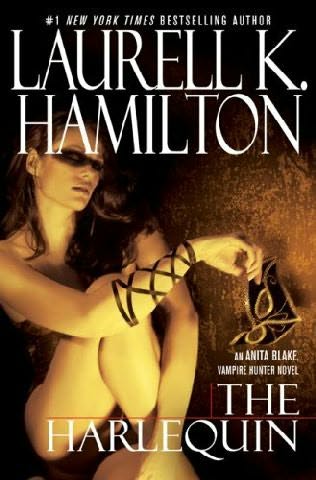
I was strongly reminded of Laurell K. Hamilton's Anita Blake series as I was reading these. Hamilton is strictly adult reading, but there are strong similarities in the triangle formed by a human woman, a vampire and a werewolf. The vampire and the werewolf each represent two different (and largely incompatible) life paths and both Anita Blake and Bella Swan must make choices about who they are, and how they will live, in the face of these extremes. Anita Blake finds a way of life that allows her to love both the vampire and the werewolf, as well as others, recognizing that these are all somewhat different kinds of love, but love nonetheless. I rather respect that of those books--the insistence on Bella and Edward being "soul mates" makes me uncomfortable. I'm old enough to recognize that for the fantasy it is, but it is dangerously attractive view of love.

Of course, so was Romeo and Juliet.

Monday, February 11, 2008

Drums, Girls and Dangerous Pie, by Jordan Sonnenblick


This is a book my sixth grader brought home to read for the Maud Hart Lovelace awards. It is the story of a 13 year old boy who is trying to muddle through middle school while his 5 year old brother battles leukemia.

There is much you would expect from a book on this topic: frightening scenes of watching his baby brother getting stabbed with long needles, the death of another patient on the pediatric ward, the steady progression of the protagonist through the various stages of grief: disbelief, bargaining, anger, sadness, acceptance.

The beauty of this book is that all this is done with a very light touch. The tone is chatty and fairly lighthearted, while handling a hard topic. The author claims he was inspired to write it while teaching in a middle school, when one of his students had a younger sibling get cancer. He felt she needed a book that showed her that it was okay to laugh, and take joy in life, even during such a serious health crisis. Because he couldn't find that book, he decided to write it.

There are times where the 13 year old voice wears thin--he starts out sarcastic, and as things get harder for him, we get reporting of his emotions--we are told, not shown, because the snarky tone was so strongly established, that it's hard for Sonnenblick to move his character into a different emotional space. Instead, we get sentences like: "Suddenly, I realized that tears were running down my face, and I didn't know why." Maybe he doesn't know why, but shouldn't we?

Still, this is an "issue" book that isn't pompous or overbearing in handling its subject, which is sometimes all you can ask for from a YA book.

Tuesday, February 05, 2008

Memoirs of a Teen Age Amnesiac, by Gabrielle Zevin


If Naomi had chosen heads, none of it would have happened. So begins this latest YA book I read. Once again, we have a 16 year old trying to figure out who she is in the context of the boys/men in her life. This hoary and frankly regressive format is made more tolerable by the use of amnesia. Naomi has hit her head on the stone staircase at school, and wakes up unable to remember anything about the last four years--her entire middle school and high school career.

She is found at the bottom of the stairs by James Larkin--a sulky James Dean type boy, who rides with her to the hospital. She quickly is reintroduced to the eccentric Will--who claims he is her best friend--and Ace, her tennis playing jock boyfriend. She also has to confront her parents' divorce, her mother's remarriage and four year old half sister, a new house, and who she has become over the last four years.

There is an interesting premise that hovers tantalizingly over the first half of the book--does a girl given a clean slate make herself anew, or does she fit herself back into the person she used to be? Naomi does a little of both--she gives herself some time to figure out what she saw in Ace, before deciding that whatever it was, he's not enough for her now. She finds herself drawn to the mysterious James, who nobody seems to like, and who runs hot and cold unpredictably. She settles into Will's proffered friendship, both because she genuinely likes him, and because he can tell her about who she used to be.

The amnesia causes some practical difficulties for her, which are handled deftly and with a light touch. She can't remember how to drive, but hates being dependent on her father to take her places. She remembers math and science, but not language, and she struggles to keep up with her classes while working on the larger problem of who she is and where she fits in.

It won't be a surprise to anyone who has ever seen Sixteen Candles that Naomi's fascination with James breaks Will's heart--because Will has been in love with her forever. What Zevin does with this triangle is slightly different from the usual--Naomi doesn't figure out that Will loves her, and she develops a relationship with the troubling James. However, she's with him long enough to learn that he isn't really right for her either. She eventually recovers her memory, realizes what Will means to her, but that relationship is no longer viable due to the choices she has made since the accident.

Will is angry with her because she has quit the yearbook, which the two of them were co-chairing, first to appear in a play, and then to be with James. Will gets another girlfriend, who is also angry at Naomi for how she has treated Will. By the end, however, the two of them have been through enough that they are able to (slowly, cautiously) reapproach each other.

The emotional territory Naomi moves through in her relationships with Ace, James and Will are authentic and well handled. Zevin has overloaded the book, I think, with more plot than she can handle. Naomi was adopted by her parents as a baby from Russia, which creates another identity crisis that is more or less just thrown in briefly, then dropped. Similarly, Naomi finds a food diary in her bedroom, indicating an incipient anorexia with it's obsessive focus on minimal calories. She (wisely) throws it out, calling it insane--and the issue also disappears. We later learn that Naomi was an outstanding tennis player--an athleticism with is at odds with the food diary. Again--more plot than Zevin could handle.

The whole issue of her parents' divorce is also more weight than the book can handle. The pre-accident Naomi has refused to speak to her mother, because her mother's infidelity ended the marriage. The two never quite make up, but neither does Naomi really have a believable emotional arc over this new disruption in her life. Her father, too, is about to remarry--a decision that pre-accident Naomi apparently was a complete bitch about, but post-accident Naomi accepts with slightly more grace--but not entirely believably.

Finally, the exquisitely depressed James (as Will derides) turns out to have serious and recurrent depression, a failed suicide attempt in his past, and more demons than he can handle. He ends up in California, and Naomi lies to her father and goes to meet him there. James is sinking rapidly, and ends up abandoning her for hours on a beach where she has no way to get in touch with anyone. James' problems are too large for a girlfriend to shoulder or solve, and this harebrained trip to California is not really consistent with the girl we are discovering. In fact, the post-accident Naomi seems to have messed up her life as thoroughly as pre-accident Naomi did, just in new and excitingly different ways.

Zevin does a nice job with the amnesia, so it's not merely a gimmick, but does lend some emotional crediblity to Naomi's attempts to find her balance. It's just sad that neither Naomi seems to have had any real female friends, or really any non-romantic relationships with boys either. Still, it's sensitively written and the emotional path she takes to find her way to Will feels authentic. A few less disasters would have kept the book better balanced is all.

I'd Tell You I Love You, But Then I'd Have To Kill You, by Ally Carter


Yup--I'm doing a bunch more YA reading recently, as the kidlets are reading books that they enjoy a great deal. So, since I'm not picking such great reading material, I'm borrowing theirs.

Tell/Love/Kill is a hybrid spy/romance/boarding school novel and is clearly setting itself up to become a series. Our Heroine, Cammy Morgan, is the enrolled at the Gallagher Academy for Exceptional Girls, and all girls boarding school outside Washington D.C. that is actually a training school for spies. The humor comes from the juxtaposition of spy training with ordinary school routines, as well as the on-going joke about all the things invented by past "Gallagher girls." "Duct tape didn't invent itself, you know.

Cammy is in an unusual position--her mother is the headmistress of the academy, and her father disappeared on a mission some years back. As a result she has become "the Chameleon"--a girl who fades into the background so she isn't noticed. Things change one night when the girls are allowed into town to attend a carnival, and a boy sees her. Really sees her, which is so unusual that Cammy is surprised.

A relationship develops, which Cammy tries to keep secret from her mother, while sneaking out to see Josh--a task which is made possible by her spy training. She then invents a "cover" for Josh, since she can't tell him she's a Gallagher girl--he doesn't have the right clearance for that kind of sensitive information.

Things develop as you think they might, made fresh and funny by the spy motif. Cammy and her friends rappel in and out of Josh's house to confirm he isn't there to infiltrate the school--Cammy goes along because she's dying to know more about him. Things come to a head as she's about to be outed to Josh as a Gallagher girl, so she decides she has to break up with him--sacrificing their budding relationship to maintain secrecy. So it's just too bad that her Covert Ops final is sprung on her as she walks away--poor Josh sees her grabbed, blindfolded and pulled into a speeding van. Safe to say that very few Gallagher finals have concluded with a town boy driving a front end loaded into a school building to rescue his girlfriend.

Written with some of the flippancy of Meg Cabot's Princess Diaries series, Tell/Love/Kill covers the excitement of developing romantic relationships while warning girls of the pitfalls of trying to be someone else for a boy--a lesson made easier to swallow by the whole spy theme. The book ends satisfactorily, but without a clear and final resolution for Cammy and Josh. There is already a sequel out, Cross My Heart And Hope To Spy, and that one will be coming home too.

Thursday, January 31, 2008

The Constant Princess, by Philippa Gregory


Gregory has previously mined the lives of the Tudors in The Other Boleyn Girl, The Boleyn Inheritance, The Queen's Fool and The Virgin's Lover. The Constant Princess is the story of Katherine of Aragon--more specifically, her life prior to 1514 and the birth of Mary I.

Gregory doesn't replow the years Katherine is best known for--the years in which Henry VIII struggled to rid himself of her in order to marry Anne Boleyn. These years are well covered in The Other Boleyn Girl, albeit from a different perspective. Katherine is only a marginal figure in that book, as she has seemed in history.

As a Protestant myself, I have found myself irritated by Katherine's refusal to step aside, because I know how the story ends with the glorious and long reign of Elizabeth I. As a result, I have always seen her refusal to step away as a dam in the flow of history, which was remedied by Henry's break with the Roman Church and Katherine's death in 1536. It is useful to be reminded that no one knew at the time what would happen, and Katherine had her own reasons for refusing to be supplanted.

However, save yourself the time and don't bother reading this book. Gregory simply doesn't have the grasp of her material that she had in the Boleyn books. There are basically two ideas in this book, reiterated ad nasuseum: Katherine was raised by fanatic believers in the True Religion; and Katherine's marriage to Arthur (Henry's older brother) was not only consummated, but was the One True Love of her life. Thus the Great Question of Katherine's divorce--was she married in name only to Arthur?--is answered here by Gregory's frankly syrupy depictions of Katherine and Arthur as the Tristan and Isolde of their age. Sent off to Wales to "learn to rule," Arthur spends all his time sneaking into her rooms (why? Well, no good reason, except that historically, it seems that the two spent very little time together except as ordered--which does not support Gregory's theory of Twue Wuve). There the two of them have sex multiple times, and then engage in pillow talk about making England a great country--the New Camelot.

It is to gag. I mean, really! Arthur was about 15 when he married, and he died about five months later. Sure, the marriage was probably consummated--that's why she had come all the way from Spain. But really--her One True Soul Mate for All Time? Gregory piles on the slop with a deathbed promise--Katherine promises her nearly dead husband that she will stay in England, marry Prince Harry, become Queen of England, and make the England the two of them had planned. Oh, how Noble and Selfless these two were! How tragic for the country that the Real King should have died and his younger brother--who had never been taught to rule--should inherit the crown.

Let's get down to facts. Arthur was no more than 16 when he died. Even had he lived, he was not ready to rule at that age. Henry was then 11 years old, maybe 12. He was thus the heir apparent for six or seven years--enough time for him to have been taught everything he needed to know about ruling--or at least as much as Arthur knew when he died.

But no. Gregory can't have that--it interferes with the picture of True Love. Henry has to be--in every way--Arthur's inferior. Katherine has to do everything she does because of her Deathbed Promise to Arthur. Even though she knew Arthur for less than 5 months, and was married to Henry seven YEARS after Arthur's death, and remained married to Henry for 23 YEARS before he married Anne Boleyn--her heart was always true to Arthur. At best, it's not remotely believable, at worst, it's downright delusional.

Gregory hasn't finished, however. Despite being the daughter of Ferdinand and Isabella, despite going on the campaigns which drove the Muslims from Spain--Katherine meets a single Muslim and immediately comes to understand that her entire understanding of them was wrong. They aren't heretics to be converted or killed! They are just people who deserve to have their own understanding of God! That just smacks of pandering to contemporary culture. But, once you take away Katherine's faith--why else would she refuse to accept the new religion?

Oh, right. Because she promised Arthur that she would be Queen. It has nothing to do with her bloody inculcation into the Christian cause; nothing to do with forging a single nation out of warring factions through the imposition of a single faith. No--it's just Twue Wuvve--the Wuvve that outlasts life itself.

Well, barf. I would prefer a woman who is not magically capable of running an entire country without any training; I would believe in a woman who stood by her duty to God as she understood it; I would understand a woman who had intellect and ambition to make a country out of the remnants of the Wars of the Roses. I gag at this "I'm doing this all for you, dearest Arthur!" picture Gregory foists upon us.

Interestingly, each of my girls picked up this book at one point--it took me a long time to finish it, as you can probably guess by my review. Each girl read the promo material on the back "[I]t is Katherine herself who takes control of her own life by telling the most audacious lie in English history[.]" Each girl asked me what that lie was. How do you explain the whole nonsense about Henry marrying his brother's widow, and the farcical court of inquiry into whether Katherine had been a virgin 23 years before? I ended up saying something succinct like "Katherine had been married to Henry's older brother before she married him. The lie is that she said they never had sex." To which both girls said: "Ewwwww."

Which really is the proper response to this book.

Saturday, January 26, 2008

The Blind Assassin, by Margaret Atwoood


This novel won the Booker Prize in 2000, and Margaret Atwood is one of the grande dames of contemporary literature. . .which is the long way of saying that this was one hell of a tedious book and I wouldn't recommend it to anybody I can think of.

How's that for succinct?

The conceit of the book is that the narrator--an 83 year old woman named Iris Chase Griffen--is writing out the story of her life. Interspersed with this narrative are chapters from a (fictional) novel called The Blind Assassin, published in 1947-ish, written by Iris' sister, Laura Chase before she died in an automobile accident. Also interleaved in these two narratives are newspaper clippings of major life events of the main characters.

What little actual suspense this book holds is what connection the fictional novel of Blind Assassin has with the "real" people of the novel. I figured out the Big Secret about a quarter of the way in, which is not much of a secret to anyone who has read much of anything written in the last ten years.

So, here comes the plot spoiling. The Chases are the wealthy family in town, and the girls are raised in isolation, as "befits their station." When the Depression hits, the family loses all its money, and the town becomes inflamed by "communist agitators," including a man named Alex Thomas, whom the girls meet. Before losing everything, Iris's father marries her off to his business rival, Richard Griffen, and the businesses consolidate. Her father then drinks himself to death, so Laura (then 14) goes to live with Iris and her husband.

Iris has an ongoing affair with Alex Thomas which lasts until he is killed in WWII. Richard has an ongoing affair with Laura, then has her committed into a sanitarium subjected to electroshock therapy when she becomes pregnant. He has the baby aborted as well. Iris in unaware of much of this, because Richard confiscates any mail that comes to her. Laura gets out and goes into hiding until the war is over. She re-contacts Iris, who tells her that Alex Thomas is dead and that she was his lover. Laura takes Iris car and drives herself off a bridge. Iris then writes this novel as her revenge against Richard, claiming that Laura wrote it. Richard kills himself when his treatment of Laura and the sanitarium become public, ruining his political aspirations. Iris then lives another 60 years where almost nothing happens and then she dies.

The only lively writing in this entire pretentious mess is in the fictional novel. The "novel" itself is merely a chronicle of Iris's affair with Alex Thomas--all their assignations and the story he makes up for her. It is a genre tale about a barbaric civilization, complete with blind assassins and female sacrifices who have their tongues cut out. The two lovers have nothing in common, and don't seem to even like each other very much. Alex is bitter about all class distinctions, and Iris can never do anything right. All they have is the sex. They don't even agree about how the story should go.

So this is the plot of Atwood's novel. It is jumbled up, and padded out with all kinds of boring details about Iris' life, both past and present. We are treated to numbing descriptions of how far she walks for her health, and how much she doesn't eat. We get details about what clothing women wore. We get small town newspaper social columns full of the vacations taken by people who are literally nothing more than names. We get Latin exercises. Lots of minutia, no character development. Alex Thomas is completely unattractive--he seems to be the only person either Iris or Laura have ever met, otherwise, there is no reason either of them should be drawn to him. Laura is constantly described as "different," but it's hard to see how.

I passed a lot of the book entertaining myself by noticing how Iris was like the imprisoned and voiceless sacrificial virgin of Alex's story, and by trying to figure out who was like the blind assassin. There is a lot of writing about who can see, who is seen. Iris fears that people stare at her, and she dislikes being in a spotlight; her name is evocative of sight, as it is a part of the eye. Otherwise, the book is remarkably dull.

One blogger I found described the book as being the story of Iris' life with all the interesting bits taken out. After she published the book, and Richard died, she lost her daughter (Alex's as well) to Richard's pushy sister, and her daughter's child as well. So, we are supposed to believe that this woman has lived 60 years since the end of WWII . . .doing what? Regretting her life? Being a victim? Merely waiting to die? But suddenly she decides she needs to write it all out (in a boring and convoluted way) for her granddaughter to find?

There is some clever writing, but not enough to justify such an enormous waste of time. Thank god this was an audiobook, so I listened while doing other, more productive things. My recommendation? Don't bother.

Monday, January 21, 2008

The Queen of Babble, by Meg Cabot


Meg Cabot is an unusually prolific writer, famous for her teen books "The Princess Diaries," now in its 9th volume, I think. She also wrote two other teen series: The Mediator and 1-800-WhereAreYou. She has a number of adult novels as well, which are differentiated from her teen books mostly by being slightly more sexually graphic.

The Cabot formula is front and center in The Queen of Babble: a young woman (Lizzie) with the ability to run off at the mouth is uncertain about her career future, and is in love with an unsuitable man. When betrayed by him (in this case, because he is working as a waiter AND still "on the dole" in London), she flees to France, where her friend is spending the summer working at a chateau that hosts weddings. On the train, she meets a good looking young man to whom she spills--at length--her woes over her now ex-boyfriend, only to find this stranger is actually a member of the family that owns the chateau.

We have the usual obstacles to overcome: he has a girlfriend, who is obviously completely wrong for him; she insists she is too fresh from her break-up to get into a relationship; the first wedding of the season involves a terrible wedding dress that only Our Lizzie can fix. Evil Inappropriate Girlfriend gets dumped, Lizzie alters a vintage couture gown found in the attic to save the wedding, boy and girl have sex on a wine cask and all ends well.

It's exactly the kind of novel Meg Cabot writes, but it's charming and has some redeeming quirky moments. One of my favorites is when Lizzie sees her crush wearing wingtips, and nearly passes out because to Lizzie, wingtips are "so hot." Another is when Lizzie realizes her English boyfriend was lying and using her, and she wants to "take back" the blow-job she gave him. She spills this particular tidbit to the stranger on the train, and he understandably finds her funny. She gets a phone call from Bad Boyfriend, and her new friend calls himself her "attorney, seeking return of the blow-job. If he is unable to return it to her, she will be forced to sue." It's the modern "meet cute," with a side of raunchy.

A light time waster, frivolous and frothy, no surprises, but no disappointment either.

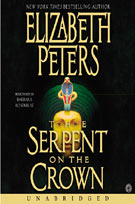
The Serpent On The Crown, by Elizabeth Peters


This is the first Amelia Peabody book I've read--and to be completely and pointlessly honest, I listened to in from Audible.com. Apparently there are quite a few of these--set in time starting in 1884 up to 1923 or so. This one is 1921 or 22--Tutankhamen's tomb has not yet been discovered, although Howard Carter is hovering around the edges of the story, and "everyone" agrees that there are no more new royal tombs in the Valley of the Kings.

Amelia is married to Egyptologist Professor Emerson, and with their grown son Ramses, his wife Nefret, and their four year old twins, they excavate and inevitably get mixed up in mysteries and murder. In this book, the Emersons are approached by a Lady Novelist, who gives them a priceless solid gold statuette, claiming there is a curse on it that killed her husband. The lady then goes missing, only to be found after a week--dead. The Emersons need some additional assistance on their team, and are approached by a German who worked on digs before The War, and a Russian who can decipher papyri.

The family endures a number of attacks on their home and their members, as thieves attempt to take the priceless statuette. They do not believe in a curse, but they do wish to know were the statute came from originally, as they have never seen anything like it.

I suppose better knowledge of the characters would have given me a better understanding of what the hell was going on most of the time. As it was, I found this to be an extremely slow moving mystery. The total reading time of the audiobook was around 10 hours, and I was already more than halfway through before the first body showed up.

The Emersons are gruff, tempermental, veddy veddy English, and hard to warm up to. They order the police around, and seem to run Luxor for their own interests--yet there is a sense that they skirt the racism that would be normal for their time. There is what appears to be some solid archeological foundation to the book--the Emersons get permission to re-excavate a tomb known as KV55, and what I found about it on the internet was precisely how Peters described it.

Nevertheless, it was an unsatisfying mystery. The murder is solved when the murderer makes a dying confession--and reveals that he had assumed somebody else's identity. So there were no clues, no decent suspects--the mystery seemed to get solved offstage. There were some lingering threads that turned out to be completely unrelated: there were at least two people running around attempting murder at the same time, but neither had anything to do with the other.

It was a pleasant enough listen, and there is something inherently Romantic about the tombs of Ancient Egypt--but I think it may be unfair for me to just jump into this series at book 16 (more or less). I could go back and read the earlier ones and see if it changes my opinion about this one.

Saturday, January 19, 2008

Lamb: The Gospel According to Biff, by Christopher Moore


So, first off, I have to admit that I have read Moore's "A Dirty Job" and enjoyed it. I'm a fan of Terry Pratchett, as you can probably tell from my profile, and I was looking forward to an off-beat and irreverent view of the Bible.

Not that I was disappointed, exactly, but it wasn't what I expected. If you are offended by the concept of the thirty year old Messiah calling his disciples "dumb fucks," then this book isn't for you. If that breathes some fresh air into an ossified image, then you might enjoy this book. Moore, though, isn't much more iconoclastic than that.

Everything reported in the Bible happened, more or less exactly as reported, with a few swear words tossed in. Jesus (actually called "Joshua," the Hebrew name he actually had) did do all the miracles, did cast out demons and heal the sick, etc. etc. Sure, as a kid, he and his younger brother played "resurrect the lizard," but even that isn't really heretical.

Biff--or, as reported, "Levi who is called Biff" met Joshua when they were six, and the two were best friends their entire lives. It was Biff (his name is a Hebrew slang term meaning "slap upside the head") is Joshua's first disciple, and chronicles their lives together between the ages of 6 and 30, when Joshua returns to Galilee and begins his ministry.

The intervening years are spent performing minor miracles--Joshua puts his face on all the Passover bread one year--and as they approach manhood, they leave Israel to travel east to find the three wisemen. Joshua doesn't understand what he is supposed to do as the Son of God, and hopes to learn his mission from the three men who travelled to see him at his birth.

He finds Balthazar outside Kabul, where the man studies magic and has a powerful demon trapped in a warded room, which makes him immortal. Balthazaar is attended by eight beautiful and brilliant Chinese women, and Biff gets to live a sybaritic life for the years Joshua studies with the magus. This, incidentally, is where the Jewish tradition of celebrating Jesus' birthday with Chinese food starts.

After leaving Kabul, Joshua and Biff travel to Tibet, where Gaspar is the abbot of a Buddhist temple. Joshua masters Buddhist disciplines, and meets the last remaining yeti--a gentle creature that was hunted to extinction by the humans who could not understand its non-aggressive nature. Foreshadowing much? The monks of Gaspar's monastery make every one who seeks them wait outside their door for three days (significant much?) before letting them in. Joshua swears that anyone who knocks on his door to heaven will be let in.

After eight years or so in Tibet, they leave to seek Gaspar's brother Melchior, who lives in India. There they interrupt a bloody sacrifice to Kali, and Joshua swears there will be no more sacrifices. Well, okay, maybe ONE more.

Perhaps there is something to be gained in experiencing Jesus as a student of several world religions, and thus thinking of Christianity as yet another aspect of a universal search for relationship with the divine. This is as far from canonical Bible as Moore takes his book; leaving one to wonder what drove him to write this particular book. There is nothing very outrageous here: Jesus does not marry, he does not ever doubt his role as the Son of God. Culturally, this book is much less daring than "The Last Temptation of Christ" or even Dan Brown's "Da Vinci Code."

In the end, this is a pleasant diversion, but very little that you wouldn't find in Sunday School.

Monday, January 14, 2008

One Good Turn, by Kate Atkinson


I picked this one up at a "Buy 1 Get 2nd Half Price" sale. I read her book "Case Histories" quite a while ago. So long ago, in fact, that I can't remember much about it, other than it was a good read. This one had gotten some good reviews as well, so I figured it was worth a shot.

It was. The novel takes place over three days in Edinburgh, during the Fringe Festival--a period when hundreds of tourists clog the town. The timing on my reading this was coincidentally right after hearing from two dear friends about their trips to Edinburgh. So many of the locations for the book felt familiar to me, because I had just spent some time immersed in the geography of the city.

The story starts with a bang--literally, as a shady character in a silver Peugeot is rear-ended by someone driving a blue Honda. The street is crowded with people lining up to get into a Fringe venue, and so there are a lot of witnesses who see the Honda guy get out of his car brandishing a pipe and beating the Peugeot guy senseless. One person in the crowd throws his briefcase at the Honda guy, clipping him on the shoulder, and stopping the beating long enough for the police to come.

Each chapter is told from a different point of view, with a different character as its locus. The first chapter is told from the point of view of Peugeot Guy, the second by the gentle man who threw the briefcase. There is the wife of a shady real estate developer, a retired policeman whose girlfriend is acting in a Fringe production, a fading comedian whose career is bottoming out at the Fringe, and probably some others I have forgotten. We see the "road rage" incident from several points of view, and see how its ripples spread out from the center.

Atkinson is straddling a couple of genres with this book, as she did in "Case Histories." Her policeman is putting together the pieces of what happened, but this is not strictly a detective story. Who was Honda man? Where has he gone? Why did he beat up the guy in the Peugot? What happened after the man threw his briefcase? Atkinson pulls us along through the book with these questions, but the book is more interested in exploring the characters who are caught up in this incident. We see the disintegration of the policeman's relationship with his actress girlfriend, attended by his unease in having inherited a substantial fortune that means he no longer has to work.

We see the grim malice of the real estate developer's wife as the government agents close in on his business. She has been setting aside money in preparation for this--she has suspected he was going to disappear once the business was exposed, and she intended to keep herself in the style to which she had become accustomed. It was a form of karmic payback that he had a stroke while in bed with a prostitute. He lay in a coma at the hospital as his shady dealings all came home to roost.

We see the hard life of a policewoman who lives in one of those substandard housing developments, as her house deteriorates around her, she struggles to raise her teenage son as a single parent and struggles to be accepted in the largely male world of the police.

Things become complicated when the former policeman finds a girl's corpse washed up on an island, but it slips out on the tide before he can pull it to shore. Who was she, why was she killed, and who killed her?

Atkinson is a smart writer, and she keeps a sure hand on all the various plots. Each of the characters assumes a richness that makes each of them sympathetic in some way, while simultaneously serving as elements of a complicated plot. Matryoshka dolls appear over and over again in the book--the Russian nesting dolls, where each doll holds another one inside it, until you come to the last, tiny doll: the nub of the system.

The novel itself arguable has a similar structure--each story opens up to reveal another one inside it, until at the end Atkinson reveals the center of the story--the reason it all started. Upon finishing the book, however, I was immediately reminded of the ourobouros, the snake that swallows its own tale. The ending of the book is its beginning, and the whole spins around until it meets its beginning again. It's a well crafted book, and an engaging and entertaining read.


***********HERE BE SPOILERS************

I was puzzled throughout the book--why would Honda guy be the one with road rage? He was the one who hit the other car--why did he get out and proceed to beat up the presumably innocent driver of the other car?

Atkinson answers this at the end of the book--with a little slight-of-hand/sly storytelling. Peugot guy was shady, and he had been hired by the real estate developer's wife to kill her husband. It was just coincidence that he had a stroke at the very time the "road rage" incident was happening. Honda guy is the developer's personal thug, and was trying to foil the murder before it happened. Everyone is implicated. Everyone is guilty of something. There are different degrees of guilty, and we see many of them in this book.

Monday, November 19, 2007

Endymion Spring, by Matthew Skelton


I picked this one up a year ago at the school book festival. It looked intriguing, but apparently not so much that I read it right away.

Endymion Spring is the name of a young man living in Mainz, Germany, in 1453. He is an apprentice to Johann Gutenberg, helping to carve type for the Bible printing project. Herr Gutenberg is approached by the malevolent Johannes Fust, who provides financing for the Bibles in return for an undefined, but unholy, project.

The book switches between 15th Century Germany and modern Oxford, where a young man named Blake Winters is spending part of the year with his scholar mother and his younger sister. The family is on the verge of divorce, and Blake's father has remained in the States. While waiting--once again--for his mother to finish up in the library, Blake finds an old book that seems to have no writing in its pages, until a cryptic poem appears that only he can see. But the book disappears, a shadowy figure begins to follow Blake, and the race is on to solve the mystery of this book.

This is a debut novel, and it falls into an increasingly populated genre of what might be called "library mysteries." Like A.S. Byatt's Possession, or Diane Setterfield's The Thirteenth Tale, or Elizabeth Kostova's The Historian, or even The Club Dumas, by Arturo Perez-Reverte, there is a mystery that only an academic can solve through patient research and a little bit of supernatural intervention.

The strength of this book is not the mystery, involving dragon skin and forbidden knowledge, the characters or the writing. Rather, it is clear that Matthew Skelton has a great love for Oxford, which is lovingly detailed throughout the book. The colleges, the traditions, the architecture, the quality of the light--Oxford is the real star of this book.

It's a YA title, and as such is not ever too scary, nor does it end ambiguously. Blake succeeds in his quest, he retains possession of the elusive book of all knowledge, and the book ends as he opens it to read--raising the possibility of future sequels. I have plenty of quibbles, but slight as the book is, it's probably not worth detailing them.

Not a bad read, and does offer a view of scholarship as a deeply exciting pursuit.

Sunday, October 21, 2007

Eat, Pray, Love, by Elizabeth Gilbert--Part II

I finished this book on the plane home from San Francisco. And while I have some quibbles about it, I have found myself flashing back to it. There are specific scenes which are very good, and there is something about the feelings the book created in me that I keep returning to. It's as though the emotional landscape is hard to leave. I remain conflicted about this book, however.

After four months in an ashram in India, learning to meditate, Gilbert ends the book in Bali. There, she has crafted a bookend finish that is in many ways the exact opposite of the way the book began. The woman who was trapped and miserable in a house, with a husband and the pressure for a baby in New York is now somewhat older, homeless, with a Brazilian lover 16 years her senior. Not only has he already raised a family, he now has a vasectomy, so there is no chance of a baby at all. They make a commitment to each other that they will share their lives between America, Australia, Bali and Brazil.

She also ends with a story about a Zen teaching—that an oak tree is created by the existence of the acorn, plus the force of the tree the acorn will grow into, willing the acorn into growth, to create its own existence. Perhaps, she thinks, the voice that comforted her back when she was sobbing on the bathroom floor in her house in New York was the older, happier, more balanced self who is now in Bali . She does not have a house. . .so far as we know; she is not planning on marrying her lover, and the two of them are not going to have any babies. Her life at the end of the book is the mirror opposite of the life she was leading at the beginning. The book leaves the impression that she is a different person from the woman she was at the beginning, and as all such "journey of self discovery" books must, we have a happy ending.

But is this really believable? Certainly, Gilbert could not have ended the book ambiguously--a book that ended with her feeling dissatisfied and uncertain what to do next would simply not have been one that would be published. I left the book feeling a little bit manipulated--played, if you will--by this woman.

Think about it, after all. Here is a woman who is in a terrible place in her life--her divorce got ugly and dragged on and on. Her rebound relationship also fell apart. She was left with very little after the settlement. So, she proposes a book where she will spend four months in each of three countries to find herself, or find balance, or something. How likely is it that at the end of a single year she will have any real handle on The Right Way to live her life?

I'll tell you. Not very likely at all. BUT--it can be written as though she has found The Right Way, and she doesn't have to reveal any glitches, or failures, or anything negative that happened. And I think that is what happened. It all looks lovely at the end, but I doubt that her life stayed as idyllic as it looked while she was on vacation with her new lover in the South Pacific.

NOBODY'S life ever ends up as idyllic as it looks while on vacation.

So, here's the problem I have with this book: I think we have been manipulated into thinking that Elizabeth Gilbert ate and prayed her way into balance, which was actualized on Bali. I think she was not all that different a person at the end than at the beginning of the book, and all the "growth" the book presents is illusory.

What makes me say that? The first thing that really rang false for me was the night she met her Brazilian lover. She hardly noticed him at all that night. Instead, she met a Welsh ex-pat named Ian, and they talked for hours. She says at least twice "I really liked this guy." At the end of the evening, they part without exchanging contact information, and Ian says "We will meet again when [the gods] think it's right."

And she goes home and obsesses over this guy. She relives everything they said, and projects a future with him. She starts to worry about where they would live, how she would be able to continue her career from Bali. She essentially abandons everything about herself in order to mold herself around this new man. This is David Redux--everything about this monologue is exactly the same endless dither she used to do about David.

Remember, she doesn't know where he lives, she doesn't have a phone number for him. He doesn't have her address or her email. Even Prince Charming had Cinderella's shoe to help him find her again! Ian and Liz have less than that. So, we are treated to the very real idea that if Ian ever called her again, she'd dive right back into the same kind of clingy dependent relationship that she had with David less than a year before. Everything about this spells disaster.

Except that she doesn't run into him again. Ever. (As far as we know.) The infatuation burns itself out, we are left to suppose, because she doesn't mention him again after that one experience. It seems that the only thing that allowed her to move herself out of the rut of bad relationship patterns was sheer luck in not seeing this guy again! How enlightened is that?

Second, the final scenes of the book feel set up and manipulated. Gilbert ends the book describing a vacation she is taking on another island close to Bali. This is an island she has visited before, at the nadir of her divorce and breakup. Here she took a vow of silence, and meditated and tried to quiet her turbulent emotions. She describes beautifully the process of examining her fear. anger and shame, and accepting those feelings. She says she invites those things into her heart to rest. She reassures them (and herself) that they are loved, accepted, and that "it is over." After ten days, she finds herself at peace.

SO--why were we walked through her time in India, if she was already able to do this? And why should we believe that her experience in India is any more permanent than her island retreat had been? Even before she started this book project, she had learned how to let things go. Her biggest revelation in India is that she has to let David go. But does she--really? She has at least one night in Bali when she considers calling David to see if he wants to get back together. Sure, she doesn't act on it--so far as she tells us--but the fact that she hasn't really let him go makes me suspicious of how much of this book is really fiction.

So, with these questions in my mind, what do I have at the end of this book? I have a woman who had a bad divorce and a bad rebound relationship. From the time she realized she didn't want to be married anymore until the peaceful ending of this book was roughly 4 or 5 years. Look, even without eating pasta in Italy, meditating in India, and vacationing in Bali, she might have felt better--and felt wiser too. As far as I can see, she was lucky to meet a fabulous man who seems to love her just the enveloping way she wanted her previous men to love her. She doesn't need to cling to Felipe, because he clings to her. He is, she says, molding his life around her--so she doesn't have to mold her life around him. But the relationship dynamic isn't really all that different. Her expectations of love haven't really changed. She is a little older, a little more at peace, a little wiser--maybe. And not necessarily because of anything that has happened in this book.

Lots of people love this book, and I would be very interested in hearing from those of you who did. Do you have any of the misgivings I have about this?

Thursday, October 18, 2007

Eat, Pray, Love, by Elizabeth Gilbert--Part I


Yet another book that everyone is reading. But the closer I came to reading it (the TBR list is particularly long right now), the more I ran into people who did not love it. Did not like it, to tell the truth. Which surprised me, given its ubiquitousness.

Although that is probably a good thing, because it lowered my expectations, and no matter how good a book is, most cannot live up to their positive press.

I am now one third of the way through, having traveled through Italy with Liz Gilbert, and I must say I see the strengths and the weaknesses I was warned about.

First off, I have a lot of sympathy with where Our Liz found herself at the beginning of the book. Turning 30 (more or less) is a hard thing, not because an age that ends with a "0" is a particularly traumatic thing in itself. Rather, 30 is an age when you start to truly cross over out of adolescence. During your twenties, in America, you are working your way through college, graduate school, first jobs. You have prepared yourself for a career and life with which you have very little visceral experience, but you have already invested heavily of time, energy and money.

Think about it--the standard American model is that you select a college when you are about 17--we have only just decided you can be trusted with a driver's license, then we throw you into a decision that will affect many many choices about the rest of your life. You select a major, you prepare yourself for what you think you want, often having little or no way to know is that is really the life you think it will be.

Liz Gilbert starts her book huddling on the bathroom floor, sobbing, suffocating in the life she has chosen. The plan was that she and her husband would spend their twenties being young, expecting that by the time they were 30, they would be ready to settle down, buy a big house, start a family. What happened was that at 30, Gilbert found that she wasn't ready. She had the husband, she had the big house, she had the life she thought she would want at 30.

Only problem was that she didn't want it.

And it was a physical rejection she experienced. Her body wouldn't let her sleep, wouldn't let her breath between sobs. She was desperately unhappy, and she truly couldn't explain why. She had a wonderful life, a life a lot of women would give significant body parts to have. Why wouldn't she want that life?

But these things are not logical, and cannot be explained. And they cause a lot of pain. She went through a lot of pain herself before she even began to understand what it was she wanted; then the pain started to spread, and her husband got hurt as well.

It wasn't his fault, you know. They both made this plan, and it was a good plan for him. Nothing had changed to make it a bad plan--it was just that his wife didn't want it any more. And how can that feel? You were together, on a life path, and then suddenly you weren't. And his hurt made him mean, just as it made her miserable and desperate.

She didn't want to hurt him, but the only way NOT to hurt him was to push herself forward into a life she desperately didn't want. There are no good choices in that situation, and I have a lot of sympathy for both of them.

Which has affected my experience of this book. As I read this, I see much that I can relate to, much I can admire; but I'm not sure I would like Elizabeth Gilbert if I met her in person. I'm not sure I would enjoy spending the hours in her company that I am spending with her book. So I see why the people who didn't like this book felt that way.

The book is also curiously distancing; she spends the first third of the book in Italy, learning to love the culture, the food, the experience of living in a world view fundamentally different from her upbringing. And yet, the experience on the page is a bit flat. She admits that she doesn't see Rome architecturally, historically, or any of a number of ways that would bring it alive for me. It's good food (which I love, of course, but even that is a bit dull), and how she feels about it. And since I'm not invested emotionally in her, it's a bit off-putting. She doesn't show me Rome so I can appreciate it and share--she shows me how Rome affects her, in a way that keeps me out of Italy.

So, the solution, I guess, is to bloody well go to Rome myself, and write that book. Right?

Wednesday, October 17, 2007

Water For Elephants, by Sara Gruen


This is a book that I greatly enjoyed, probably more for the setting than for the more usual strengths of a novel. To be honest, the characterization was rather thin, the plot rather predictable where it wasn't straining credulity. Still, it was a greatly enjoyable ride and one I would recommend.

The tale is told by Jacob Jankowsky, a ninety-some year old man remembering when he was twenty-three years old working in a small circus for a season during the Depression. We are introduced to Jacob as a young man in the middle of a crisis resulting in a man's death and a stampede of circus animals. Following this prologue, we meet the elderly Jacob in "assisted living" where he has earned himself a reputation as uncooperative because he insists on his own humanity. As he argues, "There's nothing wrong with me, I'm just old." He is old; very old, but he has all his faculties as well as his teeth.

A small circus has come to town and set up within sight of the facility. It is all the residents talk about, and one man makes himself interesting to the group by claiming he used to carry water for the elephants. Jacob calls him a liar: he knows how much water an elephant drinks, and no one could carry that much water. (I looked this up, and an elephant can drink up to 50 gallons of water a day--that's 400 pounds of water. Daily.)

This leads Jacob to remember his days with the Benzini Brothers Circus; a "grift" circus that made money on surruptitious stripper shows and false "freak shows;" that obtains new clothes for its members by stealing them from wash lines in the towns they pass through; where the owner regularly withholds pay to keep the workers in line; where strong men "redlight" anyone they perceive as a troublemaker, throwing them off the train while in motion, sometimes even off of train trestles.

Gruen does a pretty skillful job of getting her narrator into the circus in a fashion that allows him to see all the different castes: because make no mistake, there is a strictly defined hierarchy, and there are not many people in a circus who would get the chance to see the other levels. As the novel starts, Jacob is finishing his degree in veterinary medicine at Cornell, with plans to join his father's practice after graduation. Just before the end of term, he learns that his parents have both been killed in a car accident, have mortgaged their property to the hilt, and since the Depression means no one can afford to pay the vet, there is nothing left. It all goes to the bank. Jacob travels home to identify the bodies of his parents; the shock of it all comes to a head during his final exams, and he simply cannot concentrate enough to write them. He walks away from everything--literally--and after about two days realizes he's lost, hungry, penniless, homeless, and has nowhere to go. He decides to climb a train, with the idea he will get off at the next town and try to find work. It turns out to be a circus train, and the stage is set.

The men in the train car he boards are roustabouts--working men who raise and lower the tents, move the equipment, feed and muck the animals, and are generally the muscle of the circus. Jacob is first put to work cleaning out the animal cars, soon graduates to herding customers into the tents, works security for the cooch tent (the stripper show), and finally gets assigned as the circus vet. Here he meets the Equestrian Director, Augus Rosenbluth (his new boss), and Marlena, the bosses wife and a performer herself.

You could probably write the plot from here. Jacob falls in love with Marlena, her husband turns out to be a violent man, a climactic circus disaster occurs which takes August's life, closes down the Benzini Brothers Circus for good, and allows Jacob and Marlena to marry. This is not the interesting part of the book. What makes this book so enjoyable are the scenes for the circus world--the basic mechanics of moving and feeding so many people and animals, for example. There is the side of the circus the public sees: the spangles, the tricks, the parades--which contrasts sharply with the inside view of the circus: distrust, envy and anger between the performers and the working men; the way the black men have to hide so they are never glimpsed by the public; the hard decisions that are made about sick animals; the sharp business practices to keep the show going.

There is some tenderness as well. The first man to help Jacob get a job later becomes paralyzed from drinking contaminated "jake"--illegal alcohol. Jacob protects the man, giving up his own bedroll out of loyalty and concern. Ultimately, however, Jacob cannot save him (or others) from being redlighted, and his two closest friends die. Jacob earns the affection of several of the animals as well, especially Bobo the chimp, and Rosie the elephant. We see him struggle with his innate need to care for animals, and the business needs of the circus, uncertain where his loyalty must lie. In the end, Jacob champions the animals in his care, and finds how to be true to himself.

I enjoyed the breezy writing, the tour of this exotic world. The ending is a bit fanciful: at 93, Jacob rejoins a circus--which strains credulity, but at the same time ends the book on such an upbeat note that it's hard not to smile.

There are literary elements I've not yet plumbed, as well. According to the author interview in the back of the book, Jacob's story is based on the story of Jacob in the Bible. That might be interesting to pursue. Also, there is an inherent parallel between Jacob in the nursing home, and the animals in the circus: both are helpless, dependent on others to provide what they are used to getting for themselves. This is the stuff just made for book clubs, and mine is scheduled to discuss it November 15th.

Tuesday, October 09, 2007

The Harlequin, by Laurell K. Hamilton

I have kind of a love/hate relationship with Laurell Hamilton's works. On the surface, it's just hard to admit to reading them--just try and summarize what's going on. Well, it takes place in St. Louis, where there are vampires running strip clubs, werewolves and wereleopards and wererats and werehyenas and werelions and zombies and . . .

See? I have now lost all credibility as a critical reader of contemporary fiction. This is not prize-wining midlist fiction--this is the kind of stuff that you get at the cash register aisles at the grocery store. Just look at the cover and see if my credibility remains:

Oh yeah. The fact that it's hardcover only means that I can take that picture off, which slightly compensates for the fact that this stuff sells at typical hardcover price. Which I paid. Because once I knew it was out, I couldn't wait for it to get to the library. Or to paperback.

And I'm not really sure why.

This is about book 15 in the Anita Blake Vampire Hunter series, and it's right in line with its immediate predecessors. And just as incredible. And I mean that literally. In-credible, as in unbelievable. But I keep reading them.

Anita Blake started as a necromancer, who used her talents on a hired basis to raise zombies. In a move that makes me laugh, the most often repeat customers are lawyers, who need to find out where the will is hidden, or who the killer was, or some other matter of evidence and estate. Trust lawyers to hire zombies, eh? At the start of the series, Anita did that job full time, while occasionally serving as a consultant to the police on crimes committed by non-humans. She had studied vampires and the "furry community" (meaning all those were-animals), and was able to provide more information than the police had on their own. Her necrotic abilities gave her some psychic powers not ordinarily available either, and for the first half dozen or so books, she primarily solved violent preternatural crimes. She started out with a boyfriend (Richard) who had caught lycanthropy from a vaccine, and was twisted with self-hatred for what he viewed as the monster in him. She was also avoiding being courted by Jean-Claude, a powerful vampire--since part of her job involved killing vampires convicted of a crime, it seemed like a conflict of interest. Plus, she saw vampires as monsters herself.

And the violence was a big part of all of this. Lots of blood, lots of gore, lots of scary scary monsters and magic and violence. I am not a big fan of violence, and I don't find blood to be anything but offputting. As the books went on, Hamilton seemed to find herself in a bind--the books demanded escalating violence, but there were only so many ways to do that, and she was running out of ideas. She had to change something, and so she switched to sex.

Which is not to say there isn't any blood--there's still a LOT of that. Psychotic mercenaries, serial killing vampires, were-animals with anger issues and powerful claws--someone usually ends up dead one way or another, which is typical for thriller kind of novels: science fiction/vampire thriller detective novels, I guess, which is (oddly enough) a growing genre. But increasinly, the focus is on the relationships between the characters--personal relationships, sexual relationships, political alliances, and the way the different powers of the different preternaturals combine and divide.

Which is maybe why I like these--Hamilton takes time to show that werewolves are organized differently than leopards would be, based on the survival tactics of the animals. Vampires have laws that govern their behavior--reasonable, given that they are essentially immortal, inhumanly powerful, and capable of creating their own armys of completely loyal vampires--so vampire relations are marked by deceit, cunning, hidden agendas, and political maneuvering. When vampires of different strengths and powers get together, there is strict protocol which cannot be ignored for any reason. Meanwhile, the werewolves only respect physical dominance and simply fight out their differences.

We see Anita come to accept that humanity inherent in the different preternaturals--accepting that the "monsters" are not necessarily monstrous. Although they are just as capable of inhuman acts as humans are. She falls in love with Jean-Claude, and grows over the course of the books in ways she would never have imagined at the start. She thought, at the beginning, that she could be happy married to Richard, living the white picket fence life--maybe. But as time goes on, she finds that his self-loathing gets in the way of his ability to accept her and the way her live has developed. In this most recent book, it looks like the two of them may break up for good--one that has been a long time coming, in the way it happens in real life too.

Sure, realism isn't a big thing in these books. For example, it's a little hard to accept that Anita has all the different powers she has gained over time--apparently, no one in this alternate history have had as many different types of affinity for were-animals (without being one herself), or such strong vampire powers (without being one herself), or the ability to form power triumvirates with other species while remaining technically human. But some of the emotional power of these books feels true--true enough for fiction, anyway.

Interestingly, despite the growing populations of all these different meta-humans, we still see a lot of prejudice and hatred, which spices up the pot. The head of the Preternatural Crimes Team is completely squicked out that Anita is "dating" a vampire--as she "dates" more and more different men/creatures, he can't stand to even look at her and doesn't call her onto cases any more. When they are thrown together--as they are in this book--he can't stop himself from interrogating her about her personal life, even as there are preternatural criminals to catch. Richard can't stand how Anita is comfortable with the "monsters" and lives a life that involves sleeping with far too many different men. He is possessive, significantly homophobic, and unwilling to acknowledge that maybe. . .just maybe. . .he's stuck with the life he has. Anita is learning to accept that her life is going to have to be unlike the one she thought she would have--it's the nature of what has happened to her. Richard cannot. And again--that feels like a real emotional battle.

So, I guess I'm going to keep reading these, and being embarrassed by the fact that I do. Maybe I'll come to some form of acceptance too. . .you never know.

First Among Sequels, by Jasper Fforde


I can't believe I haven't written about this one yet. I adore Jasper Fforde. If you are, like me, a geeky English major, there is nothing funnier than The Eyre Affair, the original Thursday Next adventure. Set in a highly literary "alternative history," the Thursday Next series stars Our Heroine, a lowly government worker in the SpecOps department. Her beat? Counterfeit classics--a truckload of Spenser with a street value of millions? She'll stop it. Need help verifying a lost Shakespeare play? She's got the equipment. If it's written in ball point pen in a lined, spiral bound notebook. . .authenticating is the easy part. Convincing the owner is the hard part.

It is clear that Fforde loves literature, and he loves words. He has created a version of England that is populated with the kind of literary groupies most of us wish we could be. Door to door evangelists for the theory that Francis Bacon wrote the Shakespeare plays. At diner booths, there are no juke boxes. Instead, there are "WillSpeak" machines: put in your coins and get a puppet reciting Shakespeare monologues.

Once you have accepted that this England is only tangentially related to our world, the pseudoscience of it becomes even funnier. Reverse bioengineering has created a world in which woolly mammoth migrate through back gardens, and there are no ducks, but dodos are wonderful pets. Thursday's father is a member of the ChronoGuard--time travelling policemen who enforce history. Thursday's father has gone rogue, and the Guard are after him.

According to Fforde, time-travel is hard to write. The inconsistencies start to pile up, and after about the third book, he was making promises to himself that he would never write any more time-travel books. First Among Sequels is his delivery on that promise.

He had to finish up the plot lines he had started, which took him until book 4 of the series. This latest is either Book 5 of the old series, or Book 1 of a new series, and in it he writes himself free of the ChronoGuard permanently. Which is really all you need to know about the plot.

Because the plot is the engine that steams you through the book, but the fun is in the details. It helps if you've read a lot of classical/canonical fiction, because then the jokes are funnier. I happened to have gotten Cold Comfort Farm from Mr. Sweetie for my birthday, and so Fforde's comment about "something nasty in the woodshed" made more sense to me than if I hadn't read it. But you don't have to be particularly well read to appreciate that the bad guy's name is Jack Schitt.

And don't ask, just go to www.jasperfforde.com for the complete post-reading experience!

Sunday, October 07, 2007

John Adams, by David McCullough--Part I


This is still on my TBR (To Be Read) pile, as I am working my way through it. S-l-o-w-l-y. Because it is non-fiction of the drier sort. Unlike The Glass Castle, reviewed below, John Adams does not aspire to novelistic elegance. This is history, and the goal is to put in ALL the information.

Well, maybe not ALL of everything McCullough knows, since he's also published a book just about 1776 (called, creatively enough, 1776). But the goal here is to trace what all Adams did in his life, and the writing comes secondarily.

I picked this book up after having seen the play 1776 (no relation to the McCullough tome). In it, Adams and Thomas Jefferson on amiable colleagues, both seeking the same goal of independence. Yet my memory of their presidential histories is that they were quite vivid antagonists, and the brief period of Adams' presidency was Jefferson's vice presidency, and they fell apart decisively.

A not small reason for picking this up was also my father, who has indicated that he felt TJ was overrated, and Adams was unfairly uncelebrated. This intrigued me--my (admittedly somewhat limited) studies in history had made me admire TJ quite a bit, and of course I love Monticello--a man who did all the TJ did, at a relatively young age as well--how was he overrated?

Well, I'm about halfway through McCullough's book now, and I see where my dad is coming from. The timeline is post Declaration, but pre-Washington presidency. John Adams is stuck in Europe trying to get loans and recognition from European countries for this new nation. No one is really buying into the idea that America will stay independent. So, here's poor JA, away from his wife--AGAIN--being patronized by the French. And TJ is back home in Virginia, with his wife and family.

Then JA gets sent to Holland, to try to get some major bank loans to fund the new country--and nobody will even acknowledge him. And TJ is back home in Virginia, with his wife and family (and at some point fleeing the British, which is read contemporaneously as contemptuous). Here is JA, setting up the first American embassy in the world, while TJ is STILL home in Virginia.

Eventually, TJ comes to Paris to work with JA, and they are great friends. However, TJ just CANNOT stop shopping! He buys a big house, he buys fine clothes, he buys crates and crates of books, and gloves, and horses, and. . . and. . .and. . . Meanwhile, Abigail and her family come to France as well, and are barely making ends meet on their stipend from Congress. TJ is also short of funds, but doesn't seem to be able to make the connection that Lack of Funds + Compulsive Shopping = Debts. He laments his debts, he keeps careful track of each and everything he buys---but he never actually adds up the costs nor compares it to his income.

Then, JA is sent to the Court of St. James as the (first ever!) American ambassador to England. And boy, is he snubbed. The British firmly believe that the colonies will return to English rule--after all, why wouldn't they? So why take this silly little obnoxious man seriously? No one speaks to him, no one acknowledges him, no one is willing to discuss any trade or fishing rights or anything the new country needs to have to live. And TJ? Still off shopping in France.

TJ is even confronted (as he should be) about the hypocracy of insisting on independence for white men while continuing to hold slaves. His answer? Is only that if he freed his slaves, he could never pay back all his debts. . .

So, perhaps the romantic images of TJ as a giant among men is overstated. And John Adams worked tirelessly and without much salve for his ego to assure the success of the American Experiment, and his efforts really are not broadly understood. The precariousness of the new country is hard to understand from our point in history, and the fact that it succeeded at all probably has more to do with Adams' ceaseless efforts than with Jefferson's elegant Declaration.

So, we'll see how things progress. I have some hard feelings against JA for the Alien and Sedition Act he instigated, and how it was used. TJ, at least, didn't resort to silencing his critics--but again, it's hard to understand those times. That portion of history still lies ahead, and it will be interesting to see how McCullough handles that and Adams' appointment of the "Midnight Judges," which for all it's potential for abuse gave us the Supreme Court's balancing powers as we know them.