Tuesday, October 09, 2007

The Harlequin, by Laurell K. Hamilton

I have kind of a love/hate relationship with Laurell Hamilton's works. On the surface, it's just hard to admit to reading them--just try and summarize what's going on. Well, it takes place in St. Louis, where there are vampires running strip clubs, werewolves and wereleopards and wererats and werehyenas and werelions and zombies and . . .

See? I have now lost all credibility as a critical reader of contemporary fiction. This is not prize-wining midlist fiction--this is the kind of stuff that you get at the cash register aisles at the grocery store. Just look at the cover and see if my credibility remains:
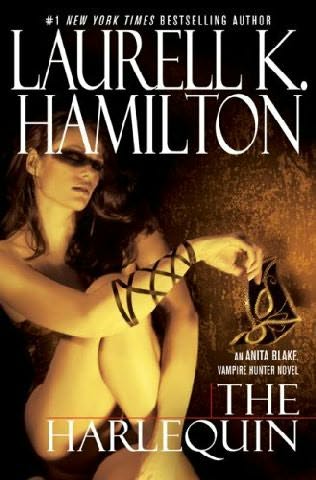
Oh yeah. The fact that it's hardcover only means that I can take that picture off, which slightly compensates for the fact that this stuff sells at typical hardcover price. Which I paid. Because once I knew it was out, I couldn't wait for it to get to the library. Or to paperback.

And I'm not really sure why.

This is about book 15 in the Anita Blake Vampire Hunter series, and it's right in line with its immediate predecessors. And just as incredible. And I mean that literally. In-credible, as in unbelievable. But I keep reading them.

Anita Blake started as a necromancer, who used her talents on a hired basis to raise zombies. In a move that makes me laugh, the most often repeat customers are lawyers, who need to find out where the will is hidden, or who the killer was, or some other matter of evidence and estate. Trust lawyers to hire zombies, eh? At the start of the series, Anita did that job full time, while occasionally serving as a consultant to the police on crimes committed by non-humans. She had studied vampires and the "furry community" (meaning all those were-animals), and was able to provide more information than the police had on their own. Her necrotic abilities gave her some psychic powers not ordinarily available either, and for the first half dozen or so books, she primarily solved violent preternatural crimes. She started out with a boyfriend (Richard) who had caught lycanthropy from a vaccine, and was twisted with self-hatred for what he viewed as the monster in him. She was also avoiding being courted by Jean-Claude, a powerful vampire--since part of her job involved killing vampires convicted of a crime, it seemed like a conflict of interest. Plus, she saw vampires as monsters herself.

And the violence was a big part of all of this. Lots of blood, lots of gore, lots of scary scary monsters and magic and violence. I am not a big fan of violence, and I don't find blood to be anything but offputting. As the books went on, Hamilton seemed to find herself in a bind--the books demanded escalating violence, but there were only so many ways to do that, and she was running out of ideas. She had to change something, and so she switched to sex.

Which is not to say there isn't any blood--there's still a LOT of that. Psychotic mercenaries, serial killing vampires, were-animals with anger issues and powerful claws--someone usually ends up dead one way or another, which is typical for thriller kind of novels: science fiction/vampire thriller detective novels, I guess, which is (oddly enough) a growing genre. But increasinly, the focus is on the relationships between the characters--personal relationships, sexual relationships, political alliances, and the way the different powers of the different preternaturals combine and divide.

Which is maybe why I like these--Hamilton takes time to show that werewolves are organized differently than leopards would be, based on the survival tactics of the animals. Vampires have laws that govern their behavior--reasonable, given that they are essentially immortal, inhumanly powerful, and capable of creating their own armys of completely loyal vampires--so vampire relations are marked by deceit, cunning, hidden agendas, and political maneuvering. When vampires of different strengths and powers get together, there is strict protocol which cannot be ignored for any reason. Meanwhile, the werewolves only respect physical dominance and simply fight out their differences.

We see Anita come to accept that humanity inherent in the different preternaturals--accepting that the "monsters" are not necessarily monstrous. Although they are just as capable of inhuman acts as humans are. She falls in love with Jean-Claude, and grows over the course of the books in ways she would never have imagined at the start. She thought, at the beginning, that she could be happy married to Richard, living the white picket fence life--maybe. But as time goes on, she finds that his self-loathing gets in the way of his ability to accept her and the way her live has developed. In this most recent book, it looks like the two of them may break up for good--one that has been a long time coming, in the way it happens in real life too.

Sure, realism isn't a big thing in these books. For example, it's a little hard to accept that Anita has all the different powers she has gained over time--apparently, no one in this alternate history have had as many different types of affinity for were-animals (without being one herself), or such strong vampire powers (without being one herself), or the ability to form power triumvirates with other species while remaining technically human. But some of the emotional power of these books feels true--true enough for fiction, anyway.

Interestingly, despite the growing populations of all these different meta-humans, we still see a lot of prejudice and hatred, which spices up the pot. The head of the Preternatural Crimes Team is completely squicked out that Anita is "dating" a vampire--as she "dates" more and more different men/creatures, he can't stand to even look at her and doesn't call her onto cases any more. When they are thrown together--as they are in this book--he can't stop himself from interrogating her about her personal life, even as there are preternatural criminals to catch. Richard can't stand how Anita is comfortable with the "monsters" and lives a life that involves sleeping with far too many different men. He is possessive, significantly homophobic, and unwilling to acknowledge that maybe. . .just maybe. . .he's stuck with the life he has. Anita is learning to accept that her life is going to have to be unlike the one she thought she would have--it's the nature of what has happened to her. Richard cannot. And again--that feels like a real emotional battle.

So, I guess I'm going to keep reading these, and being embarrassed by the fact that I do. Maybe I'll come to some form of acceptance too. . .you never know.

First Among Sequels, by Jasper Fforde


I can't believe I haven't written about this one yet. I adore Jasper Fforde. If you are, like me, a geeky English major, there is nothing funnier than The Eyre Affair, the original Thursday Next adventure. Set in a highly literary "alternative history," the Thursday Next series stars Our Heroine, a lowly government worker in the SpecOps department. Her beat? Counterfeit classics--a truckload of Spenser with a street value of millions? She'll stop it. Need help verifying a lost Shakespeare play? She's got the equipment. If it's written in ball point pen in a lined, spiral bound notebook. . .authenticating is the easy part. Convincing the owner is the hard part.

It is clear that Fforde loves literature, and he loves words. He has created a version of England that is populated with the kind of literary groupies most of us wish we could be. Door to door evangelists for the theory that Francis Bacon wrote the Shakespeare plays. At diner booths, there are no juke boxes. Instead, there are "WillSpeak" machines: put in your coins and get a puppet reciting Shakespeare monologues.

Once you have accepted that this England is only tangentially related to our world, the pseudoscience of it becomes even funnier. Reverse bioengineering has created a world in which woolly mammoth migrate through back gardens, and there are no ducks, but dodos are wonderful pets. Thursday's father is a member of the ChronoGuard--time travelling policemen who enforce history. Thursday's father has gone rogue, and the Guard are after him.

According to Fforde, time-travel is hard to write. The inconsistencies start to pile up, and after about the third book, he was making promises to himself that he would never write any more time-travel books. First Among Sequels is his delivery on that promise.

He had to finish up the plot lines he had started, which took him until book 4 of the series. This latest is either Book 5 of the old series, or Book 1 of a new series, and in it he writes himself free of the ChronoGuard permanently. Which is really all you need to know about the plot.

Because the plot is the engine that steams you through the book, but the fun is in the details. It helps if you've read a lot of classical/canonical fiction, because then the jokes are funnier. I happened to have gotten Cold Comfort Farm from Mr. Sweetie for my birthday, and so Fforde's comment about "something nasty in the woodshed" made more sense to me than if I hadn't read it. But you don't have to be particularly well read to appreciate that the bad guy's name is Jack Schitt.

And don't ask, just go to www.jasperfforde.com for the complete post-reading experience!

Sunday, October 07, 2007

John Adams, by David McCullough--Part I


This is still on my TBR (To Be Read) pile, as I am working my way through it. S-l-o-w-l-y. Because it is non-fiction of the drier sort. Unlike The Glass Castle, reviewed below, John Adams does not aspire to novelistic elegance. This is history, and the goal is to put in ALL the information.

Well, maybe not ALL of everything McCullough knows, since he's also published a book just about 1776 (called, creatively enough, 1776). But the goal here is to trace what all Adams did in his life, and the writing comes secondarily.

I picked this book up after having seen the play 1776 (no relation to the McCullough tome). In it, Adams and Thomas Jefferson on amiable colleagues, both seeking the same goal of independence. Yet my memory of their presidential histories is that they were quite vivid antagonists, and the brief period of Adams' presidency was Jefferson's vice presidency, and they fell apart decisively.

A not small reason for picking this up was also my father, who has indicated that he felt TJ was overrated, and Adams was unfairly uncelebrated. This intrigued me--my (admittedly somewhat limited) studies in history had made me admire TJ quite a bit, and of course I love Monticello--a man who did all the TJ did, at a relatively young age as well--how was he overrated?

Well, I'm about halfway through McCullough's book now, and I see where my dad is coming from. The timeline is post Declaration, but pre-Washington presidency. John Adams is stuck in Europe trying to get loans and recognition from European countries for this new nation. No one is really buying into the idea that America will stay independent. So, here's poor JA, away from his wife--AGAIN--being patronized by the French. And TJ is back home in Virginia, with his wife and family.

Then JA gets sent to Holland, to try to get some major bank loans to fund the new country--and nobody will even acknowledge him. And TJ is back home in Virginia, with his wife and family (and at some point fleeing the British, which is read contemporaneously as contemptuous). Here is JA, setting up the first American embassy in the world, while TJ is STILL home in Virginia.

Eventually, TJ comes to Paris to work with JA, and they are great friends. However, TJ just CANNOT stop shopping! He buys a big house, he buys fine clothes, he buys crates and crates of books, and gloves, and horses, and. . . and. . .and. . . Meanwhile, Abigail and her family come to France as well, and are barely making ends meet on their stipend from Congress. TJ is also short of funds, but doesn't seem to be able to make the connection that Lack of Funds + Compulsive Shopping = Debts. He laments his debts, he keeps careful track of each and everything he buys---but he never actually adds up the costs nor compares it to his income.

Then, JA is sent to the Court of St. James as the (first ever!) American ambassador to England. And boy, is he snubbed. The British firmly believe that the colonies will return to English rule--after all, why wouldn't they? So why take this silly little obnoxious man seriously? No one speaks to him, no one acknowledges him, no one is willing to discuss any trade or fishing rights or anything the new country needs to have to live. And TJ? Still off shopping in France.

TJ is even confronted (as he should be) about the hypocracy of insisting on independence for white men while continuing to hold slaves. His answer? Is only that if he freed his slaves, he could never pay back all his debts. . .

So, perhaps the romantic images of TJ as a giant among men is overstated. And John Adams worked tirelessly and without much salve for his ego to assure the success of the American Experiment, and his efforts really are not broadly understood. The precariousness of the new country is hard to understand from our point in history, and the fact that it succeeded at all probably has more to do with Adams' ceaseless efforts than with Jefferson's elegant Declaration.

So, we'll see how things progress. I have some hard feelings against JA for the Alien and Sedition Act he instigated, and how it was used. TJ, at least, didn't resort to silencing his critics--but again, it's hard to understand those times. That portion of history still lies ahead, and it will be interesting to see how McCullough handles that and Adams' appointment of the "Midnight Judges," which for all it's potential for abuse gave us the Supreme Court's balancing powers as we know them.

Saturday, September 29, 2007

The Glass Castle, by Jeannette Walls


I read this book for my book club--just like every other book club in America, it seems. All of us women slipping gracefully into a youthful middle age, reading books about how badly our parents' generation served its children. Well, as much as I like to be unlike everybody else, there are some books you just have to read to understand what is going on in the culture. So we read this.

First of all, this is a memoir, and I have to confess that I have failed to finish EVERY SINGLE book of non-fiction our group has selected. Sure, I believe you when you tell me Undaunted Courage by Stephen Ambrose is outstanding--I just can NOT make my way through it. The incredible story of an unlikely racehorse, Seabiscuit? Nope. Couldn't get past the second chapter, and I tried. I read the first chapter about five times, because as soon as I put the book down, I forgot what had happened. I have nothing by admiration for what it took to get that book written. . .but I just can't read it.

The Glass Castle was different. Perhaps it's the transparency of the writing, or the story-teller instincts of its author, but I managed to read this in near record time.

What is it about? What, are you the only person in the English speaking world who hasn't read this yet? Synopsis: Jeannette Walls, the second of four children of Rex and Rosemary Walls, grows up and out of her parents' bohemian incompetent household, while holding on to her memories of the good that happened, while looking with clear eyes at the bad.

The book starts with Jeannette having to confront her own feelings about her parents. While being driven to a meeting in Manhattan, the car passes her mother, who is digging through the trash barrels beside the road. Jeannette is so embarrassed by seeing her mother like this, and so ashamed and afraid that someone will connect the two of them, that she slides down in the seat of the car and orders the driver to take her back home. Later, she takes her mother out to lunch and tells her mother that it is humiliating to have a parent who shops in the garbage. Her mother is completely dismissive of her concern: 'You think too much about what other people think," she admonishes. And with this scene, the tone for the first half of the book is set.

Starting at age three, Jeannette recounts her life with her parents and their laissez faire parenting style. While trying to cook hot dogs by herself on the stove, Jeannette's nightgown catches fire and she spends a very long time in the hospital recovering from serious burns. Her father bundles her out of the hospital before she is discharged--and before he can billed for her care. Soon afterward, she is back making hot dogs on the stove because her mother doesn't feed her. The Walls family response seems to be "these things happen, and so now you know."

And the book careens on, with examples of what must surely be criminal neglect of the children by the parents. Rex Walls is a polymath with great dreams and a serious problem with alcohol. Rosemary is both his enabler and victim, never standing up to him, living him for his charm, living with the danger of his alcoholic rages. The family lives in the Southwest desert, sliding out of town whenever the debts get too big and the collectors get too close. For the early years of her life, Jeannette doesn't mind this life, and there is a flavor of Laura Ingalls Wilder about the experience. If Rex were trying to farm, or do anything to support his family, then the hardships and the moves and the primitive living arrangements might just be what life was like. But as time passes, it becomes apparent that--however charming they might be--these were two people who have no business raising kids.

Things get worse after Rosemary's mother dies, and that source of income disappears. The family moves into her house, but they have no more idea of how to run or maintain a house than a cat has, and it is soon overrun by insects and vermin, and starts to fall apart. Rosemary browbeats her husband into driving the family across the country to ask for financial help from his mother. They leave laundry on a line outside, so burglars will think someone is home and leave the house alone, and head for Appalachia.

Where we are shown--graphically--where Rex inherited his alcoholism. Mama Walls is every stereotype of hillbilly white trash you can imagine. She is so horrible that Rex and Rosemary run away, back to the house in the desert, leaving the four children with this angry, resentful, uneducated and alcoholic woman, who even molests the boy. There is no going back to the desert, because the laundry "security" didn't stop anyone from stealing anything that was left to be stolen, and Rex and Rosemary finally return to Appalachia.

Things continue to go from bad to worse--they move out of Mama Walls house and into a shack balanced precariously on the mountainside. There is no plumbing, just a toilet sitting on the ground under the house. There is a coal stove, but with Rex drinking any money that comes into the household, they can't afford coal. The stove explodes when they try to burn wood, and the resulting holes in the walls and ceiling are never repaired. Jeannette's brother uses a tarp for a blanket to stay dry. With no heat or insulation, dishes freeze into the sink over the winter. Garbage piles up in back of the house, and the rickety stair to the front door disintegrates.

Finally, the kids realize that their parents are never going to get them out of this place, so they make plans to move to New York--they take on odd jobs around town and save up to send the oldest daughter once she graduates from high school. There is the obligatory setback when Dad steals their coins for alcohol, but one by one the kids move to New York and find jobs, apartments with plumbing, and go about moving up.

Of course, the parents follow, and continue their self-destructive and irresponsible lives. Rex ends up in detox, gets a job at a resort in upstate New York, but returns at Rosemary's request because she misses him. He is soon drinking again, and the pair of them are soon homeless. Rex dies, but the oldest three kids have made stable lives for themselves. The youngest, Maureen, has grown up to repeat her parents' destructive pattern, and has disappeared somewhere in the West. By the end, there is hope that the oldest three kids will live productive and happy lives, and that Rosemary will simply continue in her own way.

I was surprised by the nearly universal dislike my book club had for this book. My dear friend Micki never has any patience with bad parenting in books, but that was not her complaint this time. Instead, she was unable to accept that this book was anything but highly fictionalized. "Embellished" may have been the word she used. She felt that the book was beyond what a child could have remembered, especially the earliest years.

The rest of the club found the story just to horrible to be "true." Whenever something bad could happen, not only did it happen, but it happened in the worst possible way and then got even worse than that. James Frey's name came up--the author of "A Million Little Pieces" was raked over the coals and his reputation was trashed because his "memoir" was really fiction--how had Jeannette Walls escaped that fate too?

I recuse myself from that kind of speculation, primarily because I do so badly at reading non-fiction. I don't feel qualified to weigh in on the "non-ness"of its fiction. Oddly, I did enjoy this book, probably because of its artificiality--it had a novelistic structure that resonated for me. The writing was clear and effective--there was one scene where Jeannette encounters a rat in their Appalachian shack that positively gave me the creeps. I do have a thing about rats, and she managed to press all those buttons.

In the end, it's an entertaining read, and raised a number of intriguing questions for me to ponder. How much "bad" parenting is really bad, if the result is someone like Jeannette Walls? If it was so bad, why is it that the youngest daughter, who escaped most of the difficulties of her upbringing, is unable to cope in the real world? If this had all taken place during the 1870s, instead of the 1970s, would this have been another Laura Ingalls Wilder pioneer story, rather than a 21st century book about dysfunction?

Really, what can we do about people who shouldn't have kids, but have them anyway? And where do we draw the lines? After all, one really can't predict what kind of parent one will be until the babies are born, and then what? People can learn and grow, and there is no single model for "successful parenting." And how would you define it anyway? By the results--the adults those kids become?

I found it a fascinating read, and it made me both question my own parenting (am I guilty of some of this?) and relax about it--after all, how bad a parent can I be, compared to these idiots? It's definitely worth the time it takes to read--which is not an endorsement I give lightly.

Monday, August 27, 2007

The Yiddish Policemen's Union, by Michael Chabon


I'm not sure why I liked this book so much, but I did, and I'd recommend it to just about anyone as a good literary detective novel. And yet. . .

The book is an "alternate history" (a genre that makes absolutely no sense, as it only identifies the form, and says nothing about the content), in which the displaced Jews of WWII were offered a home in Sitka, Alaska. With a large population of them in Alaska, there was less support for a Jewish homeland, and the infant state of Israel was crushed in a Middle Eastern war in 1948, and the survivors also came to Alaska.

However the offer of refuge was not permanent, and the Federal District of Sitka is scheduled to revert to the state of Alaska after 60 years. As the book opens, the reversion date is only months away, and there is no other place that will welcome the 2 million Sitka Jews.

The main character is Meyer Landsman, a homicide detective of the noirish cliche: he is divorced, drowning his pain in work and alcohol, living in a fleabag hotel. He rarely eats, can't sleep, and is awake when the night manager knocks on his door with the news that one of the hotel residents is dead.

The murder is of a thin young man, in his early 30s, a heroin addict who uses his tefillin to tie off. It is a terrible picture of religious ruination, and Meyer takes this case personally.

We are treated to the standard list of detective plot devices: his ex-wife is promoted to become his boss; official word is to label the case as unsolved and close it; Meyer Landsman refuses to comply; he drags his unwilling partner into the mess that comprises the case. We are given the slight cliche relief in that his partner is not days away from retirement, rather his wife is pregnant with their third child. Landsman finds connections to very powerful people, finds himself beaten, shot at, and running through the Alaskan snows in his underpants--because no fictional detective is ever able to solve a case without an unbelievable amount of physical abuse to his body. And I do mean unbelievable.

Even the title ends up in service of a cliche--Landsman loses his badge, so in order to question a reluctant witness, he flashes his Yiddish Policemen's Union membership card, in hopes that the witness can't read Yiddish and will believe he has some official position.

Eventually, Landsman finds a large scale conspiracy that goes all the way to the top. Yes, the evangelical American President is assisting the insular Verbover Jews of Sitka to blow up the Dome of the Rock, so the Temple of Jerusalem can be rebuilt and the Messiah return. Of course, to the Jews, Messiah hasn't come yet, but they want the Temple rebuilt as well.

Again, unbelievable, and written in a way that does not make the plot any more credible. Instead, it feels cobbled together, which is really a pity, because Chabon's writing is so good. Really, his ability to convey the paranoia of a famously paranoid peoples is outstanding. The Sitka settlement has its own industries, it's own law enforcement, it's own jargon to describe the various waves of immigration to the area. The Jews of the lower 48 refer to the Sitkans as "Icebergers," which actually cracked me up. The operating language of Sitka is Yiddish, but most of the residents are also fluent in "American," which they primarily use for it's swear words.

I found most intriguing the various social levels, and the internecine tensions between the various Jewish sects. The "Verbovers" are prosperous, insular, and ultra-Orthodox. Their prosperity is generated by smuggling, illegal arms sales, all the shadowy pursuits of organized crime. At the same time, all activity stops at Sabbath sundown, and even the most violent of the threats aimed at Landsman are immediately followed with "May you have a good Sabbath."

The Jews are, of course, not alone in Alaska. There are the "Indianers" who stand to profit with the reversion of Sitka, creating another level of tension the Jews live under. There is the disgraced Uncle Herz, who was a FBI spook for years, clandestinely using federal funds to fight for permanent status for Sitka, but was outed by the newspaper. There is also a series of father-son relationships that play out as well. Landsman feels responsible for his father's suicide many years ago; Johnny Bear/Berko Shemets sheds his Indian identity and converts to Judaism in an attempt to connect with his father; the Verbover rabbi who lost his only son to chess and drugs. The novel is rich in human relationships, which are ultimately the strength of the book, rather than the detective story plot.

Chabon's language is also delightful: evocative and playful. When describing a department store that has been empty for several years, Chabon describes where the store's name used to be as "the braille of failure." He describes a woman's eyebrows as "reaching for each other" or getting "entangled" as a way of describing her expressions. He is able to capture the many moods of snow, the kind that falls through the streetlights, the kind that melts as spring comes, the various shades of white and grey that are winter.

This is not the book for someone looking for a great mystery, but it is a wonderful read.

Saturday, June 23, 2007

Sabriel, by Garth Nix


This has been on my radar for a while, though I'm not certain where I heard about it. Possibly as a "Things To Read While Waiting For The Next Harry Potter" recommendation, possibly as a series that has a very solid fan base. Certainly, it has gotten some incredibly positive reviews.

I picked it up because I found it on CD at the library, and I really love good audiobooks on my iPod. This one is read by Tim Curry, who has a wonderful voice and it a very versatile actor. So, onto the iPod it went. And what can I say about this novel?

Tim Curry is a wonderful reader.

This is like saying that as a singer, Britney Spears is a good dancer.

I did not like this book at all. By the time I was through about a third of it, I was frantically Googling reviews to see why it was so damn popular. In the end, it has to be a matter of taste, but I was fundamentally disappointed.

The story, such as it is, is about eighteen year old Sabriel, who is newly graduated from a girls' school in Ancelstierre, which is very similar to post WWI England (Angleterre?). Her father is a sort of a necromancer who lives in the "Old Kingdom," a place that is kept separate from the rest of the world by a heavily militarized border, complete with machine guns, trenches, barbed wire and magic. The action begins when Sabriel's father doesn't turn up for a scheduled visit, and instead sends a sort of shadow zombie, to deliver his magic sword and bells. He is called Abhorsen, the Abhorsen, whose job is not to raise the dead, but to put them back down into death.

Sabriel takes her father's professional gear and goes to the Old Kingdom, blah blah blah quest, blah blah learns her role in the world, blah blah coming of age cakes. Which is as one would expect from this kind of novel--where I part company with the fans, however, is in the execution.

To start with, Nix has a crucial obligation to explain the difference between the dead, and The Dead. There is bound to be a lot of death in a book loaded with necromancy and machine guns, and there really needs to be some fundamental difference between the two. When our good guys die, Nix treats these deaths as the tragic and dispiriting losses that are necessary to avoid a greater evil. However, since the "greater evil" is that the dead then come back to life. . . I am no longer convinced that we have a convincing case for Good vs. Evil.

In point of fact, once one starts questioning the difference between the Dead and the living, the story devolves into a sort of racial battle--anti-mordicism, or something. The living don't want to die, and the Dead don't want to be dead. So everyone is basically trying to not die. The living eat fish and animals, and the Dead eat the living. Who then become animated Dead, as far as I can see.

Both living and Dead enslave living humans, and they both use the spirits of the dead to create servants. Sabriel's ancestors don't use reanimated corpses as servants, exactly, but they create "magical sendings," whatever those are, who have a human shaped form, behave like humans, and remain servants for centuries. They just don't fall apart from decomposition.

There is also a magic cat called Mogget, who is actually an enslaved magical being. He slips his bindings twice in the book, and both times turns into a vindictive and blood-thirsty magical cyclone, with an entirely different sets of goals, a different personality, and a raging hatred for the Abhorsen who have enslaved him, also for centuries. Yet, once magically recontrolled, he acts embarrassed about his behavior and seems to appreciate the civilizing influence of his enslavement. Ew.

Nix has a problem wielding this magical world as well, almost as if he is making it up as he goes along. There is a distressing lack of advance information: as soon as he introduces a magical item, or a new term, you can bet by the end of the chapter that item has become important. The most clumsy is his use of a magical ring. Sabriel is making plans to leave her father's house, and Mogget offers to come along. He then hacks up--not a hairball, but a magical ring. "You better have this, if I am to come along" he says. "You will know when you need to use it."

Yup. First thing that happens after they take off in a magical airplane is that Mogget gets free of his binding, and Sabriel uses the ring to rebind him. We then don't hear about the ring again until Mogget gets free again. This pattern is repeated over and over--"what's that thing chasing us?" "Oh, that's a [insert invented word here.]" "What do they do?" "Oh, they're only dangerous when [insert unlikely event here.]" "Oh no! [Unlikely event] is occurring!"

Yes, this is a first novel, and I should probably cut the writing some slack, but it is a bit overheated in a Lovecraftian way. There are lots of dead bodies stumbling around, and that's (I guess) unnatural, but rather than describing what is happening so we can imagine it, Nix loads the prose with heavily weighted adjectives. The Dead aren't just dead, they are routinely "foul," "obscene," "corrupted;" words that give moral rather than descriptive information. Which is probably a solution to the problem I noted above--that the living have no factual moral superiority over the Dead, so the bad guys need to be made bad by the adjectives.

Sabriel is the first of a trilogy of books about the Abhorsen--a trilogy that I am going to pass on, based on the current evidence.

Wednesday, May 09, 2007

The Lovely Bones--Alice Sebold


Oh my god, what an amazing book! I was so altered while reading this book, so caught up in the pitch perfect ambiance of grief, so moved by the pain that seeps from every paragraph--I can hardly speak rationally about this book. It is definitely one of the best books I have read this year.

In short, fourteen year old Susie Salmon is stopped on her way home from school one December evening, raped and murdered by a neighbor. She wakes up in heaven, where she can watch all the people she has loved as they deal with her death. Her body is never found, only a piece: an elbow. Her family grieves in different ways, different times of giving up hope, of letting her go. Susie watches for eight years and narrates how each person is altered by her death.

You have probably heard it said that the dead envy the living, and that is true of Susie, who had only her first kiss to open her eyes to the world of sexuality before she was murdered. She watches as the boy she kissed matures, and she still loves him. She watches her sister, only one year younger than she was, grow into the adult life Susie would never have. Her father is crippled by grief over her loss, and her mother hurts so much that she is afraid she will die and so she runs away from the family and from her overwhelming loss. Susie's little brother Buckley is only five when she is murdered, and he grows up in a family that has always been broken.

Although Susie knows her murderer, and her father becomes convinced of the man's guilt, there is never enough evidence to tie him to her death. By the time something is found, the man has left town and is never seen and recognized again. The lack of a body, the lack of a criminal trial all stand as metaphors for the unfinished business of grief they all feel.

It is a completely secular novel of death, loss and grief, which is unusual in some ways. The explicit descriptions of heaven and of the experience of dying and the afterlife owe nothing to a specific religious belief by any of the characters. Rather, it draws its inspiration from the almost purely cultural understandings we have of death. There is no judgment, there is no test, there is a heaven where the dead watch over the living. Even dogs get into heaven and recognize their owners.

But it is the overwhelming depiction of loss that makes this book so powerful. Susie's sense of loss is palpable, as she watches her friends move on and grow up into the lives she will never have. The tender pain of her father--at first he is broken by the murder, and then as time goes on, he learns to shelter his heart--causes the other children to shelter and protect him as much as they can. The family is bent around the hole that Susie's murder leaves, and it takes years for them to begin to live without the hole in the center of their lives.

I can hardly do this book justice in a review, because it is in the careful observation of pain and the sustained tone of the book that is its strength. This is a book everybody was reading a couple of years ago, and it is definitely one that lives up to that hype.

Tuesday, February 06, 2007

Thud!, by Terry Pratchett


What is there to say about Terry Pratchett? If you have read any of his Discworld books, then you know just about all you need to know about this one. If you haven't read any of his Discworld books, then you have missed the man who has inherited the mantle of P.G. Wodehouse.

Although, to be scrupulously fair, Pratchett's novels offer musings on ideas and issues more serious than whether Aunt Dahlia has pawned Uncle Tom's silver cow creamer. In this case, we are invited to consider the role of tradition and core values.

Thud! gives us Samuel Vimes as the main character. Vimes is one of the few truly good men in the entire Disc, a man who struggles to keep his corner of the world clean and honest. He is the head of the Night Watch, a ragged assortment of police officers who were once known for running after criminals, but not so fast as to actually catch them. Over the years, Vimes has created a Watch which does enforce the laws.

In this novel, Coombe Valley Day is approaching. This is the date marking the great battle between Dwarves and Trolls over a thousand years ago. There is no agreement as to which side started the fighting, nor is it clear who won. However, feelings run high and as the day approaches, the animosity begins to build. Citizens from the Dwarvish areas object to having a troll patrolman on the beat in their neighborhood. Vimes won't allow it--the Watch is THE Watch, and its members are officers, regardless of their race.

Suddenly, a dwarf is found murdered with a troll club nearby. The whispered order through the dwarves is "Don't tell the Watch. Vimes must not know, or he'll keep asking questions. . . ." Of course, Vimes does find out, and immediately starts asking questions. There is also a stolen painting of the Coombe Valley battle, which is said to provide a map to a buried treasure. Vimes ends up doing a bit of Da Vinci Code sleuthing and ends up in Coombe Valley.

In the end, the treasure of Coombe Valley turns out to be evidence that the Dwarves and the Trolls had come to make a peace treaty, but the leaders got stuck in a cavern and couldn't get out. The deepest down dwarves found out about it, and could not accept it--too much of their identity as dwarves depended on hating trolls. So the secret was to be destroyed, and the murdered dwarf was killed by his fellow leaders who objected to his plan to make the peace treaty public.

As always, the great joy of reading Terry Pratchett is his language. In a key scene, Sam Vines wakes up on the bank of an underground river where he has nearly drowned. The first thing he sees is a black hooded figure sitting on a folding chair. It is Death, and Vimes wants to know what he's doing there.

"You are having a near Death experience," Death says--Death speaks in all capitals, but I can't replicate that here. "Therefore, that means that I must have a near Vimes experience. But don't let me interfere. Do carry on; I have a book."

This is paraphrased, but is typical of the kind of cleverness that fills these books. At one point, Vimes comes upon unfriendly dwarves, but by then he has become so angry that he has had to miss his son's bedtime book, that he has gone literally berserk. The dwarves are stunned and frightened by this lone berserker warrior, who screams at them "WHERE IS MY COW? IS THAT MY COW?" The dwarves look at one another, as the berserker falls to his knees, pulls his hair and cries to the heavens "IT GOES BAAAAA. IT IS A SHEEP. IT IS NOT MY COW."

And really, that is very frightening when you think about it.

Friday, January 26, 2007

Special Topics In Calamity Physics, by Marisha Pessl


Well, this is a superhuman book. The internet and airwaves and traditional media have been awash in controversy over this debut novel. Is it being primed for success because it's author is good-looking? Is it really one of the 10 best novels of 2006, as the New York Times has declared? Does it break new ground in novel-writing, altering the form of the novel as we know it?

Well, it's a very good first novel. It's somewhat different from many of the books I have ever read, but not in a genre defying way. It's vigorous and it tries for something not often attempted. It may be deeper than it first appears.

The story is narrated by Blue Van Meer, a Harvard freshman who tells the story of her senior year of high school. Blue is the only child of a political science professor, who has spent the last ten+ years taking short term appointments at thrid tier colleges across the country. Much of Blue's life has been unmoored, and she and her father are unusually close as a result.

Blue is a hyper-educated girl, who has spent the years of her life with her father on long cross-country car trips from post to post, spending the time memorizing poetry, being quizzed on vocabulary--a life-long Baby Einstein project. As a result, she has read many many books, but she is inexperienced at life, and is intellectually as sheltered as she is physically encapsulated in her father's car. So, while she can quote and expound on just about any topic, she doesn't really understand what she has read--she has not truly become a critical thinker by any stretch.

This is in large part given the oversized character of her father. He is an academic who routinely derides the work of his peers to Blue, and is cynical about much of what life shows him. He sleeps through productions of "Our Town," he picks up and drops women in each of the towns they live in, he is given to nasty characterizations of anyone who does not live up to his standards--which is just about everyone. "A stale strawberry Sweet/Tart" he calls one, or he willd rive 20 miles out of his way to avoid eating in a place where "the people look like tires."

Given this outsized ego and harsh criticism, it is inevitable that his daughter would seek his approval and would parrot his own opinions back to him rather than risk her own, original thought to be decimated by his nasty wit. So Blue arrives at her senior year of high school with few or no critical faculties, and with a seriously inflated opinion of her father.

There is something very The Secret History (Donna Tartt, 1992) about Blue's new school--it's a prep school, where she falls into a group of wealthy, beautiful and louche students who circle around a charismatic teacher; in this case, the film studies teacher Hannah Schneider. The students are reluctant to bring Blue into their clique, but Hannah insists. Eventually, Blue finds herself changing her hair and clothes based on the "Bluebloods'" advice, she starts lying to her father about her whereabouts and spends her weekends drinking and wasting hours and hours with them and with Hannah and one night crashes one of Hannah's parties where a man dies.

The story moves on to a camping trip into the Smokey Mountains, and on the first night, Blue finds Hannah Schneider dead, hanging by an electrical wire from a tree. Blue is found by some hunters: the rest of the Bluebloods are lost for five days. The police rule the death a suicide; the others blame Blue for Hannah's death. Blue has reason to believe that Hannah was murdered, and spends the last term of her senior year trying to "solve" the case.

Up to this point in the book, everyone of Blue's assertions has been annotated with the books she has read--many of them apparently invented by the author. Once she starts her "research" into Hannah's murder, she quickly veers away from even the most questionable of printed material and onto the internet--many sites from "geocities" and "angelfire." Starting from a tip from a dotty Southern woman, Blue pieces together a conspiracy in which "Hannah Schneider" was a member of "The Night Watchmen," a radical protest group who may (or may not) have murdered a number of prominentbusinessmen they blamed for destructive business practices. Blue becomes convinced Hannah was murdered by a fellow member of the Night Watchmen because she had become a liability following the death of the man at her Halloween party.

Before she can return to Hannah's house to search for proof of this theory, she tells her father, and he listens to her--skeptically, pointing o0ut the weaknesses of her case, but in the end saying he is impressed by her logic. The next morning, when she wakes up, he is gone, his closet, medicine cabinet and study are empty, but the car is still in the driveway. There are new clues Blue uncovers, which make it possible that her father had lived their entire live as a lie, and was himself a member of the Night Watchmen. She finishes her senior year without telling anyone her father has left, but makes up a story that he is dying of throat cancer. She leaves town the day of her graduation and the book ends with a "Final Exam."

Looking back on the book a day or two after finishing it, I was struck by some things I had not really thought about while under the spell of the book. Perhaps Blue's father was the genius she thought he was, but then, why did he only accept jobs from third rate colleges in obscure areas? The bits of philosophy we hear from him is suspiciously gassy--a lot of hot air and pretention. Once I thought about that, especially in the context of Blue's conspiracy research, it seems that what we have here is a book with a first person unreliable narrator. Once I viewed the story through that lens, the book came together much more satisfactorily.

Gareth Van Meer is a damaged man--perhaps due to the loss of his wife in a car accident 10 years before, maybe even before that. He loves his daughter, but his most meaningful relationship is with himself. He is an accomplished, even pathological, liar. He quickly picks up women and dumps them just as quickly. He is burned out--his CV says he is working on a book which he not working on and has no intention of working on. He has safely insulated himself from adult relationships by focussing on his daughter, by taking only short term teaching assignments (no need to interact with other academics that way), by moving around the country. His possible "relationship" with Hannah (which he attempts to explain away to Blue) may be just one of many hidden relationships he's had over the years, covering up for them with invented dinners with pretend scholars. When Blue finally rebels, when she becomes a complicated human relationship and no longer a malleable child, Gareth clears out without a word or note. He leaves behind money and a car, but nothing of himself. He treats his daughter as he treats the "June Bugs," the women he picked up in each town.

On its face, this book is oddly constructed. We are warned about Hannah's death in the prologue, but about 85% of the book passes before it happens. Then the "twist"--the entire history of the Night Watchmen--is crammed into the last few chapters, but goes nowhere. Imagine if Dan Brown had written the Da Vinci Code like this--Sauniere wouldn't die until page 400, and the breaking of the code would happen in two chapters, but then the characters wouldn't go anywhere.

It doesn't make sense. If, however, you read the book as if the narrator is entirely unreliable, then you have a book like Scott Turow's Presumed Innocent--a book that is much more narratively satisfying if you assume the narrator is the murderer. Once you make that leap, the book looks entirely different. Likewise, assuming that Blue doesn't understand what is really going on because she is too bookish, and not sufficiently socialized to read human relations--then the book turns into a completely different read.

Perhaps a more recent analogy is with The Curious Incident Of The Dog In The Night Time, where the narrator is autistic, and has absolutely no ability to read human emotion or dynamics, and so he fails to understand what is going on around him until it is spelled out for him. Blue doesn't get the final explanation--that is left for us to do ourselves.

It's a well written book--a vivid and energetic book, abounding with wordplay and metaphor. the most commonly used phrase in the book is probably "as if"--signalling an always interesting metaphor. Pessl's use of creative verbs is engaging: a skirt is "jitterbugging" around someone's ankles, or something is "caterpillaring" across the ground. It reads like a precocious and academic college freshman would write, and is a good companion.

I did not read this book, but had it read to me--and in the spirit of full disclosure, I found Blue's father to be pompous and nearly unbearable, and that may have been an over-reaction based on the reader's characterization. On the other hand, maybe that's just exactly how he was.

Monday, January 22, 2007

Eldest, by Christopher Paolini


This is the sequel to Eragon, the second of a projected "Inheritance Trilogy." In this book, Eragon deals with the aftermath of the climactic battle that ended the first book; goes off to finish his training; and fights another climactic battle to end this novel.

As a sequel, it suffers from "sequel-itis," and/or "sophmore slump." Or, possibly, a much tighter production schedule, as it feels like a much more derivative work. Sure, I don't expect total originality from a swords-and-sorcerors tale, but this is a bit too flabby. Eragon leaves as the rebel forces are reorganizing, and flies off to Dagobah to be trained by Yoda. The training itself mixes yoga, meditation, and sun salutes with Karate Kid martial arts. Once he completes his training, he has Matrix like abilities to dodge arrows and stop time. The influences were, oh, rather OBVIOUS!

The entire training sequence takes place in this idyllic forest setting, and since so much of it is rather Zen-like, those sections lose any sense of tension or momentum. They are pleasant, but there is little sense that time is of the essence. Which is unfortunate, because the set up is that the rebels are going to attack before the Empire expects them to. So, while Eragon is "finding his center" and composing epic poetry (really!), there are theoretically feverish preparations for battle.

To give the kid his due, however, Paolini tries something new in this book, and braids together three stories: Eragon and his training; the rebels (the Varden) and their peparations; and the exodus of the people of Eragon's village. The Empire is seeking Eragon's cousin Roren, to use as a bargaining tool to bring Eragon into the king's power. When the assassins fail to capture Roren, they take his fiancee, and suddenly Roren is off on his own quest.

These sections work the best of the book, in my opinion, because once again we see someone who is merely ordinary, become extraordinary by virtue of the circumstances. Once Roren loses his love, he know he has no choice but to search for her. He becomes the leader of the village, largely because he has no other options. Paolini crafts a compelling character arc for Roren--once he realizes that he has no other choices, he stops debating or vascillating. The men of the village are discussing what to do about the siege of their town. There are many positions and many contingencies. After hours of debate with no conclusion, Roren is tired. He stands up, and says "I'm leaving tomorrow. Anyone who wants to may come with me." And then he leaves. No surprise, the whole town ends up coming too.

Roren's story is, perhaps, the most moving because he is an ordinary human. Eragon has a dragon, which gives him magic powers, and he's apparently a prodigy too. The Varden have their own magical sources--magicians and dwarves, who are not limited as humans are.

Roren doesn't have anything but himself, and his development into a leader is the most exciting part of the book, because it's actual character development. If Paolini allows himself to pull free of the lure of the invented languages, he could be an amazing author to watch.

Thursday, January 18, 2007

Eragon, by Christopher Paolini


I read these books because my children insisted that I had to. We saw the movie Eragon twice, and I couldn't read these books because I couldn't get them out of the kidlets' hands! So, I got Eragon as an audio book.

I started out with the plot line of the story from the movie, which is not so much a reading experience as a visual-aural one. Names, places, mythic figures--were pronounced and were unexceptional. Taking on Eragon as an audiobook, I was spared the eccentric spellings and pseudo-Scandinavian languages that litter the landscape of this series. Which I think made this series easier for me to accept, because I was not constantly battling with the annoying typography of this story.

Does anyone remember the great Ice Cream Renaissance of the late 1980s? That was the era when the world brought forth Haagen-Dasz and Frusjen Gladje--words that are sprinkled with unnecessary umlauts and punctuation that this font won't duplicate. Apparently, neither of those names are actually words--they are just made up. So too are the names of people and places and things in Paolini's books.

But, if you just listen to the book, as I did, you can simplify the task of pronounciation by simply doing it phonetically. No umlauts, no extraneous apostrophes scattered between consonants--it's much the easiest way to get into the books.

And they are really much better than I had expected. Sure, it helps to have professionals reading anybody's prose, but for being a teenager, Paolini's writing is smooth and polished. Unlike, say, Dan Brown's, which is so bad that it almost makes the Da Vinci Code unreadable. Paolini isn't striving for poetic effect, for "exceptional" writing. His sentences are like river rocks, rubbed smooth and thus they do not interrupt the flow of the story. This is not a small thing: there is a fatal tendency in much fantasy writing to invert verbs and nouns in an attempt to sound "medieval." Sword and sorcery heroes have a distressing tendency to say "I know not," or "Thou shalt be." Paolini avoids this--mostly.

Which is good, because he has written a ripping good yarn. Eragon is a classic quest novel, but one in which the adventure is varied and the moral teaching are not over-emphasized. Eragon lives a quiet life in a small farming village in a mountain valley, when he finds a large blue stone in the woods. He brings it home, thinking he could sell it--and it turns out to be a dragon's egg, which hatches.

So, Eragon is faced with the job of raising an animal he has to hide from his family. There is an element of many horse stories, and even of Charlotte's Web in his first relationship with the dragon. The dragon grows--quickly--and suddenly, Eragon is on the run for his life and the dragon's. He acquires a mentor, and they have a series of "road" adventures--seeing a large city for the first time, travelling across a desert, through mountain tunnels, basic survival and travelogue adventures. Simultaneously, he is learning about dragons--his relationship with his dragon develops in a way that other novels develop characters who are going to fall in love. They don't understand each other, but they are connected, and they show each other their strengths and weaknesses.

There are also battles--soldiers and trolls (called "Urgals" here) and scary nightmarish creatures as well. There is armor and sword fighting and clever escapes from pursuit.

But Paolini adds some detective story elements as well. Eragon is searching for the creatures who killed his uncle, but he doesn't just use tracking skills to find them--when he finds a vial they dropped, they go to track shipping records to determine where the item came from and how it got to where they found it.

I think that's what impressed me most about this book was the variety of things Paolini attempted. Eragon's journey criss-crosses his imagined continent, yet he is very careful to accurately portray the different stages of the seasons--both over time, and across ecosystems. He adds lightness to the story, with some clever characters who refuse to speak or act portentiously, even when predicting his future.

There is a degree to which Paolini has clearly read maybe a leetle too much Tolkein, there are four different languages, and he tries to develop the economic/religious/cultural foundations for all the various creatures he's created--the kind of obsessive geekiness that leads people to learning Klingon, for example. But on the whole, he pushes these elements to the backstory, letting the story itself take the lead.

Eragon is the first book in a projected trilogy, and the series is set up around a mano-a-mano battle between Eragon and the evil king Galbatorix. Part of the evil king's power comes from a wicked magic-worker called a shade. In the movie, we have numerous scenes where the king commands the Shade to do stuff for him, and the Shade tries and Eragon escapes and then there is yelling. And threats. Played by John Malkovich, Galbatorix is not just evil, but he's a scenery chewer too. He has an iron grip on the country, and is awesomely powerful, but seems to spend all his time alone in a dark room wearing his crown. The only person ever in his presence is this Shade.

Paolini plays a more subtle game, and I was pleasantly surprised. While much is done in the name of Galbatorix, the man himself stays off-stage for the entire book. The Shade also is scarcely present--he appears in the prologue, and in the final battle at the end of the book. The movie shows the Shade as a one-man handyman for Galbatorix. Someone has stolen his dragon egg, so Galbatorix tells the Shade to get it back. The Shade sends this group of bad guys after it, and then a different group of bad guys, then goes back to wherever and tortures an elf to get more information so he can send another group of incompetants. The threat builds up more credibly in the book, where the really bad stuff is only hinted at, and not seen.

The movie, as I review it after having finished the book--really flattened out the level of adventure. Eragon, the book, makes a point of how distance and time have to be managed at the level of technology available, and the entire book covers the better part of a year. The movie leaves the distinct impression that everything happened in about two weeks.

I was pleasantly surprised at how much I enjoyed Eragon, enough to pick up the even longer sequel Eldest.

Wednesday, January 17, 2007

My Apologies

Wow--I've just realized I've got mad long posts.

It's okay to skip around--there won't be any test.

Tuesday, January 16, 2007

The Mayor of Castorbridge, by Thomas Hardy


I "read" this book on tape, mostly in my car while running errands. This is important, because my responses to Michael Henchard (especially) were affected by the harsh tone the reader gave to that character. The gruff roughness of his voice made Henchard seem so much more brutal than the other characters in the story, and may have fatally affected my response to this book.

That said, I have a problem with this book, and with Thomas Hardy. The man plays with loaded dice. He is so intent on presenting the fatal downfall of the man, that he is really quite hamfisted.

In brief, the book starts at a country fair, where Michael Henchard, his wife and baby daughter arrive looking for work. Henchard gets drunk, picks a fight with his wife, and then offers to sell her and the baby to anyone willing to pay. A sailor takes the offer, and by the time Henchard sobers up the next morning, they are gone. Chapter two takes place some twenty years later, as Henchard is celebrating his election as the Mayor of the village of Casterbridge. His wife and daughter come into town, having lived the time with the sailor, who has been lost at sea. Susan feels obligated to seek out the husband who sold her, bringing her now grown-daughter, Elizabeth-Jane.

Elizabeth-Jane peeks into the inn and sees the celebration--and this is the high point of the novel. From here on, everything becomes sadder, poorer, lonelier. Henchard has worked hard over the intervening years, and has made a great success of himself. But because this is a Hardy book, nothing else will ever go right for him again.

It is this inevitability of fate that feels so contrived to me. The man who manages to work himself up from transient farm-hand to substantial man of property and town mayor is a man who has something that we never see in the resulting 17 hours of narration. The Henchard we come to know is a poor businessman, a violently emotional man, a man who carries a grudge long past the point where he alonw is the victim of his malice. He makes bitter enemies, he makes nothing but bad decisions, often fueled by his own hot-headedness, and then refuses to change course or even learn to avoid those sorts of errors. How this guy managed to not be killed in a bar brawl by 25 is beyond me.

If you assume that Henchard earned his place of distinction, his fall makes no sense. If you accept the character of the man as Hardy depicts his fall, there is no way to believe that he was ever so exalted. Plus, the man is so gosh-darned unlikeable, that I found it hard to care enough to finish the damn book.

I have seen several synopses describe the book as "Michael Henchard's attempt to atone for the sale of his wife." But that's not really what it is about. Instead, it is instead the story of Michael Henchard's bad temper. It was his drunken temper that lead him to sell his wife and daughter. It was his temper that alienated his former best friend, Donald Farfrae. It was his temper that led him into terrible business decisions as he tried to destroy Farfrae, but ruining himself instead. It should have been called "Michael Henchard's Terrible, Horrible, Awful, No Good Temper."

But there are other things that are troublesome. For instance, there is a vague morality that shifts about in order to make things the worst for Henchard. He sold his wife while drunk--bad enough--but then Hardy makes the point that Susan was too stupid to realize that she didn't have to go with the sailor. Frankly, I think it probably saved her life--Henchard would probably have killed her first and then died in a bar fight--and it seems that she was happy for those years without Henchard. Plus, it was brave of her to leave Henchard behind, and set out on an unknown life with a complete stranger. It was downright noble of her to stick to Henchard's bargain--this is not a woman who deserved to be made fun of as "simple" for following the sailor.

There is a contradiction too, in the way Hardy treats Lucetta Templeman. Henchard met Lucetta in Jersey, where their relationship created such a scandal that Lucetta could only rescue her reputation by marrying him. Henchard was prepared to propose, when Susan returned, and he felt morally obligated to resume that marriage. Lucetta comes into an inheritance and moves to Castorbridge, where she gets a eyeful of Henchard, and pretty soon recognizes that it would be a mistake to marry him. Instead, she meets and falls in love with Farfrae, and rejects Henchard's marriage proposal.

This is wrong of her, in the scheme of the book--she begged Henchard to marry her when she had no prospects and a ruined reputation. When her circumstances changed, and she had other options--she still should have married him because. . .I'm not sure why. Again, I'm sure Henchard would have been the death of her, and I'm totally in favor of a woman not being forced to marry a violent man. In one scene, Henchard enters Lucetta's house and threatens her until she promises to marry him--under the very real threat of serious physical harm, she makes a promise she does not want to make, just to get away from him. She then secretly marries Farfrae--both because she loves him, and to escape Henchard.

For this, Lucetta gets a terrible reputation! Not just in Casterbridge, but in a lot of critical reviews. Hardy treats this promise as binding--so what if she was afraid for her life? She made a promise, and she should have kept it! Compare this to Hardy's treatment of Susan--who believed herself to be bound by her word. A woman can't catch a break!

There is also a heavy handed use of coincidence. Sure, I'm willing to suspend a lot of disbelief in the context of a novel, but Hardy's coincidences are fuel for Henchard's bad temper, and thus they HAVE to happen, or Henchard wouldn't self-destruct. For example, Henchard decides (after Susan's death) to tell Elizabeth-Jane the truth: that he and Susan were married long ago, and that he, not the sailor Newson, is her father. No sooner does he decide to do this then he finds a letter written by Susan saying that Elizabeth-Jane is actually Newson's daughter, and "his" Elizabeth-Jane died years ago. Henchard's pig-headedness erupts in full force, and he decides he cannot bear to have Elizabeth-Jane in his house.

There are other examples, where Henchard decides to do something, only to find out in the literal next minute the exact and only thing that makes him change his mind completely. He gets so angry at Farfrae, that he tricks Farfrae into a fist-fight in which he fully intends to kill the man. Less than 2 hours later, Henchard is running across country to tell Farfrae that Lucetta is ill. Of course, Farfrae thinks it's a trick to send him into another ambush, and Henchard suffers immediate and complete remorse for his earlier fight.

So, I found myself not at all sympathetic to the Mayor of Casterbridge--the man was certifiable, and his downfall is unbelievable in part because there is no way such a volatile man would have risen the way he did.

There are some fascinating aspects to the work--aspects that get overwhelmed by Hardy's insistence on the arc of Henchard's life, but that are really quite wonderful. The detail of the country fairs, the civic celebrations, the rhythms of agricultural life in the era before mechanization--they all preserve a way of life that was gone by the time Hardy was writing.

Hardy does set up some elegant balances to his work: Henchard's stubborn clinging to tradition, versus Farfrae's curiosity about the future, for example; or Elizabeth-Jane's care to dress modestly versus Lucetta's extravagant cherry red costuming. There is a sensitive reporting of the different social and economic classes that exist even in the smallest of villages: the rustics who cling to superstition and tradition are carefully described. After Susan Henchard is buried, one of the rustics mentions that Susan had provided everything for her own funeral, even the four pennies for her eyes. One of the other rustics digs up the money, illustrating the desperate practicality of the poor over the sentiment available to the more well off.

I felt this way about Tess of the D'Urbervilles as well: the whole plot turns on the question of who is Tess's "true" husband: the man who raped her, or the man who married her? Even so, Tess's fate is not sealed until she murders D'Urberville. Really, once the blood seeps through the floor to drip from the ceiling below--it's hard to feel that Fate has ruined Tess's life, since she did such a nice job of setting herself up for the gallows all by her self.

There is an interesting article in last week's New Yorker about Thomas Hardy, calling him the novelist of the world in which God is dead. I don't agree: Hardy uses "Fate" to punish the wicked and the weak, and even the good end up damaged--but I don't see a material distinction between his "Fate" and many conceptions of "God." Men's fates are predetermined in Hardy's novel, and that's as God-like as John Calvin.

Monday, January 15, 2007

Great Expectations, By Charles Dickens


So, we discussed this book for my RL bookclub in December. I hadn't quite gotten to the end, but have since finished it up. Interestingly, I was reading this book while listening to The Mayor of Castorbridge and periodically taking up The Awakening by Kate Chopin. Great Expectations was written in approximately 1860. The Mayor of Castorbridge was written about 1889 and The Awakening was 1899. Of the three, Dickens is the most lively writer, and truly one who seems the most contemporary.

The book tells the story of young Phillip Pirrup, called Pip, starting at approximately age 7. He is cultivating his melancholy by reading the tombstones of his parents. He is met by a frightening specter of an escaped convict who frightens the boy into bringing food and a file to aid in his escape. The boy returns to his sister's house, where he lives, and manages to smuggle the goods to the convict. This experience has a profound impact on the boy, and he lives in fear that the convict will return and do him harm.

Not long afterward, he is sent to the home of the local wealthy eccentric, Miss Havisham, to provide her with distraction and to entertain her. Miss Havisham was abandoned on her wedding day by her groom, and has refused to make any changes in her house since then. The clocks have all stopped, she has never changed out of her bridal gown, the wedding feast remains on the dining table, now given over to the rats and spiders. (The traditional English wedding cake is a fruit cake, which I guess is how it has lasted all these years). Miss Havisham has an adopted daughter named Estella, whom she has raised to be incapable of love, so that she may take revenge on all men for Miss Havisham's loss.

At some point, Pip is contacted by a lawyer who tells him that he has an anonymous benefactor who wishes him to become a gentleman. Pip leaves his uncle (to whom he is apprenticed as a blacksmith) and heads to London to become a gentleman.

The story shows Pip as an outsider to everyone in his life. Once he is taken up by Miss Havisham, he becomes acutely embarassed by the relative poverty he lives in. He strives to be an acceptable companion to Estella, but never feels he does. Meanwhile, his desires for gentility move him away from being comfortable in his life as a blacksmith's apprentice. He attempts to educate himself, which makes him embarassed at how little he knows, and how much more he knows than those around him. He becomes unsuited to be a blacksmith, so when the anonymous benefactor appears, he is glad to get away.

In London, however, it becomes apparent how far he is from being a true gentleman. He takes up an apartment in a shabby hotel, in a seedy neighborhood. He studies with and corrupts the son of his new tutor, running them both into debt--Pip, at least, because he does not really know how to manage money, and he has no real occupation or calling. Always, there is the promise of great wealth to come to him, at some unknown time in the future.

Pip is convinced that his benefactor is Miss Havisham, and that she intends for him to marry Estella. He is deeply in love with Estella, and these are his "Great Expectations." Of course, expectations don't always materialize, and the last third of the book chronicles his downfall. Miss Havisham is not his benefactor--instead, it is the convict from his youth. Magwitch has been transported to Australia, and has made himself wealthy. He has come back to England (in direct violation of his sentence) to see the gentleman he has bought and paid for with his new wealth.

Pip is appalled, and feels honor bound to refuse any more money from the man. He further finds himself forced to smuggle the man out of England, lest he be caught and hanged. In the end, he comes to feel empathy and affection for the man, but Magwitch is caught, and his assets are confiscated to the crown. Pip returns home, thinking that he will marry a girl from the village, only to find that she has married his uncle. His love for Estella remains, although she has married a brute of a man, and Pip needs to pay off his debts and find a living for himself.

In the end, he takes a job in the company he (anonymously) helped his roommate to buy into. Years pass, he leaves England for the company, and he finds himself finally able to be comfortable with his lot as a working genteel man. He meets with Estella, who has left her brute of a husband, and there is the hint of a happy ending.

Of course, being that this is Dickens, there are far too many coincidences to be believable. Magwitch has a double, a criminal who has enough education and manners to make Magwitch the fall guy for his own schemes. This man, Compeyson, is also the groom who jilted Miss Havisham, who he only wooed to get access to her money. Magwitch turns out to be Estella's true father. There are more, but these suffice to make the point.

I haven't read much Dickens, but did recently read A Tale of Two Cities, and the writing is much better in Great Expectations. Sure, Tale of Two Cities has a killer opening sentence, as well as a killer last sentence, and how many books have that? "It was the best of times, it was the worst of times..." to "It is a far far better thing I do than I have ever done before." But inbetween, there is some of the sentimental claptrap ever committed to paper--and almost all of it uttered by his heroine, Lucy.

The women of Great Expectations, in contrast, do not fall into this trap. Miss Havisham could have been a similar character, eternally mourning the wedding she did not have. Instead, she is a virago, a nemesis, turned bitter and angry and enacting a cold plan for revenge against all men. Despite living amid the ruins of her dreams (and I can only think that even that is better than marriage to Compeyson would ever have been), she looks on these relics in a way that just makes her hate grow stronger.

Estella, too, is a cold and loveless woman--raised to be that way by Miss Havisham. She never varies from her charge to force men to fall in love with her, and then leave them. Even by the end of the book, after her disasterous marriage, she is not tender so much as she is bruised and regretful--hoping to find some better way of living and feeling, but not confident she can do it.

Pip's sister, "Mrs. Joe" is a bitter and selfish woman, all vinegar and bile. The woman who taught him to read, and who ends up marrying Joe, is kind and warm and loving in an entirely practical way. Pip's uncle Joe is a decent man, happy in his station, determined to do good to others and to live his life ethically. He is one of the few likeable people in Pip's life. The other is Wemmick, a man with two personalities: one at work, and one at home.

Pip himself is a cipher, and a rather obnoxious character. I found him not at all likeable, but given the precarious social position he has to live in his whole life, I found that unlikability to be realistic.

Dickens is also quite funny in this book--funnier than I tend to think of him being. Wemmick has an old, deaf father that he lives with and cares for, and refers to him as "Aged Parent," or "The Aged P." There is something so affectionately flippant about this that reminds me of P.G. Wodehouse. Some of the descriptions have the tartness of Jane Austen as well.

Take another glass of wine, and excuse my mentioning that society as a body does not expect one to be so strictly conscientious in emptying one's glass, as to turn it bottom upwards with the rim on one's nose.

I was always treated as if I had insisted on being born, in opposition to the dictates of reason, religion, and morality, and against the dissuading arguments of my best friends.

Who knew Dickens was so funny? I certainly didn't. Turgid, didactic, heavy on the Victorian morals and ethos--but not funny! Maybe I'd better go read Pickwick Papers, huh?

Anyway, this book has it all--humorous writing, gothic horror (Miss Havisham), tart women characters, foundling orphans, escaped convicts, theft and murder and hangings. You know, between the moral lessons, Victorian literature is quite lurid!


From The Stacks Challenge--Update

I'm now in the middle of January, and I thought I'd better check how I'm doing on my From the Stacks Challenge. And the results are mixed.

I finished two of the five books I said I'd read: the ones that my daughters insisted that I read. The adult books? I finished one, am still only halfway through the second and haven't touched the third.

Which is not to say I haven't been reading--I've even been reading books from my shelves! Some of them. However, most of the "reading" I've done in the last month has been audio books. Do those count? If I have the actual book in my stacks, even if I did acquire the audio book since the challenge has started? I may need to get a ruling from michelle on this.

Anyway, here's where it stands:

The Outsiders, by S.E. Hinton--FINISHED
The Enchanted Forest Chronicles--FINISHED
Broken For You, by Stephanie Kallos--FINISHED
The Awakening, by Kate Chopin--Half-way through and I haven't touched it for a month.
Love, by Toni Morrison--Not even off the shelf

Great Expectations, by Charles Dickens--FINISHED
The Mayor of Castorbridge, by Thomas Hardy (audio)--FINISHED
The Other Boleyn Girl, by Philippa Gregory (audio)--FINISHED
The Boleyn Inheritance, by Philippa Gregory (audio, abridged)--FINISHED
Eragon, by Christopher Paolini (audio)--FINISHED
The Adventures of Sally, by P.G. Wodehouse (audio)--FINISHED
Thank You, Jeeves, by P.G. Wodehouse (audio)--FINISHED
Eldest, by Christopher Paolini--Page 61 of 668

So, if I can amend my list, and substitute Great Expectations for The Awakening, and Eragon for Love, then I DID IT!

So, I guess I'd better post some reviews, pronto, before I forget everything I've read and have to start all over again!

Tuesday, January 02, 2007

The Other Boleyn Girl, by Philippa Gregory


My book group has chosen this book for our February meeting, and I've already finished it. I had actually read it about two years ago, but the REAL reason I'm already through it is that my dear sweetie got me an iPod for Christmas, AND an Audible.com account. I didn't read The Other Boleyn Girl, I had it read to me.

Being read to is a great delight, although it goes much slower than I am able to go myself. The balance comes from all the times I can't be looking at a book, but can listen: in the car, walking the dog, shopping, cleaning the kitchen and making dinner... But this is not a review of audiobooks, its about this particular book.

The Other Boleyn Girl is the story of Mary Boleyn, sister to the fated Anne, and also a mistress to Henry VIII during his marriage to Katherine of Aragon. Philippa Gregory takes what facts are known about Mary and Anne, and weaves a compelling story of the rise and fall of the Boleyn family. The book is fairly melodramatic, with loads of sex, betrayal, plotting, jostling for position, and some more sex. Nevertheless, there are some elements which feel absolutely accurate and believable:

Henry's seduction of Mary. Mary was very young when she became Henry's mistress; the book suggests she was about 14. She had already been married to a member of the king's train, but when Henry noticed her, her family pushed her forward and was rewarded with lands and commissions and titles. Gregory deftly presents the young girl's response: as a twelve year old wife, sex was something her husband did but she didn't understand. Dancing with Henry at a masque, his seductive banter made her breathless. Hell, if I had been fourteen, dancing with such a handsome man, who was king besides, I'd have totally fallen for him too.

Anne's character. Gregory gives us an Anne Boleyn who prided herself on being different, on standing out. Upon her arrival in the English court, Anne announces that she intends to be different--that every woman needs something to stand out from the crowd. Anne plans to be French--her dress, her headwear, her style.
This continues into her relationship with Henry, as she continues to provoke his interest with her contrast to his dutiful wife. Anne knows her fascination must continue to hold the king's interest, but the length of time it takes between his interest and their marriage means she must be fascinating and unreachable for five or six years. She did not dare lose him before marriage, as that would be the end of her ability to provide for herself, but once married, the toll of those years made her quick-tempered and screechy. Gregory makes the point that such a passionate woman is tempting to a passionate man, but that as Henry aged and weakened, her passion became wearying.

Fear and tyranny. In the course of trying Anne for adultery, incest, witchcraft and treason, it became apparent that in throwing off Rome, England had almost no protection from its ruler. There was no pope, no clergy, no check on Henry's claims that his wants were also God's will. Increasingly, the consequences of Anne's "success" come to appear horrible. If as good a woman as Katherine could be set aside, then no marriage was secure. If Henry were both the head of state and the head of the church, then he became the ultimate arbiter of what was treason and what was punishable by death. Before Anne's rise, it was treason to say out loud that Henry could not father a son. After Anne's fall, it became treason to even think it. And Henry was the judge of whether someone had so thought. What a convenient way to get rid of anyone who did not agree with anything the king wanted.

The enervation of court life. The court was the site of masques and dances and tournaments and feasts...for year after wearying year. As the years at court accumulate, the Boleyns all are visibly tired of keeping up the pace of unending, forced gaiety. Anne, burdened with her precarious position and the increasing physical toll of pregnancy, has to physically work harder as queen than ever before. George becomes less careful about his homosexuality, as it's just so much work, and he is feeling less and less that the struggle for position is providing him anything.

The headstrong King Henry. Crowned at age 18, Henry had been king for 27 years by the time Anne Boleyn was executed. He ruled a stable country with surplus money in the treasury, and was able to indulge his interests, leaving the work to Wolsey. The result Gregory portrays is a spoiled and pampered man, who has been flattered his entire life and as a result cannot understand why the one thing he needs--a son--has not been granted him. After all, he got everything else he wanted. Why not this? This is the sort of man who would take the huge step of breaking with the Pope to get what he wanted--and would continue discarding wives in the search for a son.

In both the book, and in real life, Mary Boleyn escapes court life entirely, living on a small estate in Kent with her "nobody" husband. She has two or three children, and her descendants themselves end up as leading families of the country. They are not "Boleyns," which may just be to their advantage as they are not flashpoints for controversy. Mary's daughter Catherine marries a courtier, and ultimately dies at Hampton Court Palace and is buried at Westminster Abbey--quite an honor. Catherine's daughter Lettice marries the first Earl of Essex, and is the mother of the second Earl of Essex, one of Elizabeth's greatest favorites. Lettice's second husband is Elizabeth's rejected suitor (but still a favorite of hers), Robert Dudley, Lord Leicester. Lettice is a great beauty, and extremely wealthy and considered a rival of Elizabeth's. Interestingly, Lettice lives to be incredibly old--95, well into the second Stuart monarchy.

I have picked up a couple of other Philippa Gregory Tudor-era novels, but didn't enjoy them as much as I did this one. Even so, when we went to London almost two years ago now, we found ourselves on our first day walking across the Tower Bridge, and right there, on the north end, was THE Tower of London, and one of the first features I saw was the "Traitor's Gate." I got goosebumps as the reality of these people and their lives swept over me. After 400+ years, it's easy to think of these people as fictional characters. But the events are true, and the buildings and gates and halls these people walked are still standing. It made it all startlingly current!

Wednesday, December 06, 2006

The Enchanted Forest Chronicles--Patricia C. Wrede

The Enchanted Forest Chronicles are my 10 year old's favorite books right now, and together serve as the third book in my From The Stacks Challenge. The series comprises four books so far: Dealing with Dragons, Searching for Dragons, Calling on Dragons; and Talking to Dragons. These are delightful fantasies which are empowering for girls without being heavy-handed.

Dealing with Dragons starts with the sad story of Princess Cimorene, one of 12 princesses in her family. Cimorene wants more substantive education than is generally allowed for a princess, and she manages to get some training in magic, fencing, Latin, and cooking before she is found out and forced to cease. Chafing at her restricted role, she finally runs away before she can be married to a handsome but terribly boring prince.

Cimorene finds herself becoming a dragon's princess, a post she wins since she can make cherries jubilee and knows a little Latin. She is "adopted" by a female dragon named Kazul, and finds the life to her liking. She runs the kitchen, catalogues Kazul's treasure, and organizes the library (where her Latin comes in handy). At first, she is bothered by princes and knights who feel obligated to rescue her and battle the dragon; she soon learns to direct them to the other dragon princesses who want to be rescued.

Throughout the books, the dragons and other inhabitants of the Enchanted Forest find themselves at odds with the Society of Wizards--classic robe wearing, staff carrying men who have no magic of their own, and so steal magic from others in order to increase their own power. Bit of male bashing? Perhaps, though balanced by the heroic King of the Enchanted Forest and his son Daystar in books 2-4.

Cimorene is an independent and strong character, who speaks her mind and knows what she wants. She is represented as different from "other princesses" and admired for it. Her dragon, Kazul, becomes King of the Dragons. Why not Queen? Queen of the Dragons is a stupid job, the dragons all agree, and nobody wants it. "King of the Dragons" is the name of the job, no matter who holds it. This is handled lightly and humorously, reinforcing the message that girls need not limit themselves to traditional roles.

Additionally, Wrede sprinkles in additional spins on traditional tales. In one book, the characters meet a farmer named McDonald who explains his modern methods of farming. "Not like my father, who did it the old way. A chicken here, a cow there, you can't make a living farming like that." (paraphrased).

These books are a pleasant diversion, entertaining and provoking rethinking of stories that we all thought we knew.

Broken For You-- Stephanie Kallos


This is my second book in the From The Stacks Challenge. It is the debut novel of this writer, and lives solidly in midlist fiction.

The story starts with Margaret Hughes, a woman who lives alone in a huge house in the expensive neighborhood in Seattle. She has decided to place an ad to find a boarder to share her house. She is concerned about how the others in her house will feel about a new person.

These "others" turn out to be hundreds of porcelain pieces that fill every room of her mansion. Margaret communes with these pieces, imparting personalities and relationships to soup tureens, tea cups and saucers. Margaret has a brain tumor and expects to die soon. She is divorced, her ex-husband has remarried, and their only child died many years ago in a car accident that her husband survived. Now she has retired to her house where she cares for all the antiques she inherited from her father.

Margaret's ad is answered by a young woman named Wanda Schultz, who is in Seattle searching for her boyfriend, who had announced he was leaving her in New York. She sold everything and uprooted herself to find him again. She believes she will find him in Seattle. Wanda is a stage manager who works most evenings. She and Margaret slowly begin to thaw toward each other, yet keep their own secrets close.

Wanda continues to look for her lost boyfriend while finding herself attracted to a stagehand who is really too good to be true. Margaret starts to go out of the house and finds herself a boyfriend. Margaret carries a secret--the porcelains were bought from Europe during World War II--likely stolen from Jewish families by Nazis. One day, Margaret looks at her wedding china, and realizes it means nothing to her but weighs her down. She bullies Wanda into helping her smash the entire set. Margaret begins to free herself from her guilt and shyness as she frees herself from her inheritance. The shattered fragment become the basis for Wanda's mosaic art, which drives the last third of the novel.

Wanda finds her boyfriend, and sees him with new eyes, and just as she finds herself free from him, she is hit by a car and sustains serious injuries. She has to give up her work as a stage manager, and she finds her way into doing mosaicsc.

About halfway through the book, we meet the man who is Wanda's father--who left her with his sister while he went to look for his wife, who left him. Wanda's father manages a bowling alley and becomes friends with an elderly Jewish lady who bowls twice a week. She brings him out of his shell, and he brings her out of her grief after her husband dies.

By the end of the book, Margaret has died, but her house by this time is full of people she has collected who now work to make Wanda's art possible. Wanda's father comes on as handyman, and they open an art school to teach mosaic techniques.

There is a great deal of writerly effort in this book. For example, Margaret's tumor is an "astroblastoma," which she calls "the star." One of Wanda's first mosaics is of Jewish children wearing the Nazi-required star on their coats. The china breaks into star patterns--we see repeating stars throughout the book. Similarly, many things are broken: china, bones, families, marriages. Throughout the book, the characters take the broken parts of their lives and put them together in new ways, just as the china is broken into tesserae and made into new art with a different meaning and use than before.

This was a well written book, with some engaging characters, but not an unqualified success. Wanda didn't come together as a character for me; alternately obsessed, whiny and cold, it was never believable to me why she persisted in persuing her ex-boyfriend, especially when she worked with a warm and wonderful man who cared for her and treated her with respect. There was never enough information for the reader to understand why Wanda spurned Troy throughout the book, even after she met up with her old boyfriend again. Nor is it clear why Troy loved her so much.

Margaret's childhood is portrayed: she was the adored daughter of a doting and genial father, with a distant and aloof mother. The father we see with young Margaret shares no characteristics with the avaricious Jew-hater he is painted to be in the latter half of the book. The story is also saddled with the ghost of Margaret's mother, which is inconsistent with the rest of the book, which operates without any other supernatural elements. Margaret never knew her mother, and the ghost that appears in her old age is just not consistent with what she would have known of her mother earlier.

There are some rapid and successful characterizations: Susan, the nurse who becomes a boarder in Margaret's house, is presented beautifully in her interactions with the children to whom she is the nanny. Within a few pages, I loved her and wanted her to live with me--even if she didn't take care of my kids. There is some very good prose about the nature of porcelain and the emotional attachements we make with inanimate things.

So, while I didn't fall completely into its spell, Broken For You was a book I found myself longing to return to. It's a satisfying read, and I'd look forward to more work by this author.