Wednesday, May 09, 2007

The Lovely Bones--Alice Sebold


Oh my god, what an amazing book! I was so altered while reading this book, so caught up in the pitch perfect ambiance of grief, so moved by the pain that seeps from every paragraph--I can hardly speak rationally about this book. It is definitely one of the best books I have read this year.

In short, fourteen year old Susie Salmon is stopped on her way home from school one December evening, raped and murdered by a neighbor. She wakes up in heaven, where she can watch all the people she has loved as they deal with her death. Her body is never found, only a piece: an elbow. Her family grieves in different ways, different times of giving up hope, of letting her go. Susie watches for eight years and narrates how each person is altered by her death.

You have probably heard it said that the dead envy the living, and that is true of Susie, who had only her first kiss to open her eyes to the world of sexuality before she was murdered. She watches as the boy she kissed matures, and she still loves him. She watches her sister, only one year younger than she was, grow into the adult life Susie would never have. Her father is crippled by grief over her loss, and her mother hurts so much that she is afraid she will die and so she runs away from the family and from her overwhelming loss. Susie's little brother Buckley is only five when she is murdered, and he grows up in a family that has always been broken.

Although Susie knows her murderer, and her father becomes convinced of the man's guilt, there is never enough evidence to tie him to her death. By the time something is found, the man has left town and is never seen and recognized again. The lack of a body, the lack of a criminal trial all stand as metaphors for the unfinished business of grief they all feel.

It is a completely secular novel of death, loss and grief, which is unusual in some ways. The explicit descriptions of heaven and of the experience of dying and the afterlife owe nothing to a specific religious belief by any of the characters. Rather, it draws its inspiration from the almost purely cultural understandings we have of death. There is no judgment, there is no test, there is a heaven where the dead watch over the living. Even dogs get into heaven and recognize their owners.

But it is the overwhelming depiction of loss that makes this book so powerful. Susie's sense of loss is palpable, as she watches her friends move on and grow up into the lives she will never have. The tender pain of her father--at first he is broken by the murder, and then as time goes on, he learns to shelter his heart--causes the other children to shelter and protect him as much as they can. The family is bent around the hole that Susie's murder leaves, and it takes years for them to begin to live without the hole in the center of their lives.

I can hardly do this book justice in a review, because it is in the careful observation of pain and the sustained tone of the book that is its strength. This is a book everybody was reading a couple of years ago, and it is definitely one that lives up to that hype.

Tuesday, February 06, 2007

Thud!, by Terry Pratchett


What is there to say about Terry Pratchett? If you have read any of his Discworld books, then you know just about all you need to know about this one. If you haven't read any of his Discworld books, then you have missed the man who has inherited the mantle of P.G. Wodehouse.

Although, to be scrupulously fair, Pratchett's novels offer musings on ideas and issues more serious than whether Aunt Dahlia has pawned Uncle Tom's silver cow creamer. In this case, we are invited to consider the role of tradition and core values.

Thud! gives us Samuel Vimes as the main character. Vimes is one of the few truly good men in the entire Disc, a man who struggles to keep his corner of the world clean and honest. He is the head of the Night Watch, a ragged assortment of police officers who were once known for running after criminals, but not so fast as to actually catch them. Over the years, Vimes has created a Watch which does enforce the laws.

In this novel, Coombe Valley Day is approaching. This is the date marking the great battle between Dwarves and Trolls over a thousand years ago. There is no agreement as to which side started the fighting, nor is it clear who won. However, feelings run high and as the day approaches, the animosity begins to build. Citizens from the Dwarvish areas object to having a troll patrolman on the beat in their neighborhood. Vimes won't allow it--the Watch is THE Watch, and its members are officers, regardless of their race.

Suddenly, a dwarf is found murdered with a troll club nearby. The whispered order through the dwarves is "Don't tell the Watch. Vimes must not know, or he'll keep asking questions. . . ." Of course, Vimes does find out, and immediately starts asking questions. There is also a stolen painting of the Coombe Valley battle, which is said to provide a map to a buried treasure. Vimes ends up doing a bit of Da Vinci Code sleuthing and ends up in Coombe Valley.

In the end, the treasure of Coombe Valley turns out to be evidence that the Dwarves and the Trolls had come to make a peace treaty, but the leaders got stuck in a cavern and couldn't get out. The deepest down dwarves found out about it, and could not accept it--too much of their identity as dwarves depended on hating trolls. So the secret was to be destroyed, and the murdered dwarf was killed by his fellow leaders who objected to his plan to make the peace treaty public.

As always, the great joy of reading Terry Pratchett is his language. In a key scene, Sam Vines wakes up on the bank of an underground river where he has nearly drowned. The first thing he sees is a black hooded figure sitting on a folding chair. It is Death, and Vimes wants to know what he's doing there.

"You are having a near Death experience," Death says--Death speaks in all capitals, but I can't replicate that here. "Therefore, that means that I must have a near Vimes experience. But don't let me interfere. Do carry on; I have a book."

This is paraphrased, but is typical of the kind of cleverness that fills these books. At one point, Vimes comes upon unfriendly dwarves, but by then he has become so angry that he has had to miss his son's bedtime book, that he has gone literally berserk. The dwarves are stunned and frightened by this lone berserker warrior, who screams at them "WHERE IS MY COW? IS THAT MY COW?" The dwarves look at one another, as the berserker falls to his knees, pulls his hair and cries to the heavens "IT GOES BAAAAA. IT IS A SHEEP. IT IS NOT MY COW."

And really, that is very frightening when you think about it.

Friday, January 26, 2007

Special Topics In Calamity Physics, by Marisha Pessl


Well, this is a superhuman book. The internet and airwaves and traditional media have been awash in controversy over this debut novel. Is it being primed for success because it's author is good-looking? Is it really one of the 10 best novels of 2006, as the New York Times has declared? Does it break new ground in novel-writing, altering the form of the novel as we know it?

Well, it's a very good first novel. It's somewhat different from many of the books I have ever read, but not in a genre defying way. It's vigorous and it tries for something not often attempted. It may be deeper than it first appears.

The story is narrated by Blue Van Meer, a Harvard freshman who tells the story of her senior year of high school. Blue is the only child of a political science professor, who has spent the last ten+ years taking short term appointments at thrid tier colleges across the country. Much of Blue's life has been unmoored, and she and her father are unusually close as a result.

Blue is a hyper-educated girl, who has spent the years of her life with her father on long cross-country car trips from post to post, spending the time memorizing poetry, being quizzed on vocabulary--a life-long Baby Einstein project. As a result, she has read many many books, but she is inexperienced at life, and is intellectually as sheltered as she is physically encapsulated in her father's car. So, while she can quote and expound on just about any topic, she doesn't really understand what she has read--she has not truly become a critical thinker by any stretch.

This is in large part given the oversized character of her father. He is an academic who routinely derides the work of his peers to Blue, and is cynical about much of what life shows him. He sleeps through productions of "Our Town," he picks up and drops women in each of the towns they live in, he is given to nasty characterizations of anyone who does not live up to his standards--which is just about everyone. "A stale strawberry Sweet/Tart" he calls one, or he willd rive 20 miles out of his way to avoid eating in a place where "the people look like tires."

Given this outsized ego and harsh criticism, it is inevitable that his daughter would seek his approval and would parrot his own opinions back to him rather than risk her own, original thought to be decimated by his nasty wit. So Blue arrives at her senior year of high school with few or no critical faculties, and with a seriously inflated opinion of her father.

There is something very The Secret History (Donna Tartt, 1992) about Blue's new school--it's a prep school, where she falls into a group of wealthy, beautiful and louche students who circle around a charismatic teacher; in this case, the film studies teacher Hannah Schneider. The students are reluctant to bring Blue into their clique, but Hannah insists. Eventually, Blue finds herself changing her hair and clothes based on the "Bluebloods'" advice, she starts lying to her father about her whereabouts and spends her weekends drinking and wasting hours and hours with them and with Hannah and one night crashes one of Hannah's parties where a man dies.

The story moves on to a camping trip into the Smokey Mountains, and on the first night, Blue finds Hannah Schneider dead, hanging by an electrical wire from a tree. Blue is found by some hunters: the rest of the Bluebloods are lost for five days. The police rule the death a suicide; the others blame Blue for Hannah's death. Blue has reason to believe that Hannah was murdered, and spends the last term of her senior year trying to "solve" the case.

Up to this point in the book, everyone of Blue's assertions has been annotated with the books she has read--many of them apparently invented by the author. Once she starts her "research" into Hannah's murder, she quickly veers away from even the most questionable of printed material and onto the internet--many sites from "geocities" and "angelfire." Starting from a tip from a dotty Southern woman, Blue pieces together a conspiracy in which "Hannah Schneider" was a member of "The Night Watchmen," a radical protest group who may (or may not) have murdered a number of prominentbusinessmen they blamed for destructive business practices. Blue becomes convinced Hannah was murdered by a fellow member of the Night Watchmen because she had become a liability following the death of the man at her Halloween party.

Before she can return to Hannah's house to search for proof of this theory, she tells her father, and he listens to her--skeptically, pointing o0ut the weaknesses of her case, but in the end saying he is impressed by her logic. The next morning, when she wakes up, he is gone, his closet, medicine cabinet and study are empty, but the car is still in the driveway. There are new clues Blue uncovers, which make it possible that her father had lived their entire live as a lie, and was himself a member of the Night Watchmen. She finishes her senior year without telling anyone her father has left, but makes up a story that he is dying of throat cancer. She leaves town the day of her graduation and the book ends with a "Final Exam."

Looking back on the book a day or two after finishing it, I was struck by some things I had not really thought about while under the spell of the book. Perhaps Blue's father was the genius she thought he was, but then, why did he only accept jobs from third rate colleges in obscure areas? The bits of philosophy we hear from him is suspiciously gassy--a lot of hot air and pretention. Once I thought about that, especially in the context of Blue's conspiracy research, it seems that what we have here is a book with a first person unreliable narrator. Once I viewed the story through that lens, the book came together much more satisfactorily.

Gareth Van Meer is a damaged man--perhaps due to the loss of his wife in a car accident 10 years before, maybe even before that. He loves his daughter, but his most meaningful relationship is with himself. He is an accomplished, even pathological, liar. He quickly picks up women and dumps them just as quickly. He is burned out--his CV says he is working on a book which he not working on and has no intention of working on. He has safely insulated himself from adult relationships by focussing on his daughter, by taking only short term teaching assignments (no need to interact with other academics that way), by moving around the country. His possible "relationship" with Hannah (which he attempts to explain away to Blue) may be just one of many hidden relationships he's had over the years, covering up for them with invented dinners with pretend scholars. When Blue finally rebels, when she becomes a complicated human relationship and no longer a malleable child, Gareth clears out without a word or note. He leaves behind money and a car, but nothing of himself. He treats his daughter as he treats the "June Bugs," the women he picked up in each town.

On its face, this book is oddly constructed. We are warned about Hannah's death in the prologue, but about 85% of the book passes before it happens. Then the "twist"--the entire history of the Night Watchmen--is crammed into the last few chapters, but goes nowhere. Imagine if Dan Brown had written the Da Vinci Code like this--Sauniere wouldn't die until page 400, and the breaking of the code would happen in two chapters, but then the characters wouldn't go anywhere.

It doesn't make sense. If, however, you read the book as if the narrator is entirely unreliable, then you have a book like Scott Turow's Presumed Innocent--a book that is much more narratively satisfying if you assume the narrator is the murderer. Once you make that leap, the book looks entirely different. Likewise, assuming that Blue doesn't understand what is really going on because she is too bookish, and not sufficiently socialized to read human relations--then the book turns into a completely different read.

Perhaps a more recent analogy is with The Curious Incident Of The Dog In The Night Time, where the narrator is autistic, and has absolutely no ability to read human emotion or dynamics, and so he fails to understand what is going on around him until it is spelled out for him. Blue doesn't get the final explanation--that is left for us to do ourselves.

It's a well written book--a vivid and energetic book, abounding with wordplay and metaphor. the most commonly used phrase in the book is probably "as if"--signalling an always interesting metaphor. Pessl's use of creative verbs is engaging: a skirt is "jitterbugging" around someone's ankles, or something is "caterpillaring" across the ground. It reads like a precocious and academic college freshman would write, and is a good companion.

I did not read this book, but had it read to me--and in the spirit of full disclosure, I found Blue's father to be pompous and nearly unbearable, and that may have been an over-reaction based on the reader's characterization. On the other hand, maybe that's just exactly how he was.

Monday, January 22, 2007

Eldest, by Christopher Paolini


This is the sequel to Eragon, the second of a projected "Inheritance Trilogy." In this book, Eragon deals with the aftermath of the climactic battle that ended the first book; goes off to finish his training; and fights another climactic battle to end this novel.

As a sequel, it suffers from "sequel-itis," and/or "sophmore slump." Or, possibly, a much tighter production schedule, as it feels like a much more derivative work. Sure, I don't expect total originality from a swords-and-sorcerors tale, but this is a bit too flabby. Eragon leaves as the rebel forces are reorganizing, and flies off to Dagobah to be trained by Yoda. The training itself mixes yoga, meditation, and sun salutes with Karate Kid martial arts. Once he completes his training, he has Matrix like abilities to dodge arrows and stop time. The influences were, oh, rather OBVIOUS!

The entire training sequence takes place in this idyllic forest setting, and since so much of it is rather Zen-like, those sections lose any sense of tension or momentum. They are pleasant, but there is little sense that time is of the essence. Which is unfortunate, because the set up is that the rebels are going to attack before the Empire expects them to. So, while Eragon is "finding his center" and composing epic poetry (really!), there are theoretically feverish preparations for battle.

To give the kid his due, however, Paolini tries something new in this book, and braids together three stories: Eragon and his training; the rebels (the Varden) and their peparations; and the exodus of the people of Eragon's village. The Empire is seeking Eragon's cousin Roren, to use as a bargaining tool to bring Eragon into the king's power. When the assassins fail to capture Roren, they take his fiancee, and suddenly Roren is off on his own quest.

These sections work the best of the book, in my opinion, because once again we see someone who is merely ordinary, become extraordinary by virtue of the circumstances. Once Roren loses his love, he know he has no choice but to search for her. He becomes the leader of the village, largely because he has no other options. Paolini crafts a compelling character arc for Roren--once he realizes that he has no other choices, he stops debating or vascillating. The men of the village are discussing what to do about the siege of their town. There are many positions and many contingencies. After hours of debate with no conclusion, Roren is tired. He stands up, and says "I'm leaving tomorrow. Anyone who wants to may come with me." And then he leaves. No surprise, the whole town ends up coming too.

Roren's story is, perhaps, the most moving because he is an ordinary human. Eragon has a dragon, which gives him magic powers, and he's apparently a prodigy too. The Varden have their own magical sources--magicians and dwarves, who are not limited as humans are.

Roren doesn't have anything but himself, and his development into a leader is the most exciting part of the book, because it's actual character development. If Paolini allows himself to pull free of the lure of the invented languages, he could be an amazing author to watch.

Thursday, January 18, 2007

Eragon, by Christopher Paolini


I read these books because my children insisted that I had to. We saw the movie Eragon twice, and I couldn't read these books because I couldn't get them out of the kidlets' hands! So, I got Eragon as an audio book.

I started out with the plot line of the story from the movie, which is not so much a reading experience as a visual-aural one. Names, places, mythic figures--were pronounced and were unexceptional. Taking on Eragon as an audiobook, I was spared the eccentric spellings and pseudo-Scandinavian languages that litter the landscape of this series. Which I think made this series easier for me to accept, because I was not constantly battling with the annoying typography of this story.

Does anyone remember the great Ice Cream Renaissance of the late 1980s? That was the era when the world brought forth Haagen-Dasz and Frusjen Gladje--words that are sprinkled with unnecessary umlauts and punctuation that this font won't duplicate. Apparently, neither of those names are actually words--they are just made up. So too are the names of people and places and things in Paolini's books.

But, if you just listen to the book, as I did, you can simplify the task of pronounciation by simply doing it phonetically. No umlauts, no extraneous apostrophes scattered between consonants--it's much the easiest way to get into the books.

And they are really much better than I had expected. Sure, it helps to have professionals reading anybody's prose, but for being a teenager, Paolini's writing is smooth and polished. Unlike, say, Dan Brown's, which is so bad that it almost makes the Da Vinci Code unreadable. Paolini isn't striving for poetic effect, for "exceptional" writing. His sentences are like river rocks, rubbed smooth and thus they do not interrupt the flow of the story. This is not a small thing: there is a fatal tendency in much fantasy writing to invert verbs and nouns in an attempt to sound "medieval." Sword and sorcery heroes have a distressing tendency to say "I know not," or "Thou shalt be." Paolini avoids this--mostly.

Which is good, because he has written a ripping good yarn. Eragon is a classic quest novel, but one in which the adventure is varied and the moral teaching are not over-emphasized. Eragon lives a quiet life in a small farming village in a mountain valley, when he finds a large blue stone in the woods. He brings it home, thinking he could sell it--and it turns out to be a dragon's egg, which hatches.

So, Eragon is faced with the job of raising an animal he has to hide from his family. There is an element of many horse stories, and even of Charlotte's Web in his first relationship with the dragon. The dragon grows--quickly--and suddenly, Eragon is on the run for his life and the dragon's. He acquires a mentor, and they have a series of "road" adventures--seeing a large city for the first time, travelling across a desert, through mountain tunnels, basic survival and travelogue adventures. Simultaneously, he is learning about dragons--his relationship with his dragon develops in a way that other novels develop characters who are going to fall in love. They don't understand each other, but they are connected, and they show each other their strengths and weaknesses.

There are also battles--soldiers and trolls (called "Urgals" here) and scary nightmarish creatures as well. There is armor and sword fighting and clever escapes from pursuit.

But Paolini adds some detective story elements as well. Eragon is searching for the creatures who killed his uncle, but he doesn't just use tracking skills to find them--when he finds a vial they dropped, they go to track shipping records to determine where the item came from and how it got to where they found it.

I think that's what impressed me most about this book was the variety of things Paolini attempted. Eragon's journey criss-crosses his imagined continent, yet he is very careful to accurately portray the different stages of the seasons--both over time, and across ecosystems. He adds lightness to the story, with some clever characters who refuse to speak or act portentiously, even when predicting his future.

There is a degree to which Paolini has clearly read maybe a leetle too much Tolkein, there are four different languages, and he tries to develop the economic/religious/cultural foundations for all the various creatures he's created--the kind of obsessive geekiness that leads people to learning Klingon, for example. But on the whole, he pushes these elements to the backstory, letting the story itself take the lead.

Eragon is the first book in a projected trilogy, and the series is set up around a mano-a-mano battle between Eragon and the evil king Galbatorix. Part of the evil king's power comes from a wicked magic-worker called a shade. In the movie, we have numerous scenes where the king commands the Shade to do stuff for him, and the Shade tries and Eragon escapes and then there is yelling. And threats. Played by John Malkovich, Galbatorix is not just evil, but he's a scenery chewer too. He has an iron grip on the country, and is awesomely powerful, but seems to spend all his time alone in a dark room wearing his crown. The only person ever in his presence is this Shade.

Paolini plays a more subtle game, and I was pleasantly surprised. While much is done in the name of Galbatorix, the man himself stays off-stage for the entire book. The Shade also is scarcely present--he appears in the prologue, and in the final battle at the end of the book. The movie shows the Shade as a one-man handyman for Galbatorix. Someone has stolen his dragon egg, so Galbatorix tells the Shade to get it back. The Shade sends this group of bad guys after it, and then a different group of bad guys, then goes back to wherever and tortures an elf to get more information so he can send another group of incompetants. The threat builds up more credibly in the book, where the really bad stuff is only hinted at, and not seen.

The movie, as I review it after having finished the book--really flattened out the level of adventure. Eragon, the book, makes a point of how distance and time have to be managed at the level of technology available, and the entire book covers the better part of a year. The movie leaves the distinct impression that everything happened in about two weeks.

I was pleasantly surprised at how much I enjoyed Eragon, enough to pick up the even longer sequel Eldest.

Wednesday, January 17, 2007

My Apologies

Wow--I've just realized I've got mad long posts.

It's okay to skip around--there won't be any test.

Tuesday, January 16, 2007

The Mayor of Castorbridge, by Thomas Hardy


I "read" this book on tape, mostly in my car while running errands. This is important, because my responses to Michael Henchard (especially) were affected by the harsh tone the reader gave to that character. The gruff roughness of his voice made Henchard seem so much more brutal than the other characters in the story, and may have fatally affected my response to this book.

That said, I have a problem with this book, and with Thomas Hardy. The man plays with loaded dice. He is so intent on presenting the fatal downfall of the man, that he is really quite hamfisted.

In brief, the book starts at a country fair, where Michael Henchard, his wife and baby daughter arrive looking for work. Henchard gets drunk, picks a fight with his wife, and then offers to sell her and the baby to anyone willing to pay. A sailor takes the offer, and by the time Henchard sobers up the next morning, they are gone. Chapter two takes place some twenty years later, as Henchard is celebrating his election as the Mayor of the village of Casterbridge. His wife and daughter come into town, having lived the time with the sailor, who has been lost at sea. Susan feels obligated to seek out the husband who sold her, bringing her now grown-daughter, Elizabeth-Jane.

Elizabeth-Jane peeks into the inn and sees the celebration--and this is the high point of the novel. From here on, everything becomes sadder, poorer, lonelier. Henchard has worked hard over the intervening years, and has made a great success of himself. But because this is a Hardy book, nothing else will ever go right for him again.

It is this inevitability of fate that feels so contrived to me. The man who manages to work himself up from transient farm-hand to substantial man of property and town mayor is a man who has something that we never see in the resulting 17 hours of narration. The Henchard we come to know is a poor businessman, a violently emotional man, a man who carries a grudge long past the point where he alonw is the victim of his malice. He makes bitter enemies, he makes nothing but bad decisions, often fueled by his own hot-headedness, and then refuses to change course or even learn to avoid those sorts of errors. How this guy managed to not be killed in a bar brawl by 25 is beyond me.

If you assume that Henchard earned his place of distinction, his fall makes no sense. If you accept the character of the man as Hardy depicts his fall, there is no way to believe that he was ever so exalted. Plus, the man is so gosh-darned unlikeable, that I found it hard to care enough to finish the damn book.

I have seen several synopses describe the book as "Michael Henchard's attempt to atone for the sale of his wife." But that's not really what it is about. Instead, it is instead the story of Michael Henchard's bad temper. It was his drunken temper that lead him to sell his wife and daughter. It was his temper that alienated his former best friend, Donald Farfrae. It was his temper that led him into terrible business decisions as he tried to destroy Farfrae, but ruining himself instead. It should have been called "Michael Henchard's Terrible, Horrible, Awful, No Good Temper."

But there are other things that are troublesome. For instance, there is a vague morality that shifts about in order to make things the worst for Henchard. He sold his wife while drunk--bad enough--but then Hardy makes the point that Susan was too stupid to realize that she didn't have to go with the sailor. Frankly, I think it probably saved her life--Henchard would probably have killed her first and then died in a bar fight--and it seems that she was happy for those years without Henchard. Plus, it was brave of her to leave Henchard behind, and set out on an unknown life with a complete stranger. It was downright noble of her to stick to Henchard's bargain--this is not a woman who deserved to be made fun of as "simple" for following the sailor.

There is a contradiction too, in the way Hardy treats Lucetta Templeman. Henchard met Lucetta in Jersey, where their relationship created such a scandal that Lucetta could only rescue her reputation by marrying him. Henchard was prepared to propose, when Susan returned, and he felt morally obligated to resume that marriage. Lucetta comes into an inheritance and moves to Castorbridge, where she gets a eyeful of Henchard, and pretty soon recognizes that it would be a mistake to marry him. Instead, she meets and falls in love with Farfrae, and rejects Henchard's marriage proposal.

This is wrong of her, in the scheme of the book--she begged Henchard to marry her when she had no prospects and a ruined reputation. When her circumstances changed, and she had other options--she still should have married him because. . .I'm not sure why. Again, I'm sure Henchard would have been the death of her, and I'm totally in favor of a woman not being forced to marry a violent man. In one scene, Henchard enters Lucetta's house and threatens her until she promises to marry him--under the very real threat of serious physical harm, she makes a promise she does not want to make, just to get away from him. She then secretly marries Farfrae--both because she loves him, and to escape Henchard.

For this, Lucetta gets a terrible reputation! Not just in Casterbridge, but in a lot of critical reviews. Hardy treats this promise as binding--so what if she was afraid for her life? She made a promise, and she should have kept it! Compare this to Hardy's treatment of Susan--who believed herself to be bound by her word. A woman can't catch a break!

There is also a heavy handed use of coincidence. Sure, I'm willing to suspend a lot of disbelief in the context of a novel, but Hardy's coincidences are fuel for Henchard's bad temper, and thus they HAVE to happen, or Henchard wouldn't self-destruct. For example, Henchard decides (after Susan's death) to tell Elizabeth-Jane the truth: that he and Susan were married long ago, and that he, not the sailor Newson, is her father. No sooner does he decide to do this then he finds a letter written by Susan saying that Elizabeth-Jane is actually Newson's daughter, and "his" Elizabeth-Jane died years ago. Henchard's pig-headedness erupts in full force, and he decides he cannot bear to have Elizabeth-Jane in his house.

There are other examples, where Henchard decides to do something, only to find out in the literal next minute the exact and only thing that makes him change his mind completely. He gets so angry at Farfrae, that he tricks Farfrae into a fist-fight in which he fully intends to kill the man. Less than 2 hours later, Henchard is running across country to tell Farfrae that Lucetta is ill. Of course, Farfrae thinks it's a trick to send him into another ambush, and Henchard suffers immediate and complete remorse for his earlier fight.

So, I found myself not at all sympathetic to the Mayor of Casterbridge--the man was certifiable, and his downfall is unbelievable in part because there is no way such a volatile man would have risen the way he did.

There are some fascinating aspects to the work--aspects that get overwhelmed by Hardy's insistence on the arc of Henchard's life, but that are really quite wonderful. The detail of the country fairs, the civic celebrations, the rhythms of agricultural life in the era before mechanization--they all preserve a way of life that was gone by the time Hardy was writing.

Hardy does set up some elegant balances to his work: Henchard's stubborn clinging to tradition, versus Farfrae's curiosity about the future, for example; or Elizabeth-Jane's care to dress modestly versus Lucetta's extravagant cherry red costuming. There is a sensitive reporting of the different social and economic classes that exist even in the smallest of villages: the rustics who cling to superstition and tradition are carefully described. After Susan Henchard is buried, one of the rustics mentions that Susan had provided everything for her own funeral, even the four pennies for her eyes. One of the other rustics digs up the money, illustrating the desperate practicality of the poor over the sentiment available to the more well off.

I felt this way about Tess of the D'Urbervilles as well: the whole plot turns on the question of who is Tess's "true" husband: the man who raped her, or the man who married her? Even so, Tess's fate is not sealed until she murders D'Urberville. Really, once the blood seeps through the floor to drip from the ceiling below--it's hard to feel that Fate has ruined Tess's life, since she did such a nice job of setting herself up for the gallows all by her self.

There is an interesting article in last week's New Yorker about Thomas Hardy, calling him the novelist of the world in which God is dead. I don't agree: Hardy uses "Fate" to punish the wicked and the weak, and even the good end up damaged--but I don't see a material distinction between his "Fate" and many conceptions of "God." Men's fates are predetermined in Hardy's novel, and that's as God-like as John Calvin.

Monday, January 15, 2007

Great Expectations, By Charles Dickens


So, we discussed this book for my RL bookclub in December. I hadn't quite gotten to the end, but have since finished it up. Interestingly, I was reading this book while listening to The Mayor of Castorbridge and periodically taking up The Awakening by Kate Chopin. Great Expectations was written in approximately 1860. The Mayor of Castorbridge was written about 1889 and The Awakening was 1899. Of the three, Dickens is the most lively writer, and truly one who seems the most contemporary.

The book tells the story of young Phillip Pirrup, called Pip, starting at approximately age 7. He is cultivating his melancholy by reading the tombstones of his parents. He is met by a frightening specter of an escaped convict who frightens the boy into bringing food and a file to aid in his escape. The boy returns to his sister's house, where he lives, and manages to smuggle the goods to the convict. This experience has a profound impact on the boy, and he lives in fear that the convict will return and do him harm.

Not long afterward, he is sent to the home of the local wealthy eccentric, Miss Havisham, to provide her with distraction and to entertain her. Miss Havisham was abandoned on her wedding day by her groom, and has refused to make any changes in her house since then. The clocks have all stopped, she has never changed out of her bridal gown, the wedding feast remains on the dining table, now given over to the rats and spiders. (The traditional English wedding cake is a fruit cake, which I guess is how it has lasted all these years). Miss Havisham has an adopted daughter named Estella, whom she has raised to be incapable of love, so that she may take revenge on all men for Miss Havisham's loss.

At some point, Pip is contacted by a lawyer who tells him that he has an anonymous benefactor who wishes him to become a gentleman. Pip leaves his uncle (to whom he is apprenticed as a blacksmith) and heads to London to become a gentleman.

The story shows Pip as an outsider to everyone in his life. Once he is taken up by Miss Havisham, he becomes acutely embarassed by the relative poverty he lives in. He strives to be an acceptable companion to Estella, but never feels he does. Meanwhile, his desires for gentility move him away from being comfortable in his life as a blacksmith's apprentice. He attempts to educate himself, which makes him embarassed at how little he knows, and how much more he knows than those around him. He becomes unsuited to be a blacksmith, so when the anonymous benefactor appears, he is glad to get away.

In London, however, it becomes apparent how far he is from being a true gentleman. He takes up an apartment in a shabby hotel, in a seedy neighborhood. He studies with and corrupts the son of his new tutor, running them both into debt--Pip, at least, because he does not really know how to manage money, and he has no real occupation or calling. Always, there is the promise of great wealth to come to him, at some unknown time in the future.

Pip is convinced that his benefactor is Miss Havisham, and that she intends for him to marry Estella. He is deeply in love with Estella, and these are his "Great Expectations." Of course, expectations don't always materialize, and the last third of the book chronicles his downfall. Miss Havisham is not his benefactor--instead, it is the convict from his youth. Magwitch has been transported to Australia, and has made himself wealthy. He has come back to England (in direct violation of his sentence) to see the gentleman he has bought and paid for with his new wealth.

Pip is appalled, and feels honor bound to refuse any more money from the man. He further finds himself forced to smuggle the man out of England, lest he be caught and hanged. In the end, he comes to feel empathy and affection for the man, but Magwitch is caught, and his assets are confiscated to the crown. Pip returns home, thinking that he will marry a girl from the village, only to find that she has married his uncle. His love for Estella remains, although she has married a brute of a man, and Pip needs to pay off his debts and find a living for himself.

In the end, he takes a job in the company he (anonymously) helped his roommate to buy into. Years pass, he leaves England for the company, and he finds himself finally able to be comfortable with his lot as a working genteel man. He meets with Estella, who has left her brute of a husband, and there is the hint of a happy ending.

Of course, being that this is Dickens, there are far too many coincidences to be believable. Magwitch has a double, a criminal who has enough education and manners to make Magwitch the fall guy for his own schemes. This man, Compeyson, is also the groom who jilted Miss Havisham, who he only wooed to get access to her money. Magwitch turns out to be Estella's true father. There are more, but these suffice to make the point.

I haven't read much Dickens, but did recently read A Tale of Two Cities, and the writing is much better in Great Expectations. Sure, Tale of Two Cities has a killer opening sentence, as well as a killer last sentence, and how many books have that? "It was the best of times, it was the worst of times..." to "It is a far far better thing I do than I have ever done before." But inbetween, there is some of the sentimental claptrap ever committed to paper--and almost all of it uttered by his heroine, Lucy.

The women of Great Expectations, in contrast, do not fall into this trap. Miss Havisham could have been a similar character, eternally mourning the wedding she did not have. Instead, she is a virago, a nemesis, turned bitter and angry and enacting a cold plan for revenge against all men. Despite living amid the ruins of her dreams (and I can only think that even that is better than marriage to Compeyson would ever have been), she looks on these relics in a way that just makes her hate grow stronger.

Estella, too, is a cold and loveless woman--raised to be that way by Miss Havisham. She never varies from her charge to force men to fall in love with her, and then leave them. Even by the end of the book, after her disasterous marriage, she is not tender so much as she is bruised and regretful--hoping to find some better way of living and feeling, but not confident she can do it.

Pip's sister, "Mrs. Joe" is a bitter and selfish woman, all vinegar and bile. The woman who taught him to read, and who ends up marrying Joe, is kind and warm and loving in an entirely practical way. Pip's uncle Joe is a decent man, happy in his station, determined to do good to others and to live his life ethically. He is one of the few likeable people in Pip's life. The other is Wemmick, a man with two personalities: one at work, and one at home.

Pip himself is a cipher, and a rather obnoxious character. I found him not at all likeable, but given the precarious social position he has to live in his whole life, I found that unlikability to be realistic.

Dickens is also quite funny in this book--funnier than I tend to think of him being. Wemmick has an old, deaf father that he lives with and cares for, and refers to him as "Aged Parent," or "The Aged P." There is something so affectionately flippant about this that reminds me of P.G. Wodehouse. Some of the descriptions have the tartness of Jane Austen as well.

Take another glass of wine, and excuse my mentioning that society as a body does not expect one to be so strictly conscientious in emptying one's glass, as to turn it bottom upwards with the rim on one's nose.

I was always treated as if I had insisted on being born, in opposition to the dictates of reason, religion, and morality, and against the dissuading arguments of my best friends.

Who knew Dickens was so funny? I certainly didn't. Turgid, didactic, heavy on the Victorian morals and ethos--but not funny! Maybe I'd better go read Pickwick Papers, huh?

Anyway, this book has it all--humorous writing, gothic horror (Miss Havisham), tart women characters, foundling orphans, escaped convicts, theft and murder and hangings. You know, between the moral lessons, Victorian literature is quite lurid!


From The Stacks Challenge--Update

I'm now in the middle of January, and I thought I'd better check how I'm doing on my From the Stacks Challenge. And the results are mixed.

I finished two of the five books I said I'd read: the ones that my daughters insisted that I read. The adult books? I finished one, am still only halfway through the second and haven't touched the third.

Which is not to say I haven't been reading--I've even been reading books from my shelves! Some of them. However, most of the "reading" I've done in the last month has been audio books. Do those count? If I have the actual book in my stacks, even if I did acquire the audio book since the challenge has started? I may need to get a ruling from michelle on this.

Anyway, here's where it stands:

The Outsiders, by S.E. Hinton--FINISHED
The Enchanted Forest Chronicles--FINISHED
Broken For You, by Stephanie Kallos--FINISHED
The Awakening, by Kate Chopin--Half-way through and I haven't touched it for a month.
Love, by Toni Morrison--Not even off the shelf

Great Expectations, by Charles Dickens--FINISHED
The Mayor of Castorbridge, by Thomas Hardy (audio)--FINISHED
The Other Boleyn Girl, by Philippa Gregory (audio)--FINISHED
The Boleyn Inheritance, by Philippa Gregory (audio, abridged)--FINISHED
Eragon, by Christopher Paolini (audio)--FINISHED
The Adventures of Sally, by P.G. Wodehouse (audio)--FINISHED
Thank You, Jeeves, by P.G. Wodehouse (audio)--FINISHED
Eldest, by Christopher Paolini--Page 61 of 668

So, if I can amend my list, and substitute Great Expectations for The Awakening, and Eragon for Love, then I DID IT!

So, I guess I'd better post some reviews, pronto, before I forget everything I've read and have to start all over again!

Tuesday, January 02, 2007

The Other Boleyn Girl, by Philippa Gregory


My book group has chosen this book for our February meeting, and I've already finished it. I had actually read it about two years ago, but the REAL reason I'm already through it is that my dear sweetie got me an iPod for Christmas, AND an Audible.com account. I didn't read The Other Boleyn Girl, I had it read to me.

Being read to is a great delight, although it goes much slower than I am able to go myself. The balance comes from all the times I can't be looking at a book, but can listen: in the car, walking the dog, shopping, cleaning the kitchen and making dinner... But this is not a review of audiobooks, its about this particular book.

The Other Boleyn Girl is the story of Mary Boleyn, sister to the fated Anne, and also a mistress to Henry VIII during his marriage to Katherine of Aragon. Philippa Gregory takes what facts are known about Mary and Anne, and weaves a compelling story of the rise and fall of the Boleyn family. The book is fairly melodramatic, with loads of sex, betrayal, plotting, jostling for position, and some more sex. Nevertheless, there are some elements which feel absolutely accurate and believable:

Henry's seduction of Mary. Mary was very young when she became Henry's mistress; the book suggests she was about 14. She had already been married to a member of the king's train, but when Henry noticed her, her family pushed her forward and was rewarded with lands and commissions and titles. Gregory deftly presents the young girl's response: as a twelve year old wife, sex was something her husband did but she didn't understand. Dancing with Henry at a masque, his seductive banter made her breathless. Hell, if I had been fourteen, dancing with such a handsome man, who was king besides, I'd have totally fallen for him too.

Anne's character. Gregory gives us an Anne Boleyn who prided herself on being different, on standing out. Upon her arrival in the English court, Anne announces that she intends to be different--that every woman needs something to stand out from the crowd. Anne plans to be French--her dress, her headwear, her style.
This continues into her relationship with Henry, as she continues to provoke his interest with her contrast to his dutiful wife. Anne knows her fascination must continue to hold the king's interest, but the length of time it takes between his interest and their marriage means she must be fascinating and unreachable for five or six years. She did not dare lose him before marriage, as that would be the end of her ability to provide for herself, but once married, the toll of those years made her quick-tempered and screechy. Gregory makes the point that such a passionate woman is tempting to a passionate man, but that as Henry aged and weakened, her passion became wearying.

Fear and tyranny. In the course of trying Anne for adultery, incest, witchcraft and treason, it became apparent that in throwing off Rome, England had almost no protection from its ruler. There was no pope, no clergy, no check on Henry's claims that his wants were also God's will. Increasingly, the consequences of Anne's "success" come to appear horrible. If as good a woman as Katherine could be set aside, then no marriage was secure. If Henry were both the head of state and the head of the church, then he became the ultimate arbiter of what was treason and what was punishable by death. Before Anne's rise, it was treason to say out loud that Henry could not father a son. After Anne's fall, it became treason to even think it. And Henry was the judge of whether someone had so thought. What a convenient way to get rid of anyone who did not agree with anything the king wanted.

The enervation of court life. The court was the site of masques and dances and tournaments and feasts...for year after wearying year. As the years at court accumulate, the Boleyns all are visibly tired of keeping up the pace of unending, forced gaiety. Anne, burdened with her precarious position and the increasing physical toll of pregnancy, has to physically work harder as queen than ever before. George becomes less careful about his homosexuality, as it's just so much work, and he is feeling less and less that the struggle for position is providing him anything.

The headstrong King Henry. Crowned at age 18, Henry had been king for 27 years by the time Anne Boleyn was executed. He ruled a stable country with surplus money in the treasury, and was able to indulge his interests, leaving the work to Wolsey. The result Gregory portrays is a spoiled and pampered man, who has been flattered his entire life and as a result cannot understand why the one thing he needs--a son--has not been granted him. After all, he got everything else he wanted. Why not this? This is the sort of man who would take the huge step of breaking with the Pope to get what he wanted--and would continue discarding wives in the search for a son.

In both the book, and in real life, Mary Boleyn escapes court life entirely, living on a small estate in Kent with her "nobody" husband. She has two or three children, and her descendants themselves end up as leading families of the country. They are not "Boleyns," which may just be to their advantage as they are not flashpoints for controversy. Mary's daughter Catherine marries a courtier, and ultimately dies at Hampton Court Palace and is buried at Westminster Abbey--quite an honor. Catherine's daughter Lettice marries the first Earl of Essex, and is the mother of the second Earl of Essex, one of Elizabeth's greatest favorites. Lettice's second husband is Elizabeth's rejected suitor (but still a favorite of hers), Robert Dudley, Lord Leicester. Lettice is a great beauty, and extremely wealthy and considered a rival of Elizabeth's. Interestingly, Lettice lives to be incredibly old--95, well into the second Stuart monarchy.

I have picked up a couple of other Philippa Gregory Tudor-era novels, but didn't enjoy them as much as I did this one. Even so, when we went to London almost two years ago now, we found ourselves on our first day walking across the Tower Bridge, and right there, on the north end, was THE Tower of London, and one of the first features I saw was the "Traitor's Gate." I got goosebumps as the reality of these people and their lives swept over me. After 400+ years, it's easy to think of these people as fictional characters. But the events are true, and the buildings and gates and halls these people walked are still standing. It made it all startlingly current!

Wednesday, December 06, 2006

The Enchanted Forest Chronicles--Patricia C. Wrede

The Enchanted Forest Chronicles are my 10 year old's favorite books right now, and together serve as the third book in my From The Stacks Challenge. The series comprises four books so far: Dealing with Dragons, Searching for Dragons, Calling on Dragons; and Talking to Dragons. These are delightful fantasies which are empowering for girls without being heavy-handed.

Dealing with Dragons starts with the sad story of Princess Cimorene, one of 12 princesses in her family. Cimorene wants more substantive education than is generally allowed for a princess, and she manages to get some training in magic, fencing, Latin, and cooking before she is found out and forced to cease. Chafing at her restricted role, she finally runs away before she can be married to a handsome but terribly boring prince.

Cimorene finds herself becoming a dragon's princess, a post she wins since she can make cherries jubilee and knows a little Latin. She is "adopted" by a female dragon named Kazul, and finds the life to her liking. She runs the kitchen, catalogues Kazul's treasure, and organizes the library (where her Latin comes in handy). At first, she is bothered by princes and knights who feel obligated to rescue her and battle the dragon; she soon learns to direct them to the other dragon princesses who want to be rescued.

Throughout the books, the dragons and other inhabitants of the Enchanted Forest find themselves at odds with the Society of Wizards--classic robe wearing, staff carrying men who have no magic of their own, and so steal magic from others in order to increase their own power. Bit of male bashing? Perhaps, though balanced by the heroic King of the Enchanted Forest and his son Daystar in books 2-4.

Cimorene is an independent and strong character, who speaks her mind and knows what she wants. She is represented as different from "other princesses" and admired for it. Her dragon, Kazul, becomes King of the Dragons. Why not Queen? Queen of the Dragons is a stupid job, the dragons all agree, and nobody wants it. "King of the Dragons" is the name of the job, no matter who holds it. This is handled lightly and humorously, reinforcing the message that girls need not limit themselves to traditional roles.

Additionally, Wrede sprinkles in additional spins on traditional tales. In one book, the characters meet a farmer named McDonald who explains his modern methods of farming. "Not like my father, who did it the old way. A chicken here, a cow there, you can't make a living farming like that." (paraphrased).

These books are a pleasant diversion, entertaining and provoking rethinking of stories that we all thought we knew.

Broken For You-- Stephanie Kallos


This is my second book in the From The Stacks Challenge. It is the debut novel of this writer, and lives solidly in midlist fiction.

The story starts with Margaret Hughes, a woman who lives alone in a huge house in the expensive neighborhood in Seattle. She has decided to place an ad to find a boarder to share her house. She is concerned about how the others in her house will feel about a new person.

These "others" turn out to be hundreds of porcelain pieces that fill every room of her mansion. Margaret communes with these pieces, imparting personalities and relationships to soup tureens, tea cups and saucers. Margaret has a brain tumor and expects to die soon. She is divorced, her ex-husband has remarried, and their only child died many years ago in a car accident that her husband survived. Now she has retired to her house where she cares for all the antiques she inherited from her father.

Margaret's ad is answered by a young woman named Wanda Schultz, who is in Seattle searching for her boyfriend, who had announced he was leaving her in New York. She sold everything and uprooted herself to find him again. She believes she will find him in Seattle. Wanda is a stage manager who works most evenings. She and Margaret slowly begin to thaw toward each other, yet keep their own secrets close.

Wanda continues to look for her lost boyfriend while finding herself attracted to a stagehand who is really too good to be true. Margaret starts to go out of the house and finds herself a boyfriend. Margaret carries a secret--the porcelains were bought from Europe during World War II--likely stolen from Jewish families by Nazis. One day, Margaret looks at her wedding china, and realizes it means nothing to her but weighs her down. She bullies Wanda into helping her smash the entire set. Margaret begins to free herself from her guilt and shyness as she frees herself from her inheritance. The shattered fragment become the basis for Wanda's mosaic art, which drives the last third of the novel.

Wanda finds her boyfriend, and sees him with new eyes, and just as she finds herself free from him, she is hit by a car and sustains serious injuries. She has to give up her work as a stage manager, and she finds her way into doing mosaicsc.

About halfway through the book, we meet the man who is Wanda's father--who left her with his sister while he went to look for his wife, who left him. Wanda's father manages a bowling alley and becomes friends with an elderly Jewish lady who bowls twice a week. She brings him out of his shell, and he brings her out of her grief after her husband dies.

By the end of the book, Margaret has died, but her house by this time is full of people she has collected who now work to make Wanda's art possible. Wanda's father comes on as handyman, and they open an art school to teach mosaic techniques.

There is a great deal of writerly effort in this book. For example, Margaret's tumor is an "astroblastoma," which she calls "the star." One of Wanda's first mosaics is of Jewish children wearing the Nazi-required star on their coats. The china breaks into star patterns--we see repeating stars throughout the book. Similarly, many things are broken: china, bones, families, marriages. Throughout the book, the characters take the broken parts of their lives and put them together in new ways, just as the china is broken into tesserae and made into new art with a different meaning and use than before.

This was a well written book, with some engaging characters, but not an unqualified success. Wanda didn't come together as a character for me; alternately obsessed, whiny and cold, it was never believable to me why she persisted in persuing her ex-boyfriend, especially when she worked with a warm and wonderful man who cared for her and treated her with respect. There was never enough information for the reader to understand why Wanda spurned Troy throughout the book, even after she met up with her old boyfriend again. Nor is it clear why Troy loved her so much.

Margaret's childhood is portrayed: she was the adored daughter of a doting and genial father, with a distant and aloof mother. The father we see with young Margaret shares no characteristics with the avaricious Jew-hater he is painted to be in the latter half of the book. The story is also saddled with the ghost of Margaret's mother, which is inconsistent with the rest of the book, which operates without any other supernatural elements. Margaret never knew her mother, and the ghost that appears in her old age is just not consistent with what she would have known of her mother earlier.

There are some rapid and successful characterizations: Susan, the nurse who becomes a boarder in Margaret's house, is presented beautifully in her interactions with the children to whom she is the nanny. Within a few pages, I loved her and wanted her to live with me--even if she didn't take care of my kids. There is some very good prose about the nature of porcelain and the emotional attachements we make with inanimate things.

So, while I didn't fall completely into its spell, Broken For You was a book I found myself longing to return to. It's a satisfying read, and I'd look forward to more work by this author.

Thursday, November 16, 2006

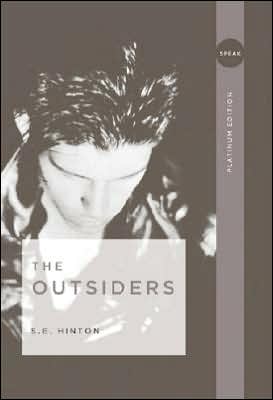
The Outsiders--S.E. Hinton


Okay, this is a book that most people read in junior high school. I first heard of it when I was in 7th grade (yes, back when dinosaurs still taught school--that long ago). One of the less stellar students gave his oral book report on it.

Did you know kids like this? This was the good looking guy who sat behind me in class, who NEVER brought a pencil or paper to class, always asked to "borrow" some from me--like I was ever going to get it back--and gave me no end of grief because I actually paid attention in class. So, I shouldn't have been surprised he liked The Outsiders so much. Actually, I think it was because he identified with it so obviously that I stayed away from it for so long.

The thing I remember the most was that he spent the entire review calling the West End kids "The Socks." "So then, Johnny got beat up by the Socks, so when the Socks came back that night..." It sounded like a bad day doing laundry.

Well now the Pony has read it for school--7th grade English--and she insisted that I read it too. So I did.

I won't bother summarizing the plot--you've all probably already read it years ago. I was struck, however, by how much it reminded me of West Side Story. So much so that I actually went back and looked up their respective histories. West Side Story came to Broadway in 1957; The Outsiders was published ten years later.

Both involve bands of boys who have organized themselves into gangs; with clearly demarked territories, with rules for fighting and a code of honor. Even when admitting to friendship with the scary Dallas, they stand up for their friends. The comparison was made explicitly to the doomed Southern gentlemen, riding off to certain death, in Gone With The Wind. Both The Outsiders and West Side Story are romances at heart--the gangs are softened, given high ideals and gentle souls: the romance of the doomed boys. I suspect the reality was less glamorous than that.

The Outsiders deals with class friction--there is none of the racial tension that fuels West Side Story--and raises the question of whether one should be proud of who you are, or whether you can escape what you are born into. The main character--Ponyboy Curtis--faces the question when he has to cut his hair to disguise himself. What did it mean that he had nothing else to be proud of except his hair and that he hung out with hoods? Was that worth being proud of?

Of course, there is the ever-present threat of the Socs--as nasty a group of madras wearing sociopaths as you'd ever meet. It might be interesting to see the story from the other point of view. I mean, assume that you are rich and handsome and you have great clothes and a great car and you rule your school. Why the hell would you go looking for some scrawny greasers to beat up? Why would you leave your side of town, your beer blasts and river parties and football practices and everything to pile into a car, go across to the poor side of town, and find some kids to beat up? As presented in the book, this happens frequently--and you really have to wonder why? What incites that kind of rage?

By midway through the book, there is a "you messed with my girl" kind of revenge battle, which at least is an attempt to explain why this would happen. It's not clear how these greasers are any kind of threat, or imposition, or even annoyance to these wealthy boys otherwise. Hinton does parse the reasons the greasers act like they do--Ponyboy asks most of them why they like to fight, as he is figuring out that he would prefer not to. There is hope that he will grow up and get out of the neighborhood--he's got good grades, he's a track star, he's actually bound for college, whether he knows it or not.

I have some quibbles: the three boys who die are almost literary cliches. Johnny was never going to grow up; he was too fragile for his environment. Like Little Eva in Uncle Tom's Cabin, he was too good for his world so he had to die. Dallas, too, was the cautionary tale character: watch out or this could happen to you--so he had to have some sort of violent end. Suicide by cop, and one can see the melodramatic end, where he stands under a streetlight and pulls an unloaded gun, then his body jerking with the force of the bullets hitting him. Just a bit over the top.

What it does do well, though, is to provide give a human voice to a character whose outer appearance doesn't match his insides. It's a way to talk about how all the characters--even the Socs--feel like outsiders. I think it would make for a fascinating study for kids who come from the metaphorical East and West sides.

Tuesday, November 14, 2006

Who Are The People In Your Neighborhood?

Can you sing it with me now?

"Oh, oh oh/Who are the people in your neighborhood?/In your neighborhood/In your Neigh-bor-hood/Say, who are the people in your neighborhood?/The people that you meet when you're walking down the street/They're the people that you meet each day!" (And thank you Sesame Street!)

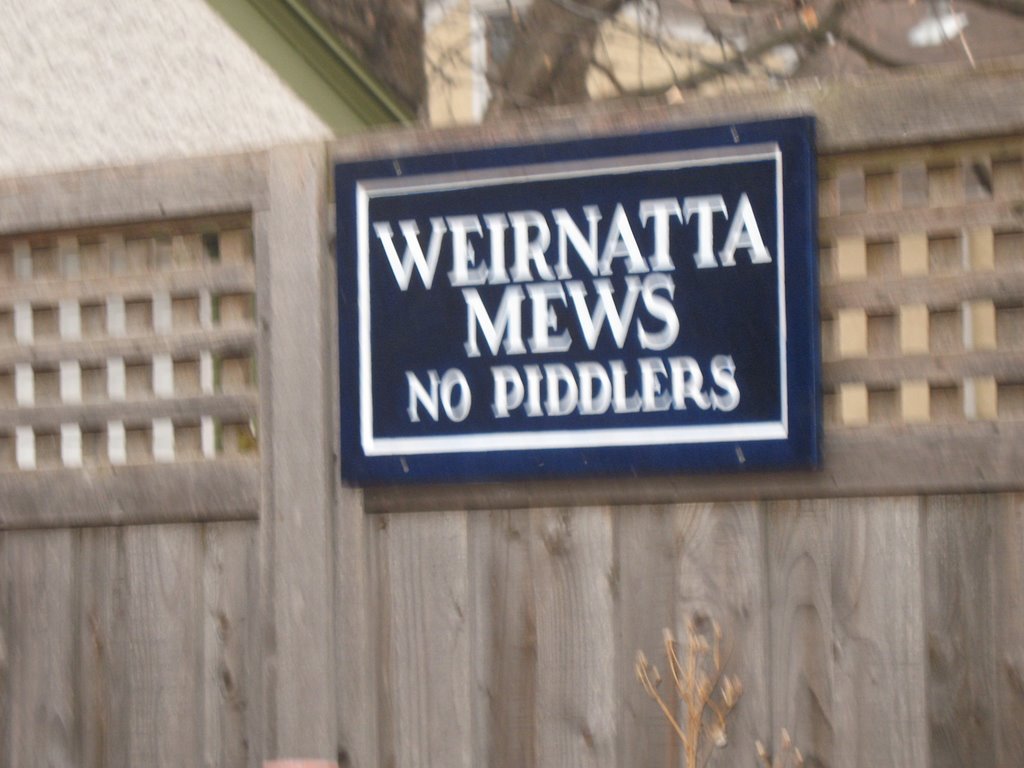
Apparently the people in my neigborhood are fond of puns. Bermondsey and I found this at the entrance to an alley while out on one of our walks. The picture is a little blurry, because Bermondsey kept tugging at the leash while I was trying to take the picture. And then we went the other way, because if there is something my dog is, it's a piddler.

Buying For Myself This Close to Christmas!?!?!

Well, yes, but I totally had to get this. It's a CafePress camisole from bookslut.com. I love the naked reader, with her cheeky expression, her Marion the Librarian hairdo, and her reading glasses.

It's probably not appropriate for the kidlets...but it sure amuses the hell out of me.

Photo courtesy of CafePress. All Bookslut merchandise may be purchased here.

Sunday, November 12, 2006

From The Stacks Challenge


Michelle at overdue books has posted a challenge to read 5 books from the books already on the shelves at home. After all, she says, you bought those books for a reason! Today, I officially signed up.

My list:

The Outsiders, by S.E. Hinton--Pony's recommendation.
The Enchanted Forest Chronicles, by Patricia C. Wrede--Bunny's recommendation
Love, by Toni Morrison
Awakening, by Kate Chopin
Broken For You, Stephanie Kallos.

Reviews to come!

Thursday, November 02, 2006

The Thirteenth Tale--Part 2


Well, I went ahead and finished this book, and to give credit where it is due, Setterfield stuck to her guns. She went ahead and kept to the ooky-spooky, pulling only one punch--rather than having two ghosts, she gave one a natural world explanation, but then she went full blown with the second one.

The time of the novel remains difficult to fix, although we do get intimations of telephones--but only when a storm blows the lines down, so it can't be used anyway. There is a brief scene with idled construction equipment--one of the crew uses his hands to mimic the biting motion of a steam shovel. So the odds are that this is supposed to be a modern day setting of what is essentially a high Victorian story.

Setterfield also acknowledges the artificality of this set up in a clever and knowing way. The narrator contracts a terribly high fever and collapses, waking up some days later in the care of the local doctor. His diagnosis? Too much reading of romantic fiction--Jane Eyre, Wuthering Heights, Sense and Sensibility. In the absence of poor nutrition or other privations of the sort suffered in the past, this patient will survive. He then (literally) prescribes Sherlock Holmes stories, to be taken twice a day until the course is complete.

There is a lot of blather about the mystic nature of twins and twinness, how a twin cannot be whole in the absence of the other. It makes for some arresting visuals, as one twin thinks she sees the other in her own reflections, but I am just too much a child of the scientific method to truly accept this Romantic idea. Twins, or more specifically, identical twins, were once "one" and divided into "two," but that division happens long before birth and brain development establishes each as individual.

Still--I enjoyed it. Setterfield has certainly digested her source material--we get a madwoman starting fires, one of which burns down the house and her in it. The governess doesn't marry the gentleman of the house, but she does marry someone. We get the secret keeping housekeeper who cares for a relative who is locked away and hidden from the narrator. And that is just Jane Eyre!

There is a delightful little inside joke--which would have been funnier if she hadn't explained it--where the governess thinks she sees the twins playing together, when one twin was definitely somewhere else. That night, the book on her nightstand is missing, replaced with "a novella by Henry James." Of course, that novella is "The Turn of the Screw" in which a nervous governess is convinced her charges are being followed by ghosts.

By the end, as Setterfield starts tying up the threads of her narrative, I was reminded of one of my all time favorite books: Possession, by A.S. Byatt. Byatt, too, ties things up a bit too neatly, with every orphan found a home, every document revealing its clues at precisely the right time. But a story like this calls for at least some endings to be happy. Byatt does a much better job of conveying the power of the authors she is creating than does Setterfield, but The Thirteenth Tale is a ripping yarn and fit to be enjoyed by the fireside this winter.

Tuesday, October 31, 2006

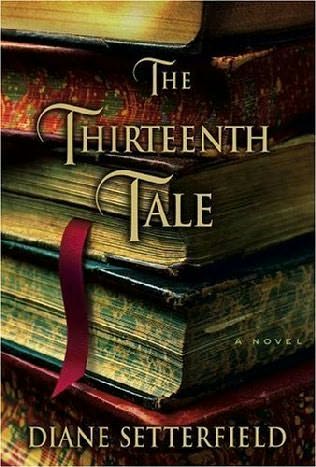
The Thirteenth Tale by Diane Setterfield


I came to this book because it is about the complex relationship between books and readers, sttrytellers and listeners, secrets and lies. The set-up is promising: a young, single woman works with her father in an antiquarian bookshop. Unexpectedly, she receives a letter from the most popular writer of all time. It is said that "Vida Winter's" sales are higher than that of the Bible, but God doesn't really keep track of the inventory.

One of Vida Winter's books is known as "The Thirteen Tales," but has only twelve short stories inside. Every interview she has given has a different story of her life, and the mystery that is Vida Winter has become one of the great conundrums of this fictional literary world. Now,the narrator has been invited to hear the true story of Ms. Winter's life. This would be the missing "Thirteenth Tale."

The tale unfolds in a damp Yorkshire house in winter. Vida Winter comes from a family of excessive emotions: her grandfather locked himself in the library for months after the death of his beloved wife; his two children had a sado-masochistic incestuous relationship of some unhealthy variation; when the daughter Isabelle was sent to a insane asylum her brother Charles lived like a beast one wing of the house and he killed himself upon hearing of her death.

Before she died, this daughter had eloped, bore twins, then returned to her childhood home a widow. These twin girls are "Vida Winter" and her sister, who have some sort of secret twin relationship that is distinctly disconcerting. The story plows on through foundling babies left on doorsteps, mysterious fires, rot and decay, adulterous affairs, ghosts and other metaphysical trappings. And I'm only just halfway through it. If this had been written by an American, it would immediately have been dismissed as "Southern Gothic," and a feeble pastiche of Flannery O'Connor and William Faulkner.

As half the book takes place in Yorkshire, I can't help but think of Wuthering Heights. The quasi-incestuous connection between the first Cathy and Heathcliff is echoed in the opaque relationship between Isabelle and her brother Charles. "Isabelle" is even a character's name in Wuthering Heights. The contrast between Wuthering Heights and The Grange is mirrored in the decay of "Angelfield" that is briefly reversed during the tenure of a governess. For a several months, cleanliness and order are imposed, lasting only until the governess abruptly leaves.

The book lacks the precise grounding of Wuthering Heights, the studied detail that made the operatic passions of those characters so unsettling. The Thirteenth Tale, thus far, seems to operate in a mist. There is no way to tell when this story takes place: no one uses the telephone, all communication occurs through letters. Transportation is by train and occasionally wagon, most often walking. The narrator transcribes her notes on reams of paper with pencil. There are no clacking typewriters, or humming laptops. No cars or airplanes or evidence of world events. Should I imagine the narrator striding through the story in the hobbled skirts of the late Victorian Age? Thus far the book does not definitively answer this question.

With that fundamental vagueness unresolved, it's hard to respond viscerally to the book's attempts at hauntings. Every day seems to be rainy and dark, every garden has no obvious layout, every house has unopened door, unasnwered questions, children who are abandoned. The unrelenting "ooky spooky"-ness of it undermines the books attempt to evoke curiosity about how the dead relate to the living, and how the living might as well be dead. It all takes place in an insubstantial dream world, and so the consequences feel just as vaporous as the morning residue of dreaming.

I'm going to keep going, but it is feeling like it's gearing up to some sort of Gothic revelation and surprise twist. We've grown disenchanted with M. Night Shymalan's twisty movies, and I'm expecting to be equally unmoved by the resolution of the Thirteenth Tale.

Friday, April 21, 2006

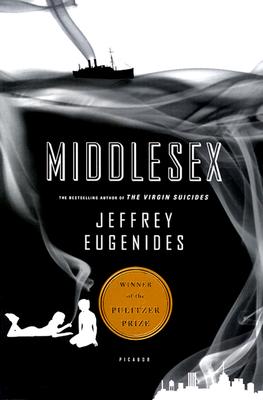
Middlesex--Jeffrey Eugenides


I read Eugenides' first novel The Virgin Suicides about a year ago, and was struck by how well written it was. The narration is in first person plural--something you don't see a lot of in current fiction--which had the effect of making me feel included in the story in a way I wouldn't have felt with a more traditional narrative voice. It has been pointed out that the narration acts like a Greek chorus as seen in classical Greek drama.

The Virgin Suicides is almost dreamlike in its telling of the story of five sisters in a strict Catholic family who are driven to kill themselves over a relatively short period of time. The narrator is actually the collective voice of all the young men, themselves on the cusp of puberty, who are fascinated by the mystery of all girls, and the glamorous tragedy of these in particular. The novel captures the confusion of adolescence, when young men are attracted to young women, while learning how little they understand them.

I was hoping for something as affecting in Eugenides' Pulitzer Prize winning Middlesex, but I was disappointed. The story hangs on the spine of Calliope Stephanides, a girl raised in Detroit of the 1970, who is discovered to be a hermaphrodite at the age of 14. Many years later, having decided to live as a male, Cal Stephanides narrates the story of how he received the recessive genetic condition that made him neither fully male nor fully female.

The story starts with Cal's grandparents, Desdemona and Lefty Stephanides, a Greek brother and sister who lived in a small village in Turkey while it was occupied by the Greeks. As they realize their attraction to each other--compounded by the absence of other romantic candidates--the Turks retake the country and they have to flee. On board a ship to America, they enact a courtship as if they had only just met, marrying at sea and beginning their new lives as man and wife.

This was the most interesting of the stories--the one where Eugenides most unleashed his ability to imagine other places and times and make them real. The subsequent story of his parents generation--first cousins on top of the illicit parentage of one of them--simply doesn't seem to engage his interest, and if one can say he "skips lightly" over anything in a book this long, one would have to say it about this section.

Cal's troubled girlhood is really unremarkable, which is bizarre given the lengthy set up to her birth. She has her share of childhood experiences and friendship troubles, but her condition escapes notice until she fails to hit puberty. At that point, after close observation by a specialist, the recommendation is made to surgically conform her body to her gender identification--female. Cal, however, has been lying to the doctor about how she truly feels about topics of sexuality and attraction, and so s/he declares himself to be a boy and runs away.

At this point, I lost my patience with the story. Mind you, I had read about seven thousand pages by now, all of which seemed to be foreshadowing things that simply weren't happening. And after that point, it got silly. Cal found his way to San Francisco where he performed in a hermaphroditic strip club. The local priest tried to extort money from Cal's parents, and Cal's father died in a high speed chase across the Canadian border. Eventually, I just put the sucker down.

What I loved about The Virgin Suicides was the amazing way he demonstrated the different worlds the boys and girls lived in--the oppressive horror of the girls' restricted lives, and the romantic way the boys perceived those lives. I had hoped for Middlesex to take that contrast one step closer, showing how the boy/girl experienced the differences of living with those different gender identities. Instead, when I got to mutual declarations of hermaphroditic free love in San Francisco, I found myself in a different book than the one I had wanted to read.

I started this post in March of 2006, and only finished it in October of the same year. And in the intervening 7 months, I have had no desire to go back and finish this one. Guess I'll cross it off my To Be Read list.

Thursday, March 02, 2006

Amerika, by Franz Kafka


Okay, time to be pretentious.

Mr. Sweetie and I had a date last weekend--both of the kidlets were off at slumber parties, so we did something grown up and date like--we went to a play.

The Emmy winning regional theater was performing their adaptation of Amerika--a work I knew nothing about. I had read several Kafka short stories, and the play had received a number of positive reviews, so we went.

Well--I didn't understand much, and found myself enjoying it less and less. Sure, Kafka is bleak and depressing, but the reviews had promised it would be funny! But it wasn't--at least not funny enough to overcome the bleak and depressing parts.

Well, I refuse to be defeated by a mere play! So, I got home and Googled Kafka. More interesting than the analysis of Amerika were the biographical facts. Kafka was the son of a domineering father and (apparently) passive mother, who never truly separated from his parents. While he took a law degree and began his career, by his mid-40s he had contracted tuberculosis which forced him to retire and to make do on money her received from his parents.

In the light of this, Kafka's writings make much more sense to me. Amerika is a surrealistic story about a young boy sent packing from his home after he was seduced by a much older housemaid. He is sent to Amerika, a place that Kafka never went--and despite making every effort, he is systematically misunderstood, abandoned, stripped of his possessions and clothing. After each episode, he is left with less than he started with, and his spiral is inexorably downward.

I have not had much exposure to people from abusive backgrounds, but what little I have has convinced me that Kafka's work is a working out of his relationship with his father--trying to do the right thing, yet always, inevitably, being wrong. Kafka's characters seek validation and acknowledgement from authorities who refuse to be placated. Each attempt to win love and support from an abusive parent leaves the child with fewer emotional resources and binds him closer to the parent.

Kafka's work resonates for me with this theme. In The Trial, Josef K is arrested and put on trial, but he never is able to understand what it is he did. The charges are never explained, only punishment is meted out. In Metamorphsis, Gregor Samsa awakes to find himself a cockroach. The transformation is never explained, only the consequences. He is locked into his room, disowned by his family. Eventually Gregor's father is so disgusted by this giant cockroach that he throws an apple core, which lands on the insect's back. Gregor has no way to remove it, and no one will come to his aid. Eventually--through no fault of his own, the apple rots and poisons him, so he dies.

Such lonliness--such isolation! Kafka wrote most of his works before World War I, and he died before World War II, but somehow I associated his writings with the paranoia of Stalinist communism. Certainly, The Trial smacks of the show trials and disappearances of mid-20th century Eastern Europe. But I think that puts too much political significance to something that is more easily understood as a response to Kafka's personal life. As the child of a domineering father, Kafka struggled with the injustice of being punished for crimes that he had not committed, but was unable to defend himself.

I am certain that there are many sophisticated analyses of Kafka as a political writer, and I don't wish to seem ignorant of those aspects. However, for me, the political aspects of Kafka come out of the personal, and I find myself a more sympathetic audience for his works as a result.